

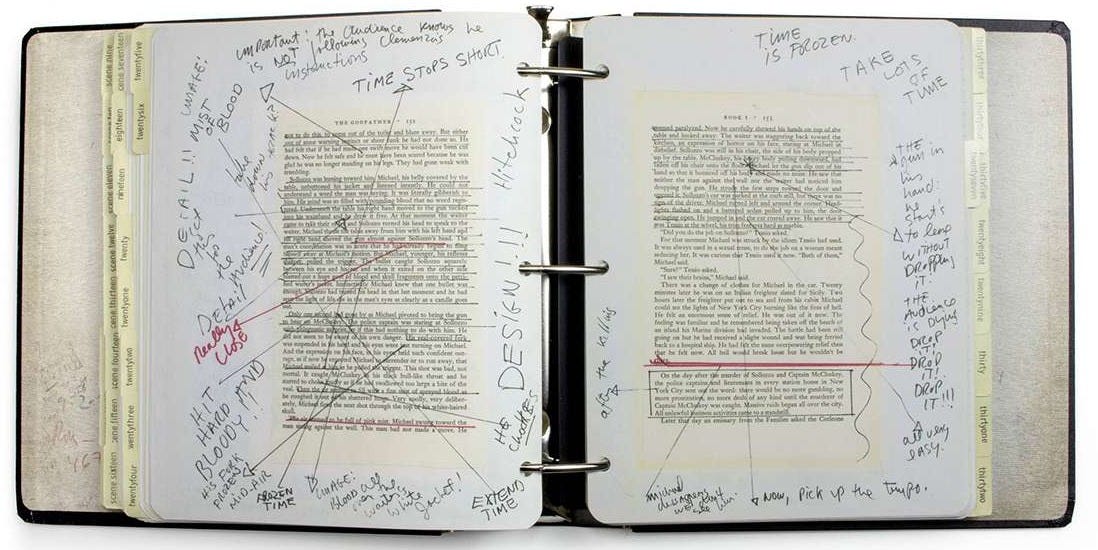
In 1970, a 31-year-old director sat in Caffe Trieste in San Francisco, an Olivetti typewriter beside him and a thick loose-leaf binder open on the table. Francis Ford Coppola was dismantling Mario Puzo’s bestseller The Godfather page by page—literally. He cut out every page of the novel and pasted them onto wider sheets, creating margins wide enough for the real work: figuring out not just what made the story work, but identifying every possible way it could fail.
This wasn’t the screenplay. This was something more fundamental: a multi-layered map of the novel’s structure, its weaknesses, and its landmines.
From Disappointment to Discovery
When Coppola first read The Godfather, he was disappointed. He’d expected Puzo to be “an intellectual on the order of Italo Calvino or Umberto Eco.” Instead, his first impression was “surprise and dismay; this was more like a Harold Robbins or Irving Wallace book, a potboiler filled with sex and silliness.”
However, Coppola didn’t trust his initial impressions. He understood something crucial: first impressions matter, but so does systematic analysis. He created what he called a “prompt book”—a theatrical tradition adapted for filmmaking. He sat with scissors and glue, cutting apart his annotated copy of the novel and pasting each page onto loose-leaf sheets with wide margins. He added sturdy grommets to both sides of every page, knowing this document would become his master reference throughout production.
The result was a “multi-layered road map” that examined the novel on multiple levels: the original text, his initial instincts, his analytical categories, and eventually his production notes. When he directed the film, he didn’t carry the screenplay. He carried this notebook.
“I totally dissected everything in that book,” Coppola explained, “what the novel was saying, how it would look, what the imagery was. And when I directed the film, I didn’t have the script with me. I had that book, and that book was what I would review when I set up every scene.”
Coppola broke down each section of the novel using five key criteria:
1. Synopsis - A brief summary of the story up to that point.
2. The Times - How the historical period influenced the story. For The Godfather, this meant understanding post-WWII America, the 1940s aesthetic, the specific cultural moment. Paramount originally wanted to update the setting to the 1970s and shoot the film in Kansas City to save money, Coppola fought them. He’d already done the systematic work of analyzing why the 1940s mattered to every scene—how the period shaped the characters’ choices, opportunities, and constraints.
3. Imagery and Tone - Visual elements and the overall feeling of each section.
4. The Core - The central essence of the scene, a concept he borrowed from Elia Kazan’s published notes on directing A Streetcar Named Desire. What is this scene really about?
5. Pitfalls - The dangers, the clichés, the specific ways this scene could fail.
Coppola’s Secret Weapon
Of all the categories Coppola used to dissect The Godfather, the most revealing is the one he called “Pitfalls.” For each section of the novel, he listed the specific ways the scene could fail. Not general principles—concrete failure conditions:
“Italians who would talk like a this” - The danger of ethnic stereotype, of leaning into Hollywood’s cartoon version of Italian-Americans rather than creating authentic voices.
“Boring people” - Audiences “must feel that they’re seeing the real thing with hundreds and hundreds of interesting specifics.” He notes examples: “the children sliding around, the sandwich man throwing the sandwich, ‘hey boino, two gabag and one p.’”
“Losing a basic humanity to all these people” - The risk that the violence and criminality would make the Corleones monsters rather than recognizable human beings.
“Failure to set up a tension between Godfather and Michael” - The structural spine that makes the story work.
“Too much exposition” - The screenwriter’s constant temptation.
For the scene where Michael meets Apollonia in Sicily, Coppola’s pitfall list becomes even more forensic:
“If Apollonia doesn’t make your heart stop just to look at her”
“If the coincidence that the innkeeper is the father of the girl they have just seen seems contrived”
“If it is funny it will not be”
“If Michael’s quick decision to marry her seems unlikely”
“If Michael in a subtle way does not have the quality of a don”
These aren’t vague warnings about “maintaining tension” or “developing character.” They’re predictions of exactly how the scene dies. Before he shot a frame, Coppola imagined the specific ways each scene could fail, then designed around those failure points.
The Restaurant Scene
Consider the restaurant scene where Michael kills Sollozzo and McCluskey—the moment when the college war hero transforms into his father’s son. Coppola’s notes reveal his method at its most sophisticated.
The Core: “To show the killing as terrifying and explicitly as possible, having taken the tension to an unbearable degree, to further define Michael’s character in regards to his cool, totally calm execution of these men.”
Pitfalls: “Rushing this would ruin it. Otherwise the scene can’t be ruined.”
That last line is remarkable. Coppola recognized that the underlying structure was so strong—Michael’s transformation, the mounting tension, the violence that changes everything—that there was only one way to fail: rushing it. The scene had perfect internal pressure. His job was to let it breathe.
So he designed the scene shot by shot, making detailed notes in his notebook’s wide margins:
“Designed shot for shot, important the audience knows he is not following Clemenza’s instructions”
“He chokes, frozen, time hit hard and bloody, his fork frozen in midair”
“Gun almost against Sollozzo’s head, really close, get this for the audience”
“Mist of blood”
“McCluskey’s fork frozen midair as he watches Sollozzo’s brains fly through the air”
“His own choking when shot in the throat”
“The gun in his hand, he starts to leave without dropping it” [the audience should be thinking: drop it, drop it, drop it]
Coppola even notes “how would Hitchcock design this?” Because Hitchcock was the master of manipulating information—of giving audiences just enough knowledge to maximize tension.
How Manuscripts Fail
While Coppola was diagnosing The Godfather’s unique vulnerabilities, he was also avoiding universal pitfalls—the accumulated wisdom about the reasons manuscripts collapse:
UNEARNED INFORMATION
Information means nothing without context that makes it matter.
Don’t info-dump before stakes exist, or explain your magic system before we care about the character who needs to use it because it is narrative death. Three paragraphs about a character’s childhood before we’ve seen them do anything in the present trains readers to skip backstory.
World-building disconnected from immediate stakes reads as background noise, however elaborate. If you’re describing your empire’s political structure during a knife fight, you’ve lost the reader.
Why it fails: The human brain prioritizes immediate threats and desires. Abstract information without emotional context is rejected as background noise.
Coppola’s version: “Boring people”—he knew audiences needed “hundreds of interesting specifics” but only specifics that mattered to what was happening right now in front of them.
INAUTHENTIC BEHAVIOR
Characters are not information delivery systems. They’re people under pressure, so they must act according to their knowledge, pressures, and nature—not the author’s need to communicate.
Don’t use “As-you-know-Bob” dialogue: “As you know, Bob, our father was killed by the Zorblaxians in the Great War of 2089.” Don’t have characters explain their own psychology: “I’m doing this because of my abandonment issues.”
Watch for convenient stupidity—smart characters missing obvious solutions because the plot needs them to. Avoid sentences where body parts act independently: “Her eyes found the doorway” (eyes don’t search; people do).
Why it fails: Readers unconsciously detect when characters are puppets serving the plot, rather than people responding to circumstances.
Coppola’s version: “Italians who would talk like a this”—he knew ethnic caricature would destroy the film’s humanity and authenticity.
UNHEROIC CHARACTERS WITH NO AGENCY
Readers want characters who engage, struggle, act, and argue. Passive characters defeat the reader’s goal.
Readers are looking for heroes, even if those heroes are flawed, make mistakes, and make terrible decisions. Even villains need agency and competence—they must be worthy opponents or the protagonist’s victory means nothing.
If your character faces a weak antagonist they can defeat easily, the reader becomes bored. If your protagonist lets the world roll over them without resistance, you’ve violated the fundamental contract of storytelling.
Why it fails: Stories are about people making consequential choices under pressure. Remove the pressure or the choices, and you have a report, not a story.
NO CONFLICT, DRAMA, OR TENSION
Every scene must contain resistance—either external conflict or internal tension that matters.
Common violations include:
Scenes of pure exposition where characters sit and explain
Placeholder scenes that move characters from A to B without anything happening
Reaction without complication—characters process events but nothing changes
False activity—characters doing things (cooking breakfast, driving to work) that don’t advance or reveal anything
Why it fails: Stories are compression machines. Real life has downtime; fiction cannot. Every scene must be pressurized or the reader’s attention dissipates.
Coppola’s version: “Rushing this would ruin it. Otherwise the scene can’t be ruined.” He knew the restaurant scene had perfect internal pressure—the only way to fail was to not let the pressure build and not let it explode.
STRUCTURAL INCOHERENCE
Every story makes promises about how its world works. Breaking those promises breaks the spell. The reader’s mind builds a model of your story’s rules—its logic, its cause-and-effect, its internal consistency. Violating those rules shatters immersion.
Common violations:
POV violations - Switching whose thoughts we’re in mid-scene without clear breaks
Tense shift - Sliding from past to present tense unconsciously
False simultaneity - “Opening the door, she rushed down the stairs” (you can’t be at the top opening a door while already rushing down)
Mood whiplash - Tonal shifts that aren’t earned (comedy immediately after tragedy without acknowledgment)
Why it fails: The reader’s unconscious mind is constantly predicting what comes next based on patterns you’ve established. When you break those patterns arbitrarily, the prediction engine stalls and they’re thrown out of the dream.
FICTION FULL OF FRICTION
Every word that reminds readers they’re reading weakens the reader’s experience and breaks the spell. The goal is transparency, not verbal virtuosity.
The reader experiences the story through sensory immediacy, not reported observation. Every layer of mediation—every word that draws attention to itself—creates friction that degrades the experience.
Avoid:
Filter words - “He saw the tree falling” vs. “The tree fell”
Reported emotion - “She felt sad” vs. “Her throat tightened”
Purple prose - Ornate description that draws attention to the writing rather than the experience
Fancy dialogue tags - “He expostulated” draws attention to the word, not what was said
Sesquipedalian vocabulary - If you have to choose between a one-syllable word and a three-syllable word, generally pick the one-syllable word
Words like “perspicacious,” “exacerbate,” “quintessential” slow the reader’s processing and create distance from the story.
Why it fails: Reading should feel like experiencing, not like decoding. Every moment of conscious effort pulls the reader out of the fictional dream.
Coppola’s version: “Gun almost against Sollozzo’s head, really close, get this for the audience”—he wanted viewers in the moment, experiencing it viscerally, not observing it from a distance.
OVERSPENDING THE WORD BUDGET
In the economy of language, operate on a tight budget. Treat each paragraph as a stand-alone poem.
Poetry is ultra-respectful of the need to not waste a single word. Fiction should be too. Build your paragraph-poems one by one, eliminating every unnecessary word, and creating images with your words.
Examples:
“He saw the tree falling” → “The tree fell”
“She felt sad” → “Her throat tightened”
“In my opinion, I think that...” → “I think...”
Every unnecessary word is a small betrayal of the reader’s attention. They accumulate. Readers have limited patience for inefficiency. Tight prose signals confidence and control. Bloated prose signals an amateur who doesn’t know what matters.
RUSHING THE JOURNEY
A fiction novel work because it is long—it gives readers time to become engrossed over days or weeks, capturing their imagination and engaging their emotions.
The story is a journey the reader joins you on, taking them out of their mundane existence into another world. This requires patience. You must slowly unravel the story like a ball of yarn, revealing it a bit at a time.
The temptation is to compress—to give readers disconnected highlights instead of sustained experience. Some writers mistake velocity for urgency. They cut connective tissue, skip emotional processing, rush from plot point to plot point.
Readers don’t just want to know what happens—they want to live through what happens. Compression without development produces “sound bites” that don’t allow true catharsis. The novel form exists because some experiences require time and space to develop properly.
PLOT VIOLATIONS
Readers have consumed thousands of stories. Familiar patterns register as lazy unless subverted with careful detail.
Recognition without surprise is boredom. Readers tolerate familiar structures but demand fresh execution and unexpected moments that make them sit up and think: “I’ve never seen it done this way before.”
Common violations:
Unearned coincidences - The right person appears exactly when needed
Deus ex machina - Problems solved by forces outside the character’s agency
Stock characters - The wise mentor, the manic pixie dream girl, the noble savage
Mechanical plotting - Following Save the Cat beat sheets so rigidly the story feels algorithmic
According to narrative theorists, there are only a handful of fundamental plots: Rags to Riches, Heroic Journey, Tragic Flaw, Boy Meets Girl—Boy Loses Girl, Defeating the Monster and Redemption. But forcing characters into these templates produces paint-by-numbers fiction.
Readers are looking for the ah-ha moment that excites their imagination. They want to feel the story could only happen this way, with these characters, in this sequence. When they see the scaffolding, the magic dies.
Coppola’s version: “If the coincidence that the innkeeper is the father of the girl they have just seen seems contrived”—he knew the plot point was borderline and needed perfect execution to work.
NO EMOTIONAL INVESTMENT
Emotion is like a bank account. You cannot withdraw what you haven’t deposited.
Reader investment must be earned through accumulated specificity and pressure before you can demand emotional payoff. Readers need time and detail to build models of characters before those characters’ fates matter.
Common pitfalls:
Starting with the Earth destroyed - Enormous stakes before we care about anyone
Immediate grief - Character deaths that should devastate but don’t because we just met them
Abrupt endings - Stopping the story to force sequel purchases
Blank slate protagonists - “Everyman” characters with no specific desires, fears, or contradictions
We don’t care about abstract people facing abstract threats. We care about specific people we’ve come to know facing specific threats we understand. The specificity and the time investment are what create the emotional bond.
Coppola’s version: “If Apollonia doesn’t make your heart stop just to look at her”—he understood the Sicilian sequence only works if we fall in love with her instantly, just as Michael does. The casting had to be perfect because the emotional investment had to be immediate and overwhelming.
Coppola’s Legacy
Years later, Coppola could look back at his notebook and see the map of his thinking—the layers of analysis, the evolution of his understanding, the specific vulnerabilities he’d identified and designed around. The sheer amount of notes he made on certain pages told him where the movie’s heart was.
The notebook represented something more than preparation. It was a dialogue between gut reaction and rigorous thinking. It preserved his initial instincts—the things that excited or worried him on first reading—while building systematic understanding on top of them.
Before you finish your next chapter, try Coppola’s method:
What are the three ways THIS scene fails? Not scenes in general—this one.
What laws does it risk violating?
What’s the single pitfall that, if you get it wrong, collapses everything?
Coppola carried his notebook in a canvas bag, thick with multi-colored annotations and asterisks marking scenes that “cannot be ruined.” He knew both his scene-specific vulnerabilities and the universal craft pitfalls.
The scene might powerful. But only if you know exactly how it could be ruined.
This essay is a distilled masterclass for writers of all genres. Thank you for posting this.
Excellent insights and thorough! Thank you for all the reminders.