

Over the holidays my partner and I went and saw Nuremberg starring Russell Crowe, who played the notorious Hermann Göring, one of the highest-ranking German officer put on trial at Nuremberg in 1945. Crowe’s outstanding performance as the jowly, narcissistic Göring was greatly enhanced by his flawless German accent.
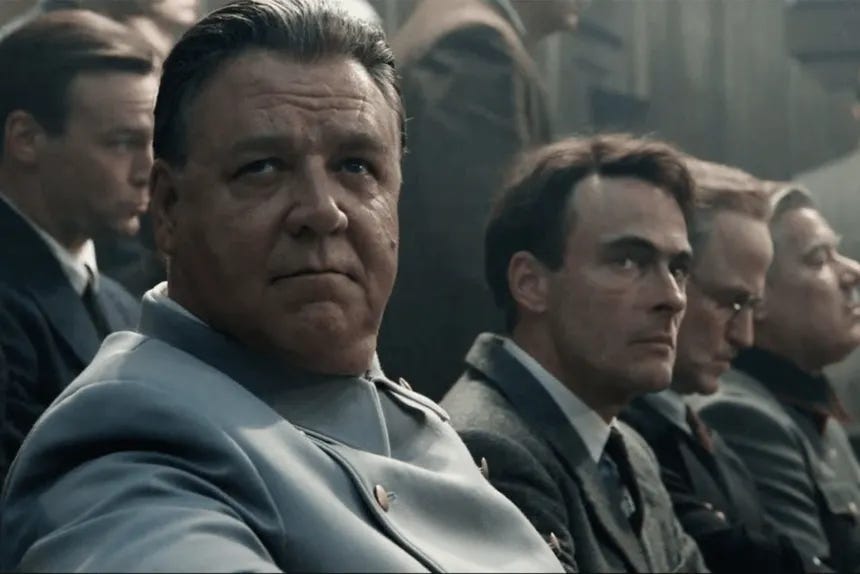
The film is based on the book, The Nazi and the Psychiatrist by Jack El-Hai, billed as the “improbable relationship between the fallen Reichsmarschall, Hermann Goering, and ambitious US Army physician, Douglas Kelley, [that] becomes a hazardous quest into the nature of evil.”
The focus of the film is the show trial at Nuremberg where Göring was sentenced to hang for war crimes. Contrary to accepted American history, it was Russian jurist Aron Trainin who played a central role in establishing the legal framework for the Nuremberg Trials that were used to hold Nazi Germany’s military and political leadership accountable through his proposal of a new legal concept, "the crime of aggression."
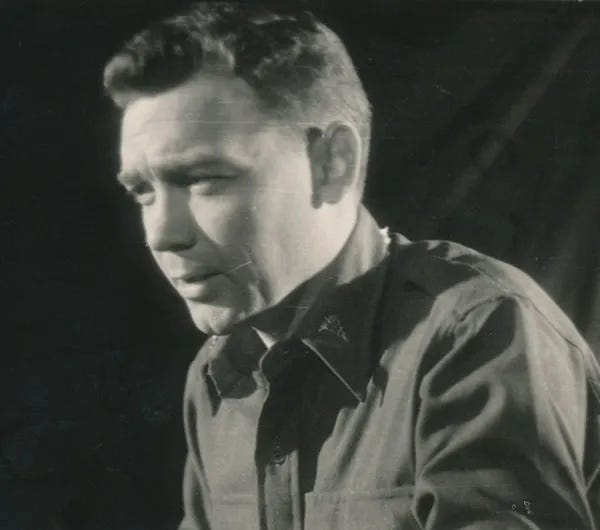
The central protagonist, Douglas Kelley, a U.S. Army psychiatrist assigned to examine the Nazi leaders held at Nuremberg, particularly Hermann Göring, reached a deeply unsettling conclusion that challenged prevailing assumptions about the nature of evil. These prevailing assumptions exist today because the majority of people subscribe to the “bogeyman theory” of evil, that all the problems in the world are caused by bogeymen, and if we could just get rid of the bogeymen, everything would be ice cream and lollipops.
Kelley’s Core Theory
Kelley’s central argument was that the Nazi leaders were psychologically normal. After conducting extensive psychiatric evaluations, Rorschach tests, and intelligence assessments on the prisoners, he concluded that these men were not psychopaths, not mentally ill, and not fundamentally different from anyone else. They had average to high intelligence, came from various backgrounds, and displayed a range of personalities—some were bureaucratic and pedantic, others charismatic, still others cold and calculating.
His most disturbing claim was that the conditions that produced the Nazis could produce similar results in any society, including America. He believed that ordinary people, under certain social, economic, and political pressures, could commit extraordinary atrocities. The Nazis weren’t monsters—they were men, which made them far more dangerous as a cautionary tale.
Kelley published his findings in 1947, in a book, 22 Cells in Nuremberg. He found Reichsmarschall Hermann Göring to be “positively jovial over my daily coming.” Kelley concluded in his book 22 Cells in Nuremberg that the Nazis “were not spectacular types, not personalities such as appear once in a century. They simply had three quite unremarkable characteristics in common combined with the opportunity to seize power. These three characteristics were: overweening ambition, low ethical standards, a strongly developed nationalism which justified anything done in the name of Germandom.”
Why His Theory Was Rejected
Kelley’s theory was deeply unpopular for several reasons:
The Western world, particularly in the immediate aftermath of WWII, needed to believe that the Nazis represented an aberration—a uniquely German or uniquely evil phenomenon. Accepting that they were psychologically normal meant accepting that such horrors could emerge anywhere, including democratic societies.
The psychiatric and legal establishments were heavily invested in the idea that they could identify dangerous individuals through psychological assessment. Kelley’s thesis undermined this assumption, and suggested that traditional diagnostic categories might miss the most dangerous social dynamics entirely.
Kelley’s colleague, psychologist Gustave Gilbert, of Jewish descent, also examined the prisoners, and reached the opposite conclusion. Gilbert argued in his book, The Nuremberg Diary, that the Nazis did show evidence of sadistic personality traits and moral deficiency. His interpretation was far more palatable—it suggested the problem was with these particular men, not with human nature or societal structures more broadly.
Gustave’s famous exchange between him and Göring is worth mentioning:
Göring: Why, of course, the people don’t want war. Why would some poor slob on a farm want to risk his life in a war when the best that he can get out of it is to come back to his farm in one piece? Naturally, the common people don’t want war; neither in Russia, nor in England, nor in America, nor for that matter in Germany. That is understood. But, after all, it is the leaders of the country who determine the policy and it is always a simple matter to drag the people along, whether it is a democracy, or a fascist dictatorship, or a parliament, or a communist dictatorship.
Gilbert: There is one difference. In a democracy the people have some say in the matter through their elected representatives, and in the United States only Congress can declare wars.
Göring: Oh, that is all well and good, but, voice or no voice, the people can always be brought to the bidding of the leaders. That is easy. All you have to do is tell them they are being attacked, and denounce the pacifists for lack of patriotism and exposing the country to danger. It works the same way in any country.
You can take a test, pioneered by UBC professor Robert Hare to determine if you are a sociopath. Hare’s Psychopathy Checklist has become the standard of the psychology profession. The test is widely used despite criticisms by professionals, claiming it is an ineffective and unreliable tool.
If Kelley was right, it meant constant vigilance was required in any society, and that the social conditions, propaganda techniques, and authoritarian structures that enabled Nazism needed to be actively guarded against everywhere. This was a more complex and uncomfortable message than simply prosecuting evil individuals.
The early Cold War period favoured clear moral binaries. Along with Aron Trainin, the Soviet Union played a pivotal and often under-appreciated role in the establishment and conduct of the Nuremberg Trials. Historian Francine Hirsch in her book, Soviet Judgment at Nuremberg: A New History of the International Military Tribunal after World War II emphasizes that the Soviet Union was the primary driver behind the creation of the International Military Tribunal (IMT), with Foreign Minister Vyacheslav Molotov formally calling for a special international tribunal as early as October 1942 to bring Nazi leaders to justice.
Kelley’s nuanced view that emphasized systemic and situational factors over individual pathology didn’t fit the emerging narrative framework of American exceptionalism.
Tragically, Kelley’s later life seemed to confirm some of his own theories about the fragility of psychological resilience—he became increasingly alcoholic and eventually died by suicide in 1958, using the same method (cyanide) that Göring had used to avoid execution.
Kelley's findings would find an unlikely echo sixteen years later in the work of political philosopher Hannah Arendt.
The Banality of Evil
There are striking parallels between Kelley’s conclusions and Hannah Arendt’s famous “banality of evil” concept, though they arrived at them through different paths and with somewhat different emphasis.
Both Kelley and Arendt reached the deeply uncomfortable conclusion that perpetrators of massive evil can be terrifyingly ordinary people. Neither found the psychiatric pathology, demonic nature, or exceptional wickedness that the public expected and wanted to see.
Kelley examined the top Nazi leadership at Nuremberg and found them psychologically normal. Arendt observed Adolf Eichmann’s 1961 trial in Jerusalem and was struck by his ordinariness—he wasn’t a monster but rather a mundane bureaucrat who never deeply questioned his role in genocide.
Both emphasized that this ordinariness made the phenomenon more dangerous, not less, because it meant that such horrors could happen again, because ordinary people could potentially become perpetrators. Simply identifying “bad individuals” wouldn’t prevent future atrocities.
Arendt focused more on thoughtlessness—the inability or refusal to think critically, to view things from someone else’s perspective, to question orders. For Arendt, Eichmann’s evil lay not in sadism but in his “inability to think,” his complete absorption in bureaucratic role-playing and clichéd language.
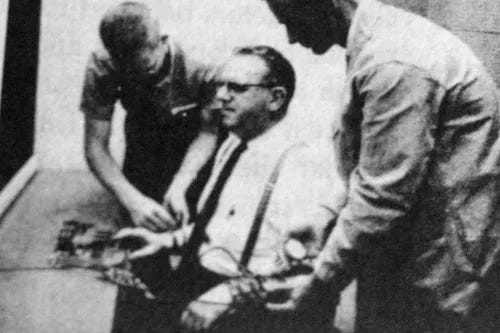
Both Arendt and Kelley’s work were later confirmed in experiments like Milgram’s obedience studies and Zimbardo’s Stanford Prison Experiment—that ordinary people can commit terrible acts under certain conditions of authority and social pressure. People are willing to do whatever they are told to do without engaging their moral compass, if they are ordered to do so by an authority figure.
Stanley Milgram maintained that “Arendt became the object of considerable scorn, even calumny” because she highlighted Eichmann’s “banality” and “normalcy”, and accepted Eichmann’s claim that he did not subjectively experience himself as having evil intents or motives to commit such horrors; nor did he have a thought to the immorality and evil of his actions, or indeed, display, as the prosecution depicted, that he was a sadistic “monster”.
The Lasting Impact
Kelley and Arendt fundamentally challenged how we understand evil:
The old model that evil requires exceptional wickedness, sadism, or psychological pathology is in sharp contrast to their model that evil can emerge from ordinary people through thoughtlessness, bureaucratic systems, social pressures, and moral abdication. Evil is potential at all times, given the right, or we should say, wrong circumstances.
This has profound implications for prevention because we can’t just screen out the bogeymen—we need to build systems, cultures, and educational approaches that promote critical thinking, moral courage, and resistance to authority when authority demands immoral action.
Totalitarian regimes emerge from the vacuum created by a society that abandons its spiritual, religious, philosophical and cultural values. The ultimate safeguard against Nazism, or any other similar destructive political regime is protecting, fostering and sponsoring its value-based moral foundation—whether that's critical thinking in education, genuine community connection, spiritual depth, or economic systems that don't reduce human beings to units of production.
The West has been bleeding out its foundations for decades, prioritizing efficiency and profit over meaning, connection and community.
Any society, including our own, contains the potential for such horror if conditions align. The film Nuremberg is perhaps a stark cautionary tale for our current times where political extremism on both sides of the fence are stretching the limits of the social fabric. A recent review of the film, Rethinking Nuremberg for the 21st Century, ends with the ominous warning:
“The screenplay suggests that casting people into legal limbo is a harbinger of darker times to come. In other words, it could happen here—and just maybe, it will.”
This understanding of evil's ordinariness poses a challenge for fiction writers like myself: How do we dramatize moral catastrophe when the perpetrators aren't monsters but clerks? When the danger isn't the dramatic villain but the thoughtless bureaucrat? It’s far easier to create monsters and make bogeymen, but maybe these are only cartoon characters, and they don’t do justice in describing the real world we live in.
The thing about the 'Nuremberg Trials'?.......
Is that it was 100% a SHOW Trial!
As was the 'Hunting NAZIS', world-wide, in the decades to follow!
Sure, they *cough* 'found' a FEW 'NAZI War Criminals'.....but they were just 'sacrificial lambs'.
If 'THEY' ('govts') were REALLY SERIOUS about bringing NAZIS to Justice ('Hunting NAZIS')......they could have just gone to Argentina, where a SHIT-LOAD of them went to, towards the end of the war! And the USSA 'govt' KNEW that they were there!! Not to mention the ones that the USSA 'govt' took in, under Operation Paperclip (as well as the UK/USSR).
But, we get FAKE History for the DUMBED-DOWN MASSES!
BELIEVE what you are TOLD TO believe!
And it's REALLY EASY to find NAZIS, even today.....they're in all ('The West') of our 'governments'!
Another little tidbit that THEY ('govt') had FAILED to tell us......
At the end of WW II, The NAZI Party NEVER SIGNED Surrender Documents!
The NAZI Party......CONTINUED ON......to this VERY DAY!!
Shake the 'Family Tree' of all of the 'Western' 'leaders'......and watch how many NAZIS fall out of that Family Tree!!
Wer Ideologien folgt, wird eine Gegenidologie finden. Wer die Ideologien steuert, weiß warum die Ideologien ausgeteilt wurden. Wer in einem Elite-Massesystem lebt und das nicht versteht, findet sich in einer dicken Tinte wieder, weil man nicht verstanden hat warum es die Ideologie gibt. Spaltung ist gewünscht, Ideologien sind immer "alternativlos", dahinter steht die Gewalt der Spaltung. In einer Elite-Masse-Gesellschaft zu leben, die unserem Bewußtsein zu entsprechen scheint, bedeutet Krieg und Frieden zu haben, Reichtum und Armut, Wissen und Unwissen, Opferer und Opfer, Schuld und Sühne. Man kann die Aufzählung beliebig fortsetzen, aber alles gehört zum System "Erschaffen und Zerstören".
Wer die Ideologien ausgibt, gehört zu denen, die die Menschen beherrschen.
Schiller hat es gut erkannt:
Deutsche Größe
Das ist nicht des Deutschen Größe
Obzusiegen mit dem Schwert,
In das Geisterreich zu dringen
Männlich mit dem Wahn zu ringen
Das ist seines Eifers wert.
Schwere Ketten drückten alle
Völker auf dem Erdenballe
Als der Deutsche sie zerbrach,
Fehde bot dem Vatikane,
Krieg ankündigte dem Wahne,
Der die ganze Welt bestach.
Höhern Sieg hat der errungen,
Der der Wahrheit Blitz geschwungen,
Der die Geister selbst befreit.
Freiheit der Vernunft erfechten
Heißt für alle Völker rechten,
Gilt für alle ewge Zeit.