

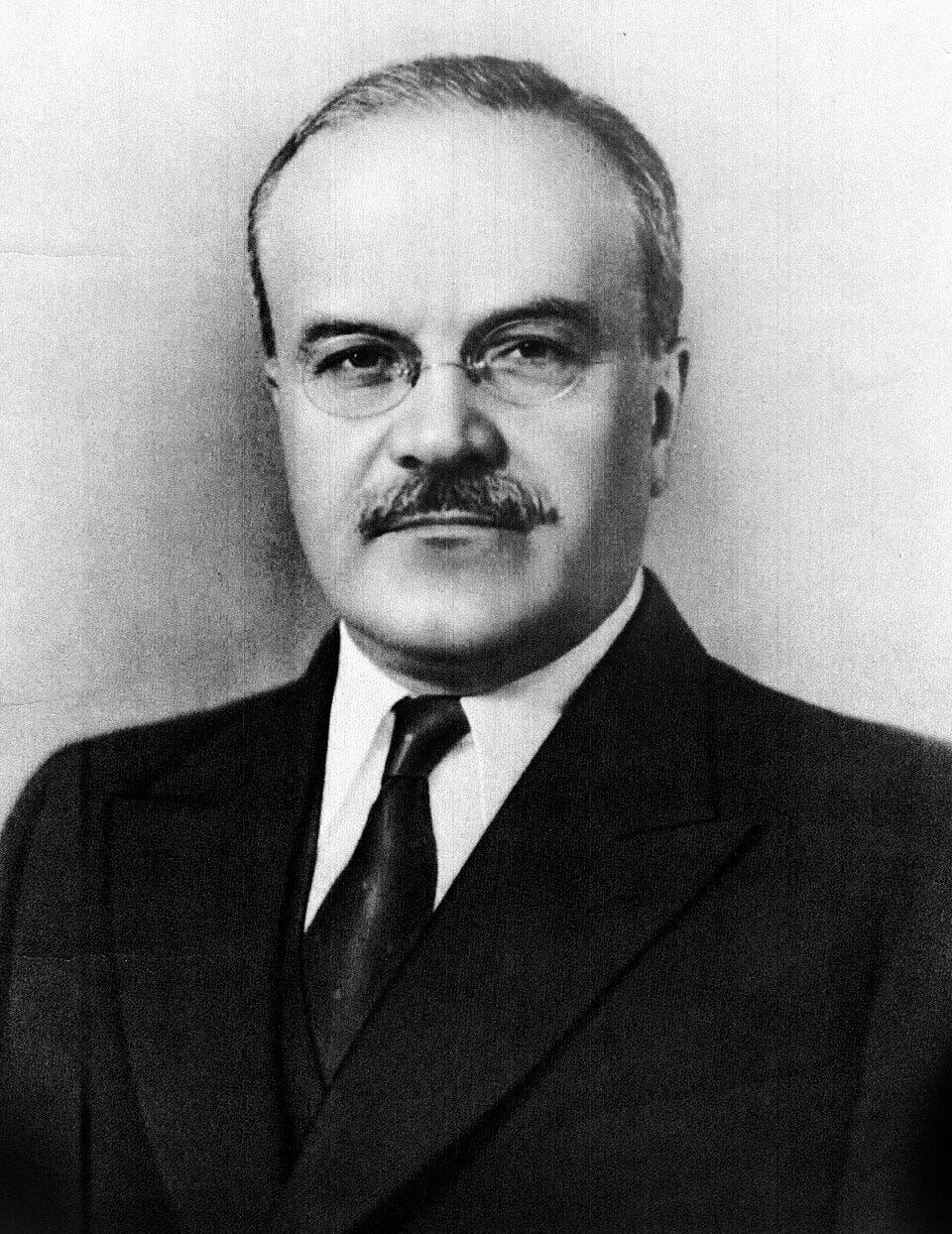
In April 1942, Soviet Foreign Minister Vyacheslav Molotov documented the Nazi atrocities committed against the Russian population. His note is almost unbearable to read.
Molotov states, “…the Hitler Government is a gang of murderers and that it aims at the extermination of our citizens [which] may be seen also from the monstrous crimes of the Hitlerites with regard to Soviet war prisoners.”
He continues through pages and pages of incidents, that combined, reveal a program of systematic genocide of the Russian people. Just a few examples: [warning: graphic content:]
On March 2 and 6, 1942, nine bodies of captured Red Army men were found on the Crimean front in the region of Height 66.3 and the village of Jantora. The bodies had been so badly mutilated that only two could be identified. Fingernails were torn out, eyes gouged out, and one body had the whole right side of its chest cut away. Others showed evidence of torture by fire, numerous knife wounds and broken jaws. [p. 23]
The liberation of Kerch made it possible to reveal the following heinous crime of the occupants, a crime which stands out even among other innumerable bloody atrocities: The local German commandant's office ordered parents to send their children to school. Obeying the order, 245 children with textbooks and composition books in their hands started to classes. None of them returned home. Only after the city was liberated were 245 bodies of these children found in a deep ditch eight kilometers from the city. [p. 22]
In the village of Burashevo, Kalinin Region, German officers and soldiers put to death 530 patients in Dr. Litvinov's hospital. When the Hitlerites occupied the hospital on November 15, 1941, they first looted all the food supplies, thereby condemning the patients to death by hunger. Then they ordered several sections of the hospital "cleaned out" and proceeded to throw out some of the patients who were too weak to move by themselves. Many patients were bayoneted and shot to death. Eighty who escaped by being removed to the village of Brednevo were shot the next day. The remaining patients were poisoned and put to death with lethal doses of narcotic drugs such as morphine, scopolamine, veronal and sodium-amytal. [p.23]
There are countless other atrocities that Molotov testified to in the document. It was apparent to the Russian high command that: “All these facts testify that the gang of brigands which goes under the name of the German Government has set as its goal the extermination of our people.” [p.23]
It is estimated that the Russian deaths in World War 2 accounted for close to half the total deaths during the conflict.
A 1995 analysis by the Russian Academy of Science, which estimated Soviet civilian deaths during World War II at 13.7 million in German-occupied territories. This figure includes:
7.4 million victims of Nazi genocide and reprisals.
2.2 million deaths of people deported to Germany for forced labor.
4.1 million deaths from famine and disease in occupied areas.
The Academy also estimated an additional 3 million civilian deaths from famine and disease in non-occupied regions, bringing the total civilian death toll to approximately 16.7 million.
According to Colonel-General Grigori F. Krivosheev's 1997 study Soviet Casualties and Combat Losses in the Twentieth Century, the estimated total military dead and missing for the Soviet Union during World War II were 8,668,400. This figure includes those killed in action, died of wounds, non-combat deaths, and missing in action, based on data from Soviet field reports and declassified archives. The study also notes that the Soviet Union suffered approximately 14,685,593 wounded during the war.
These estimates are considered by many scholars to be conservative estimates, and most likely the numbers were higher. Historian David Glantz maintains that “the war with Nazi Germany cost the Soviet Union at least 29 million military casualties”(dead, wounded and sick) “The exact numbers can never be established, and some revisionists have attempted to put the number as high as 50 million.”
The question that haunted psychiatrist Dr. Douglas Kelley at the Nuremberg Trials was: How did ordinary Germans become capable of this? The answer lay not in exceptional evil but in national trauma.
For further exploration into Dr. Douglas Kelley:
The Bogeyman Theory: What We Got Wrong About the Nazis

Over the holidays my partner and I went and saw Nuremberg starring Russell Crowe, who played the notorious Hermann Göring, one of the highest-ranking German officer put on trial at Nuremberg in 1945. Crowe’s outstanding performance as the jowly, narcissistic Göring was greatly enhanced by his flawless German accent.
How Did it Happen?
The conditions that led to World War 2, based on the consensus of historians, was firstly, the unjust Treaty of Versailles and secondly the financial crisis Germany suffered as a result of the war and the reparations imposed on them by the allies. This period was marked by escalating inflation, epidemic unemployment and acute homelessness and poverty. The Weimar Republic was incapable of dealing with the situation which led to the radicalization of German public opinion, inspiring widespread sentiments of nationalism, militarism, and anti-democracy, and an intense desire to reclaim lost Germany territory. People sought to find scapegoats for the national catastrophe, sparking the rise of racial supremacism and xenophobia.
These same factors are present in contemporary America. The American national pride has been deeply wounded by decades of job loss, stagnant wages and the escalating cost of living and rents. Homelessness in the United States has reached alarming proportions, with estimates of 770,000 homeless people living in makeshift tents and sleeping in their cars.
Wounded national pride combined with economic crisis is a recipe for disaster, or more ominously, for the rise of a political saviour who promises to fix everything.
America Has PTSD
As a Canadian observing from outside, I see America's trauma with both distance and concern. Distance allows perspective; concern arises because what happens in America affects us all. Canada has shared in much of America's trauma - we sent troops to Afghanistan, we've experienced deindustrialization, we've felt COVID's devastation.
America’s trauma is also multilayered, but it began with the Vietnam War, the first major military defeat that created deep social division and loss of innocence of the American youth who witnessed daily the carnage of the American war machine.
The Economic decline that has seen jobs moved overseas, combined with deindustrialization, wage stagnation, and the 2008 crash that rewarded the bankers with “quantitative easing.” America was devastated and traumatized by 9/11, exposed to sudden vulnerability. It shattered America’s sense of safety and exceptionalism and created a permanent fear state, surveillance apparatus, endless wars, and xenophobic fear of Islamic militants.
The fabricated weapons of mass destruction that led to a decade in Iraq and twenty years in Afghanistan, and more unwinnable conflicts, bombings of sovereign nations, more disillusionment and trillions of dollars dumped into a war machine, while the domestic situation was in serious arrears.
Then in 2020, COVID resulted in mass death, institutional failure and social breakdown. The big box stores stayed open, billionaires like Jeff Bezos profited from the crisis. The wealth of the global billionaire class significantly increased during the COVID-19 pandemic, with the world’s billionaires collectively gaining approximately $4 trillion in wealth between March 2020 and March 2021, representing a 54% increase in their fortunes.
This institutional failure is recent enough to feel raw with a million dead, institutional incompetence and political polarization over basic health measures, combined with economic disruption, social isolation and the loss of a shared reality when a virus became a political weapon.
There is a burning resentment within the American population that the nation has been hijacked and the American Dream has been stolen. And in a sense, they're right. The social contract is broken. For forty years, productivity has risen while wages stagnated. Healthcare, education, and housing - once accessible to the middle class - are now luxuries. The system that promised 'work hard and succeed' has been replaced by one where birth circumstances determine outcomes more than effort. This isn't paranoia. This is lived experience for millions of Americans watching their children inherit a diminished future.
National trauma affects everyone, left and right: Rural communities have been devastated by opioids and economic decline, and urban communities are facing violence and inequality, with escalating homelessness. Homelessness reached a record 770,000 in 2024 - an 18% increase in a single year. This marks the largest single-year increase on record and continues a multi-year upward trend driven by a shortage of affordable housing, rising rents, natural disasters, and a surge in migration.

American veterans feel betrayed by endless wars, the working class of all races are facing downward mobility, and everyone is living with pandemic grief and institutional distrust.
The US is engaged in a cultural debate and identity crisis. Do Americans know who they are anymore? The culture war between traditional and pluralist visions of America appears to be a bitter divorce with irreconcilable differences on both sides.
The Rise of a Strong Man
Traumatized populations seek strong leaders who promise to “make us great again” and restore national honor by returning the nation to a mythic past when things were “better.” Authoritarian leaders give simple explanations for complex problems, in the form of scapegoats, such as immigrants or other ethnic groups who are held responsible for all the woes of the society. The strongman promises certainty in place of chaos, and belonging in place of social disintegration.
We have seen this in history. Philosopher and politician Edmund Burke predicted the rise of a military dictator following the French Revolution, specifically foreseeing the emergence of a "popular general" who would command the allegiance of the army and ultimately become "master of your whole republic". This prediction was remarkably accurate, as Napoleon Bonaparte rose to power through a coup d'état in 1799, just eight years after Burke published his Reflections on the Revolution in France.
Edmund Burke emphasizes the dangers of radical change, in Reflections on the Revolution in France, advocating for gradual reform rooted in tradition and historical continuity. He argued that society should respect established institutions and customs, fearing that abrupt upheaval leads to chaos and tyranny. Burke championed the importance of generational wisdom and the social contract of the people and the state as the foundation for a stable and just society.
This pattern repeats across history and cultures. China's 'Century of Humiliation' - defeat by Japan, Western colonial exploitation, civil war, and famine - created the conditions for Mao Zedong to promise national restoration through revolutionary rebirth. A traumatized population embraced totalitarian rule, leading to the Cultural Revolution's catastrophic violence. Wounded national pride combined with economic desperation makes populations vulnerable to authoritarian promises.
Unprocessed trauma seeks outlets. A population suffering from PTSD, unable to grieve its losses or address its systemic failures, will turn that pain outward. It will search for enemies to blame: immigrants 'invading' our borders, establishment elites 'betraying' the nation, foreign powers 'stealing' our jobs. It will embrace simple solutions to complex problems. It will trade freedom for the promise of security. It will follow anyone who promises to restore what was lost.
The Kelley Connection
From my previous article, Dr. Douglas Kelley and Hannah Arendt both understood that atrocities don’t require exceptionally evil people. They require ordinary people under extraordinary stress. A traumatized population is a vulnerable population. The Nazis weren’t monsters, according to Kelley—they were Germans in a society that had been traumatized, humiliated, and economically destroyed. Given the right conditions, they became genocidal monsters.
To be fair, America is not Nazi Germany. But America is a traumatized nation that has never properly processed its wounds. The reckoning with Vietnam hasn’t been resolved, nor with 9/11 and the wars that followed. There isn’t a national debate to deal with the deliberate destruction of the working class. There was no inquiry or national review of the pandemic losses. America has been lurching from crisis to crisis, accumulating scar tissue, growing more angry and afraid.
The Bogeyman Theory of evil tells us that if we just get rid of the bad leader, everything will be fine. But Kelley’s research reveals a harder truth: the leader is a symptom, not the cause. The conditions create the demand for authoritarianism. Trauma makes populations vulnerable to demagogues.
Addressing “Both Sides”
This trauma manifests differently across the political spectrum:
On the right, it appears as anger at ‘replacement,’ fear of demographic change, embrace of strongman politics, and the promise to restore a mythical Golden Age when America was ‘great.’
On the left, it appears as rage at systemic injustice, demands to ‘burn it all down,’ despair about climate catastrophe, and a conviction that the entire American project is irredeemably corrupt.
Both are responses to genuine pain. Both contain elements of truth. Both are also dangerous when they descend into absolutism and dehumanization and demonization of the other team. Democracy is ideally a civil debate where the rights and opinions of others are respected, in the interest in achieving consensus or compromise to advance progressive policies for the benefit of all.
A nation can’t progress in a protracted civil war.
A Nation in Denial
I’m not suggesting America is on the brink of genocide. The democratic institutions, while strained, are still functioning. Civil society, though fractured, remains robust and has not descended into civil war. America is not Weimar Germany.
But America is a traumatized nation in denial about the trauma. And traumatized populations are vulnerable to authoritarianism, to scapegoating, to violence, to the erosion of democratic norms in the name of ‘emergency’ or ‘security’ or ‘restoration.’
The question is not whether America will become Nazi Germany— the question is: Will America recognize and address the national trauma before it consumes the nation?
What does healing national trauma actually look like?
The solutions to complex problems are often embedded in the problems themselves, once the problems have been identified:
Economic reconstruction: Not just talking about it but actually rebuilding working-class prosperity - this is material, not just psychological. Deporting immigrants does not address nor solve the domestic cost of living crisis. The biggest economic issue is wealth inequality, not illegal immigration.
Institutional reform: Rebuild trust by making institutions actually work for people. Easier said than done, but ignoring the problem won’t make it go away.
Collective grieving: America never properly mourned - not Vietnam vets, not 9/11 victims, not COVID dead, not deindustrialization. Ungrieved loss becomes rage. Why not a national day of mourning to commemorate the losses?
Truth-telling: America needs an actual reckoning with Vietnam, Iraq, Afghanistan - what happened, what it cost, what was learned. There has been no national reckoning, no truth and reconciliation commission, no public accounting of what these wars cost and what they accomplished.
Shared Purpose. Trauma heals through meaningful collective action. After WWII, there was rebuilding, a New Deal, and new institutions such as the United Nations and the UN Declaration on civil rights.
Critical thinking education: Kelley’s prescription to teach people to question authority, resist propaganda, think critically through public school programs that address the issues, so the youth don’t repeat the same mistakes of their fathers and mothers.
Resist the scapegoat: Refuse to let pain be weaponized against vulnerable populations.
Of these, economic reconstruction may be the most urgent. You cannot heal psychological trauma while people are materially desperate. Truth-telling and collective grieving matter, but they ring hollow to someone who can't afford rent or medical care. Material security creates the stability necessary for psychological healing.
The scariest truth is this: the Germans who committed those atrocities documented in Molotov’s 1942 note weren’t cartoon villains. They were traumatized people who found someone to blame for their pain. They were ordinary people who became capable of extraordinary evil, they were transformed from ordinary people into genocidal lunatics.
And if America doesn't address its own national trauma, Americans are vulnerable to a similar descent. Not because they are uniquely evil, but because they are human. And humans under enough stress, with enough fear, with enough unprocessed grief, are capable of terrible things.
The warning from history isn’t beware the dictator. It’s beware the conditions that make populations welcome dictators. It’s beware unhealed trauma.
It’s beware the Bogeyman Theory that lets us ignore systemic rot.
As a fiction writer, I understand the appeal of the simple story: the hero, the villain, the battle, the resolution. But the story of national trauma is neither simple nor satisfying. It’s messy, systemic, and requires collective effort to resolve. There’s no single hero who can fix it, no single villain whose defeat would restore the nation.
The question is whether Americans have the courage to face that harder truth - and the will to do the difficult work of healing.
We imported the Nazi’s over here after WW11 and they helped us build a bomb. They helped build the control system we are living under now. WEF and Klaus Schwab is no accident. American elite and business class loved the Nazi’s.
How many were ever held accountable? Not many…
Until we understand the connection between what is happening in the U.S. and across the world as the Zionist control agenda, we will never truly understand history, and that includes what happened in Nazi Germany.