

Arthur Schopenhauer had a bleak view of human intelligence—or rather, its lack thereof. Writing in the mid-19th century, the German philosopher argued that most people operate far below the mental level we optimistically (or naively) assume, relying on belief, authority, and emotional reasoning rather than critical thought. Schopenhauer wasn’t being cynical—it was just his own observation and experience talking.
Smart people need an understanding of this phenomenon to navigate social and political life without constant frustration and friction.
Schopenhauer’s essays on “The Wisdom of Life” and “On Noise,” collected in Parerga and Paralipomena (1851) laid out a philosophy that is both bleak and liberating. Intelligence, he believed, is rare. Most people function on an instinctual level, responding to social triggers and group pressures rather than engaging in genuine discussion, analysis and debate. It is a biological fact that we are mammals, and we continue to operate like animals in social groups (herds), whether we care to admit it or not.
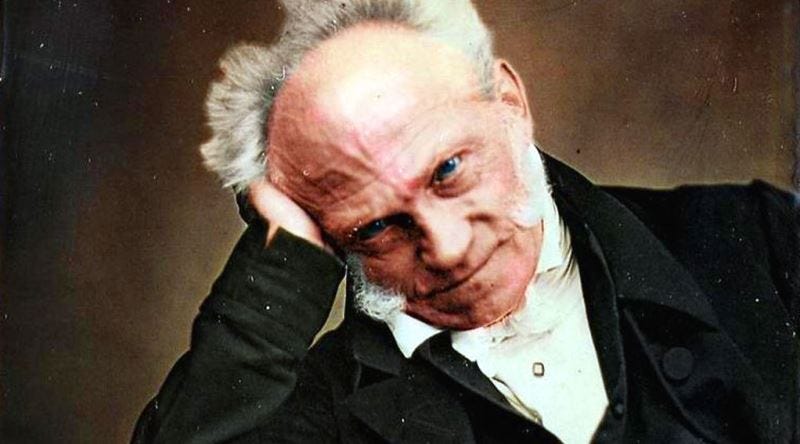
Most people form opinions based on emotion, cultural trends, media influence and tribal values—then reverse-engineer reasoning to justify what they already feel.
In short, most people don’t think.
This seems contrary to our scientifically advanced, techno-obsessed society. The illusion exists—because we have cool phones, AI, and social media—that people’s intelligence level has risen dramatically. But the truth is, the advances in science and tech were driven by a small segment of the population and everyone has benefitted without any real input.
This is echoed by Carl Sagan:
“We’ve arranged a society on science and technology in which nobody understands anything about science and technology, and this combustible mixture of ignorance and power sooner or later is going to blow up in our faces.”
Ouch.
Even more devastating, Schopenhauer argued that some people simply cannot understand certain concepts. You can’t explain calculus to a chimpanzee, and though it sounds arrogant (and maybe it is), we are not all created equal in the IQ department. Neither are we all created equal in the athletic department. The vast majority of people are never going to compete in the Olympics because they don’t have the natural ability. The idea that “all men are created equal” is demonstrably false.
Logical arguments rarely penetrate some people—we’re not dealing with positions arrived at through logic, so logic won’t change anything. Some people’s cognitive architecture doesn’t support abstract or nuanced thinking, making deeper explanations not just futile but a waste of energy. We assume, in the West, that because over 50% of people have post-secondary education, it means most people are intelligent.
But post-secondary education refers to structured learning where individuals acquire specific knowledge, skills, and credentials through formal instruction. It is an external process shaped by institutions, curricula, and assessments.
Intelligence, on the other hand, is an innate cognitive capacity—your natural ability to understand, reason, solve problems, learn from experience, and adapt to new situations. It includes various forms such as logical, creative, and emotional intelligence and is influenced by both genetics and environment.
Unintelligence (or stupidity, if we want to be blunt) according to Schopenhauer, comes with aggressive confidence—the less people know, the more certain they are, and reason cannot penetrate that certainty. Try reasoning with a Flat Earther and see how far you get. Meanwhile, those who lack intelligence cannot recognize it in themselves or others. Seeking their validation, therefore, is a reliable source of unnecessary suffering.
Intelligent people often are not as confident in their opinions as those less endowed, because the intelligent understand that our modern world is complex—things are not black and white, there are a lot of grey areas, and thus, they have more doubt in their minds.
It should also be noted that well-educated people are by no means immune from unintelligence and black and white thinking. Conformity to established knowledge, even in the face of contradictory information, can occur with the intelligentsia. Those who followed Stalin, Mao and even Hitler were often from the educated classes.
Anyone can memorize information. Doctors, lawyers, engineers or scientists may be able to process sophisticated information, but they may still be unable to think for themselves on any other subject unless there is an authority telling them that something is true or not.
For more on authority’s effect on intelligence, see my previous article on Dr. Douglas Kelley and the Nuremberg Trials:
The Bogeyman Theory: What We Got Wrong About the Nazis

Over the holidays my partner and I went and saw Nuremberg starring Russell Crowe, who played the notorious Hermann Göring, one of the highest-ranking German officer put on trial at Nuremberg in 1945. Crowe’s outstanding performance as the jowly, narcissistic Göring was greatly enhanced by his flawless German accent.
Enlightenment
A better word to describe what we are witnessing might be enlightenment. Some people’s minds are turned on and others are not. Raw processing power is an asset for anyone, and our techno-science society favours those with superior math skills, but anyone can be enlightened, regardless of IQ level. Anyone can have common sense, and anyone can sort through information and discern whether something is true or not, with the disclaimer that truth and facts are not necessarily the same thing, and that specialized knowledge, such as quantum physics, excludes the majority of people.
Schopenhauer claimed the bigger the group, the lower the IQ. Individual intelligence diminishes in group settings, where conformity and emotional reaction are rewarded over independent thought. Schopenhauer saw crowds as intelligence-dampening forces, pulling everyone toward the lowest common denominator.
In short, most people are intellectual sheep.
Add to this the uncomfortable fact that many people prefer comforting lies over uncomfortable truths, and you have a recipe for intellectual isolation. Minds are not easily changed—core opinions are tied to cultural identity, and factual evidence rarely shifts them. Cognitive capacity, in Schopenhauer’s view, is largely fixed. You cannot educate someone into a different level of intelligence.
Our society is increasingly polarized, and people are being forced into political and religious boxes. These boxes are often programmed echo chambers where people repeat slogans and dogmas, instead of engaging in serious and honest discussion about issues.
The Necessity of Solitude
Given this, Schopenhauer concluded that intelligent people naturally gravitate toward solitude—not out of misanthropy but necessity. “A high degree of intellect tends to make a man unsocial,” he wrote. This wasn’t a character flaw but an inevitable consequence of possessing a rich inner world. “The more a man has in himself, the less he needs from the outside.” Intelligent people find stimulation in reflection, art, books, and ideas. They don’t need constant companionship to distract them from boredom because they’re rarely bored when alone.
Though I would caution against isolation and anti-social behaviour because it just isn’t healthy, Schopenhauer reluctantly admitted that “Solitude is the fate of all great minds.” Superior intellects are misunderstood by the masses and thus inevitably isolated. Schopenhauer believed that the more intelligent a person is, the more they suffer—not despite their intelligence, but because of it. A higher capacity for thought leads to greater awareness of life’s suffering and futility. You see through the comfortable illusions that sustain most people, and this awareness is isolating.
This is nothing new, the Hebrew prophet lamented this thousands of years ago:
"For with much wisdom comes much sorrow;
The more knowledge, the more grief.”
~ Ecclesiastes 1:18
Yet here lies a paradox: the enlightened person needs solitude for clarity, but cannot afford complete isolation if they wish to fulfill any moral purpose. For enlightened people, social interaction often feels burdensome and inauthentic. Small talk seems tedious, ego-driven motives appear transparent, and the general shallowness of most conversation may be exhausting for smart people who value quality over quantity in relationships, seeking meaningful connections but finding them rare. Compatible minds are scarce, making deep intellectual connection infrequent. When it does occur, it’s precious. More often, enlightened people find more profound companionship in books and ideas than in crowds.
Strategic Engagement
Schopenhauer suggested a simple strategy: accept these limitations and act accordingly. Understand that many people are driven by programming—social conditioning and biological drives—rather than conscious deliberation. Recognize that displaying intelligence can invite hostility from those who feel threatened by it, so conceal it strategically when necessary. Avoid futile debates that can compromise your own clarity and substance. Don’t offer unwanted truths to people who prefer comfortable lies.
This isn’t about bitterness or superiority. It’s about understanding reality and operating within it effectively. By accepting the predictability of emotionally driven, non-critical thinking, enlightened individuals can conserve energy and navigate interactions with precision. You stop expecting people to be what they’re not. You stop being frustrated when they can’t follow you into abstraction or nuance. You accept that many decisions around you are made without the deliberation you assume is universal.
The freedom comes from letting go. You stop seeking validation from those incapable of recognizing what you’re doing. You stop trying to change minds that cannot be changed. You embrace solitude not as loneliness, but as the space where you can think clearly, create meaningfully, and connect with truth. Find your tribe of like-minded people who resonate with you and treasure those connections while accepting their scarcity.
Schopenhauer offered no utopian vision. People are what they are and intelligence is distributed unevenly. You can still build a life around your strengths rather than exhausting yourself trying to bridge unbridgeable gaps.
Finally, the enlightened person is morally obligated to help turn on the light in the minds of others. This requires serious diplomacy and tact. And patience and the humble commitment to help others cross the bridge to the promised land. This removes any intellectual pride and gives the enlightened person the attitude of a servant instead of an attitude of superiority.
Very helpful thanks ;)
Great essay and oh, oh, so true. Thank you. I've shared it.