

Davos 2026: The Capitalist Civil War
The clearest evidence that the Capitalist Civil War is in battle mode revealed itself at the World Economic Forum’s Annual Meeting in January 2026. The full Four Faction conflict — Davos, Imperialists, Silicon Valley, and State Capitalists — played out, in public, over a single 72-hour window.
On the afternoon of January 20, Larry Fink — chair of BlackRock, interim co-chair of the WEF — took the stage to introduce the keynote speaker. He called him a friend. The speaker was Mark Carney — former Governor of the Bank of Canada, former Governor of the Bank of England, sitting Prime Minister of Canada, a quintessential Davos man.
Carney delivered a eulogy for the rules-based order Davos was built to manage. "We are in the midst of a rupture, not a transition," he told the room. The old "rules-based liberal multilateral order is over." The "bargain" of American hegemony "no longer works." “Great powers,” he said, have begun "using economic integration as weapons, tariffs as leverage, financial infrastructure as coercion, supply chains as vulnerabilities to be exploited." The multilateral institutions — the WTO, the UN, the COP, "the very architecture of collective problem solving" — are under threat. He told the assembled global elite to stop invoking the rules-based international order "as though it still functions as advertised."
Nostalgia is not a strategy. The old order is not coming back.
The moderator, Gideon Rachman returning to the microphone, observed: “I don’t think I’ve seen many standing ovations at Davos, so that was interesting.”
This is not a fringe critique from outside the system. This is the system holding a funeral service for itself.
Twenty-four hours later, Donald Trump appeared at the same Davos stage. His response was not to mourn the rupture but to celebrate it. He attacked Carney directly: “Canada lives because of the United States. They should be grateful to us… I watched your prime minister yesterday. He wasn’t so grateful.”
Hours before Carney’s speech, Trump had posted an altered map on social media depicting Canada, Greenland, Venezuela, and Cuba as American territory.
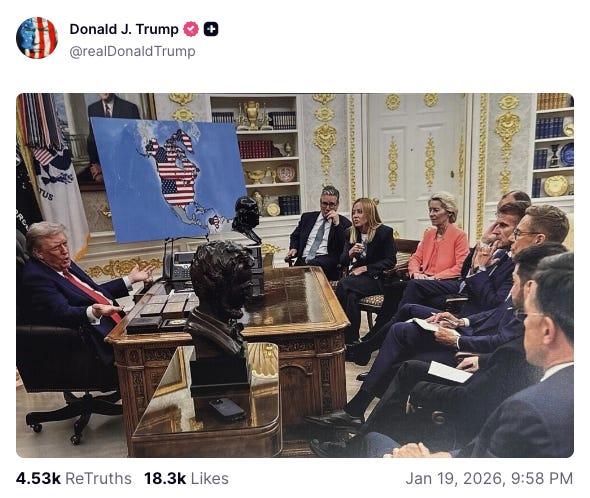
While at Davos, he unveiled a “Board of Peace” to oversee Gaza — the Kushner plan made operational, dispossession as development, empire as investment opportunity, presented from the same stage where Carney gave a eulogy for Davos the day before.
Then he rescinded Carney’s invitation to the Board.
Two days later, Larry Fink sat down with Elon Musk on the same Davos stage. Musk, who had previously dismissed the WEF as "boring af" and "an unelected world government," took Fink's invitation. The Davos man and the Silicon Valley man struck a public truce — for an afternoon.
What unfolded over those 72 hours was the Four Factions of the Transnational Capitalist Class in the midst of a public divorce, each one staking its position in real time on the most prestigious stage capitalism has ever built for itself.
Who Is in the Transnational Capitalist Class?
The Transnational Capitalist Class — the term I borrow from sociologists Leslie Sklair and William I. Robinson — is in this analysis a small and specific group. It is the global billionaires: roughly 3,400 people who own, control, or manage at least one billion dollars in assets. The overwhelming majority pass through the Ivy League or its international equivalents — Oxford, Cambridge, Tsinghua, the London School of Economics, the École Normale Supérieure. The combination of capital and elite education is what produces a class rather than a list of wealthy individuals. They know each other. They sit on each other’s boards, attend each other’s conferences, and marry into each other’s families.
The TCC is not “rich people” in the broad sense. A surgeon with five million dollars and a vacation home is not a member; he or she is subject to it. And when I refer to the State Capitalists as a faction of the TCC, I do not mean the Chinese, Russian, Iranian, or Gulf peoples. I mean their rulers — the party officials, princelings, sovereign wealth fund managers, and politically connected billionaires who own and direct transnational capital from inside those state structures. The class line cuts through every nation. It does not run between them.
This is where I depart from the original TCC definition. Sklair and Robinson tracked a class that appeared coextensive with Western-led globalization. That picture no longer matches reality. Chinese billionaires and the CCP elites who direct them, Gulf sovereign wealth managers, Russian oligarchs, Indian conglomerate dynasts — these actors own and move transnational capital at a scale that places them inside the class, whether the older Western-centric factions like it or not.
I borrow the term Transnational Capitalist Class because it’s the best term available. The analysis that follows draws more from Antonio Gramsci’s writing on organic crisis and C. Wright Mills on power elites than from the academic TCC literature.
For a shorthand of the Four Factions:
DAVOS wants to maintain the existing infrastructure.
THE IMPERIALISTS want to weaponize it.
SILICON VALLEY wants to privatize and exit from it.
THE STATE CAPITALISTS want to build parallel infrastructure beside it.
These are not policy disagreements within a shared project. They are rival answers to the most basic question a ruling class faces: through what institutions does it rule? The Capitalist Civil War — and what it means for the rest of us, who will face the fallout of whichever faction wins — is the subject of the articles that follow.
THE FIRST FACTION - DAVOS
Maintain the infrastructure.
The World Economic Forum is the playing field where all the competing teams come to play. That is what makes it different from the other factions — it is not merely a player, it is the arena. And that is what makes its current crisis so significant.
The Davos globalists maintain the infrastructure. This is the establishment of the Transnational Capitalist Class. The Forum meets every year in Davos, Switzerland, the quintessential international financial hub. Klaus Schwab presided over the elite club for fifty years. His tenure is ending, and the question of succession is itself revealing — the leading candidate is European Central Bank President Christine Lagarde, a figure drawn directly from the IMF and ECB community, a poster child for Davos.
For fifty years, Klaus Schwab promoted Stakeholder Capitalism, his brand of managerial economics that does not merely bypass democratic conventions — it substitutes for them. In place of accountability to citizens, it offers deliberation among stakeholders. In place of elections, a boardroom: corporations, banks, national leaders, mayors and NGOs hashing out global economic policy around a table where no one was voted in and no one can be voted out.
Other prominent members include Larry Fink, Mark Carney, Børge Brende, Al Gore, Marc Benioff, Chrystia Freeland, Kristalina Georgieva, and Queen Rania of Jordan. They are primarily Western-centric or Western-adjacent, though not exclusively loyal to the West. Their mission includes degrading national sovereignty and transferring power upward into transnational institutions — the WHO, IMF, BIS, carbon markets, CBDC infrastructure. The Great Reset is their roadmap, Stakeholder Capitalism is their vehicle driving the change.
Their relationship to the global financial infrastructure is intimate: they built it, they run it, they intend to keep it. Their power depends entirely on the continuation of dollar-denominated globalization managed through multilateral institutions. Keeping the cash flowing is their prime directive.
Their fatal weakness is that they have no hard power. Their entire model depends on persuasion, norms, and institutional legitimacy — and all three are eroding simultaneously. One of the recurring themes at Davos is that the world is fragmented, and the WEF positions itself as the mediator of that fragmentation. But the fragmentation is being driven by the other three factions, none of whom have any interest in being mediated. The arena is cracking because the teams have decided they no longer need it or want it.
A 2025 WEF report estimated that extreme fragmentation could reduce global GDP by up to 5% ($5.7 trillion). According to the report, “countries are increasingly using the global financial system to advance geopolitical objectives through sanctions, investment restrictions, and other economic measures. Rising geopolitical tensions risks fragmenting the global financial system into distinct blocs, reducing efficiencies that for decades have powered economic growth.”
According to the London Stock Exchange Group (LSEG), sanctions have surged by 370% since 2017, accompanied by a noticeable rise in subsidies worldwide. Davos built an entire civilizational model on the premise that hard power would gradually give way to institutional coordination. The sanctions surge tells you which direction history is actually moving — and which faction is driving it.
THE SECOND FACTION - THE IMPERIALISTS
Weaponize the infrastructure.
The Imperialists are currently represented by Trump, Netanyahu’s coalition, the neoconservative establishment, the military-industrial complex, and Jared Kushner, President Trump’s son-in-law, as the dealmaker. The military‑industrial complex —Lockheed Martin, Raytheon, Northrop Grumman — provides the weapons and lobbyists that turn imperial ambition into sustained conflict.
Their vision of Trumpian America and Israeli hard power dominance is not multilateral governance, nor institutional management, but unilateral force projection and the unapologetic exercise of imperial prerogative. The Kushner Gaza plan is this faction’s purest expression: dispossession as development, empire as investment opportunity.
Relationship to financial infrastructure: They weaponize it. Sanctions, asset freezes, the expulsion of enemies from SWIFT, dollar dominance as coercive tool. They don’t want to reform the existing infrastructure — they want to use it as a weapon to subdue and force imagined enemies into a global imperial project.
Their ideological core was forged in the 1990s. The Project for a New American Century — Wolfowitz, Cheney, Rumsfeld — produced Rebuilding America's Defenses in 2000, calling for regime change in Iraq, expanded Middle East presence, and global missile defense. The document famously suggested such ambitions would require a "catalyzing event." The 9/11 attacks provided one. The 2003 Iraq War followed.
The Heritage Foundation, Project 2025 and Stephen Miller picked up the torch in 2024, and currently, Stephen Miller, the Deputy Chief of Staff for Policy, drives much of Trump's hardline agenda. NBC News has called him “the untouchable force” in Trump's White House.
The Millerites and Finkians are aligned but disagree on method. The Millerites believe in imposing order through force—regime change, permanent bases, the unapologetic projection of American and Israeli military power. The Finkians believe in organizing order through multilateral agreements, stakeholder governance, the patient architecture of institutional legitimacy. One builds aircraft carriers; the other builds committees. Neither trusts democracy, but the Millerites at least pretend to need a popular mandate, while the Finkians long ago abandoned the people and moved into the boardroom.
Fatal weakness: Every act of financial weaponization accelerates the de-dollarization that will eventually destroy the infrastructure they depend on. They are consuming the foundation of their own power. The cost of war is not sustainable economically. The total cost of the US war in Afghanistan is estimated to be between $2.3 trillion and $2.6 trillion, according to research from Brown University’s Costs of War Project. The Trump administration’s war against Iran is estimated at $51 billion, or roughly a billion dollars a day.
The Imperialists’ endgame is not global control in the Davos sense — it's permanent hierarchical dominance with the United States (and its closest allies) at the apex. The core military doctrine of the Imperialists is Full Spectrum Dominance, it explicitly calls for U.S. military supremacy across land, sea, air, space, cyberspace, and the electromagnetic spectrum — the ability to defeat any adversary and control any situation across the full range of military operations. This isn't rhetorical. It's the organizing logic of the U.S. defense budget, ~750 overseas bases, and the weapons purchasing of the military-industrial complex.
The Davos faction wants integration — a single, harmonized governance architecture where capital flows frictionlessly across a managed global system. The Imperialists want hegemony — a stratified order where American hard power, the dollar, and the alliance system (NATO, AUKUS, the Israel-Gulf security architecture) sit permanently above everyone else. From a distance these look similar — both project American power globally — but their endgames are structurally opposed.
THE THIRD FACTION - THE STATE CAPITALISTS
Build parallel infrastructure.
Xi Jinping’s CCP oversees the Chinese one-party developmental state and the Belt and Road Initiative, the most ambitious infrastructure project in modern history. China is the primary State Capitalist power; Russia, Iran, India, and the Gulf states operate as variants and sometimes-aligned partners, each running its own version of state-directed capitalism inside a broader resistance to the Western rules-based order.
Russia is existentially at odds with both the Davos and the Imperialist factions who oppose Russia’s war in the Ukraine. The same is true for Iran, currently waist-deep in a war with the Imperialist faction. India plays its cards carefully, swinging from one faction to the other depending on context. The Gulf states likewise have their own state capitalist agenda that does not always align with China.
The CCP’s vision is a multipolar world order in which each sovereign bloc governs its own developmental capitalism. Sovereignty is non-negotiable — not transferred upward like Davos, not dismantled like Silicon Valley, not projected through hard power like the Imperialists, but defended and replicated as the organizing principle of a new world order. The Belt and Road Initiative is their Great Reset: a physical and financial rewiring of global connectivity away from Western chokepoints.
Their relationship to the financial infrastructure is constructive rather than managerial, weaponizing, or destructive. China is not duplicating Western financial architecture — it is building interconnected alternatives. The Asian Infrastructure Investment Bank, the New Development Bank, the CIPS yuan clearing system, the BRICS financial architecture, and Project mBridge offer parallel rails to SWIFT. The goal is not to seize the existing system but to render it non-essential in key corridors. mBridge has already processed over $55 billion in cross-border transactions, operating outside the dollar-clearing architecture entirely.
Fatal weakness: The parallel project requires sustained coordination among states with very different interests. Russia, India, Iran, and the Gulf are square pegs in the round hole of Chinese state capitalism. And developmental legitimacy — pointing to hundreds of millions lifted from poverty — only holds as long as development continues.
The Davos response to the State Capitalists has been telling. Officially, Schwab insisted that “stakeholder capitalism… is clearly the best response to today’s social and environmental challenges,” and that adopting it is essential for China and other emerging markets. Unofficially, the WEF has had to accommodate the reality that the parallel infrastructure is no longer hypothetical. The arena’s custodians have begun acknowledging, publicly, that the world they were built to manage is slipping out from under them.
THE FOURTH FACTION - SILICON VALLEY
Privatize the infrastructure.
The nouveau digital riche have entered the halls of American state power directly. Elon Musk, Peter Thiel, Marc Andreessen, and Sam Altman — men whose wealth owes its allegiance to digital platform monopolies, payment infrastructure, and the emerging AI stack — have moved from funding politics to occupying it. Musk was appointed head of the Department of Government Efficiency (DOGE) after contributing roughly $288 million to Trump’s 2024 campaign. Vice President JD Vance came directly out of Thiel’s orbit, representing the first time this faction has held executive office rather than merely financing it. The faction is no longer lobbying the state from outside; it is inside the gates.
A MAGA loyalist will object: Musk campaigned for Trump, Vance is the Vice President. But look at what he’s doing, not what he’s saying. DOGE didn’t capture USAID — it demolished it. That’s not nationalism. It’s sabotage from inside the state.
Musk’s team of mostly young engineers, drawn from his companies, gained access to sensitive government systems at the Office of Personnel Management, the General Services Administration, and USAID. The stated aim was efficiency; the reality was demolition. USAID, which Musk characterized as a “viper’s nest of radical-left Marxists,” was not reformed but dismantled — the agency is essentially defunct.
This is the critical point, and it is easy to miss if you think that the global elite are a single coordinated bloc. USAID was not a drag on American capital. It was one of the softer instruments through which American-led globalism projected itself abroad — development financing, NGO networks, the whole apparatus that political scientists like Joseph Nye used to call “soft power.” The Davos faction treats such institutions as allies in its long-term goals. A rising faction pursuing its own vision of global capitalism would normally seek to capture and redirect that machinery toward its own ends. Silicon Valley moved to destroy it. Demolition is categorically different from capture, and it is clear evidence that the assumption that the global elite share an agenda, and merely argue over the details, no longer holds.
Silicon Valley’s ideological inspiration comes from Curtis Yarvin, originally writing under the pseudonym Mencius Moldbug, now on Substack, Gray Mirror. Yarvin’s Dark Enlightenment rejects not merely liberal policy but the legitimacy architecture of liberal democracy itself — what he calls the “Cathedral,” the interlocking authority of media, academia, and civil-service bureaucracy. His proposed alternative, neocameralism, reinvents the state as a corporation governed by a techno-monarch CEO, with citizens recast as shareholders whose sole political right is exit. Yarvin is not a household name, but his influence travels through people who are: Vance has cited him directly; Thiel has funded the broader intellectual ecosystem around him. Andreessen’s Techno-Optimist Manifesto echo his premises. Yarvin has claimed that Thiel is “fully enlightened” — meaning, he is dark enlightened.
What matters here is not whether neocameralism is a workable system of government (because it isn’t) — what matters is the four factions no longer speak the same political language. Davos offers a vocabulary of expertise, stakeholder governance, and managed globalization; it still pays rhetorical tribute to liberal-democratic norms even as it hollows them out. The Imperial Nationalists require a popular mandate — MAGA, nationalism, the flag — to authorize the projection of hard power. Silicon Valley, through Yarvin, rejects both vocabularies. It does not appeal to expertise, and it does not appeal to the people. It appeals to exit. The State Capitalists talk about the multipolar world, where regional hegemons create a balance of power.
This is what makes the current moment a genuine fracture rather than a family quarrel.
The dystopian vision of the Dark Enlightenment is the Network State: privately governed digital-territorial enclaves, corporate sovereignty detached from the nation-state form, and a financial infrastructure built outside the institutions the other factions control. Cryptocurrency and blockchain are central to the Network State.
Thiel’s original PayPal vision was explicitly about creating money beyond government reach. Crypto is not simply a speculative asset class but an infrastructural project — payment rails, settlement systems, and stores of value that operate outside both the dollar-clearing architecture that Davos built (SWIFT, the IMF, the BIS) and the sanctions regime through which the Imperialists project financial power. If the global elite were a homogeneous blob with a shared stake in the existing dollar-denominated order, none of this would make sense.
And yet — this is the faction’s central contradiction, and the reason the fracture is unlikely to resolve in its favor — Silicon Valley’s project depends on the infrastructure it is dismantling. The Network State requires functional electrical grids, semiconductor supply chains, and enforceable property rights, which is to say it requires exactly the state capacity that DOGE attempted to gut — and failed to gut. Musk himself has called the DOGE initiative only “somewhat successful,” falling far short of his original $2 trillion savings goal. The $288 million he contributed to the Trump campaign likely yielded minimal net fiscal benefit.
Many in the MAGA coalition are under the impression that Musk, Thiel, and the Silicon Valley technocrats are on their team. They are not. The faction’s endgame is not a restored American nation but an exit from it — sovereign enclaves, private currencies, a post-democratic corporate monarchy.
The old elite consensus, the one Francis Fukuyama mistook for the end of history, has fractured — and the faction delivering the sharpest blow is not coming from outside the capitalist order but from deep inside the Transnational Capitalist Class.
The temptation will be to map these four factions onto the two American parties; but it is a temptation that ought to be resisted — the parties are terrain the factions fight over, a claim a later chapter will go into greater detail to resolve.
An Organic Crisis
A shared language of legitimacy is what allows rival factions to fight and still exist as a coherent, consolidated class. Take away the shared language and you do not have factional competition anymore. You have something closer to what Antonio Gramsci, writing from a fascist prison in the 1930s, called an organic crisis — a moment when the old order can no longer command belief and the new one has not yet been born, and in this period of transition, morbid symptoms occur.
Returning to Davos 2026:
The Davos faction — Fink, Carney, the WEF as institution — publicly conceded that the architecture they built can no longer function, and applauded the eulogy. Then, two days later, Fink tried to keep the show going by hosting Elon Musk on the same stage, talking up Tesla’s stock to the room, and asking the audience for a second round of applause when the first was thin. This is not a faction in command. This is a faction trying to absorb Musk after his failed DOGE project.
The Imperialists faction— Trump and the Kushner Gaza plan — used the Davos stage to denounce the Davos consensus, threaten allies with tariffs, post annexation maps, and unveil empire-as-investment-opportunity in real time. The Imperial faction came to Davos to break it.
The State Capitalist faction — China, unmentioned but everywhere in the subtext — exerted gravitational pull on every move that followed. Carney’s speech was read in Beijing as an opening; within a week, Trump was threatening 100% tariffs to keep Canada from drifting toward a Chinese trade deal. China didn’t need to attend Davos to shape it.
The Silicon Valley faction — Musk, who had previously dismissed the Forum as “an unelected world government,” accepted Fink’s invitation, took the stage, and used it to mock Trump’s newly-unveiled Peace Summit — “is that P-I-E-C-E, a little piece?” — sitting beside the Davos faction’s chief steward. The Silicon Valley faction will accept the Davos platform when offered. It will not accept the Davos rules.
This is not a family quarrel inside a unified ruling class. This is four factions of the Transnational Capitalist Class, each pursuing an incompatible vision of how transnational capital should be governed, colliding in public on the most prestigious stage that capitalism has ever built for itself.
The arena is no longer the arena. It is the battleground.
This is the Capitalist Civil War. The rest of us did not vote for any of these four factions. But we will live inside the world whichever one wins — or, more likely, inside the wreckage of their war.
This article is a chapter in an ongoing series I’m working on. It’s a work in progress, organized as it will eventually appear in my upcoming book, The Capitalist Civil War. Some of the articles are commentary on current developments to test the thesis in real time.
INTRODUCTION: The Great Divide: Why We’re Fighting the Wrong War
CHAPTER 1: Morbid Symptoms: The Origins of the Capitalist Civil War
CHAPTER 2: The Four Factions of the Transnational Capitalist Class
(COMMENTARY) Davos Faction Floats the United States of Europe
CHAPTER 3: Modus Operandi: Who are the Transnational Capitalist Class?
CHAPTER 4: Globespeak: The Four Dialects of the Transnational Capitalist Class
(COMMENTARY) Carney Does Europe: A Marriage Made in Heaven
CHAPTER 5: The Chinese Capitalist Party
(COMMENTARY) Trump Hurries to Beijing for Emergency De-Risking
CHAPTER 6: Silicon Valley: Cult, Club, Cabal, or Class?
(COMMENTARY) The Quadripolar World Order at the Beijing Summit
CHAPTER 7: How Mark Carney Learned to Stop Worrying and Love Variable Geometry
(COMMENTARY) BRICS is Dead.
(COMMENTARY) Danielle Smith’s Referendum is Aimed at Carney, Not Alberta
CHAPTER 8: Awareness Creep: How the Four Factions Woke Up to the War
CHAPTER 9: The Four-Clocks Problem
Thank you for this... so often we hear about how transnational capital are the puppet masters, but identifying clearly the smaller teams within the league brings much needed clarity to all the chaos.