

In the space of two days this week, four news stories came out of three different nations’ capitals that, on the surface, had nothing to do with each other. But grouped together, they reveal the underlying Capitalist Civil War that is quietly raging.
In an interview Wednesday, April 29, 2026, with CNN Christine Amanpour, Czech President Petr Pavel publicly advocated for the creation of a “United States of Europe,” arguing that a federal superstate is the only way for the continent to remain "relevant on the world map." He described this integration as “almost inevitable” and potentially necessary to counter the geopolitical brinkmanship of superpowers like Russia, China, and the United States.
Czech President Petr Pavel is a former NATO chief (2015-2018) and is strategically positioned as a Davos faction member. The Czech Republic experienced a resurgence of populism in its October 2025 parliamentary elections, when Andrej Babiš and his ANO party returned to power, defeating the incumbent center-right coalition led by Davos-aligned Prime Minister Petr Fiala.
Thus, Pavel is going against his own government. Pavel emphasizes that Europe must “speak with one voice” to effectively address security and energy challenges, stating that the bloc can no longer rely solely on transatlantic (American) support. He supports a centralized EU structure where member states cede more sovereignty to Brussels, aligning with broader federalist efforts to deepen European integration by the end of the decade.
This is evidence of the First Faction (Davos) attempting to consolidate its forces, following in the wake of a mandate laid out by Davos insider, Mark Carney in January 2026 at the WEF conclave. Carney advised (instructed) the captive audience that the path forward for the Davos faction, in the midst of a “rupture not a transition,” was for the “middle powers” to form a coalition. “Middle powers” is code for European nations.
The rupture was detonated by Donald Trump’s ongoing neocon policies of sanctions, war, tariffs and retreating from international agreements. President Donald Trump withdrew the United States from 66 international organizations, treaties, and agreements in January 2026, according to a presidential memorandum citing interests of U.S. sovereignty and prosperity. This sweeping move included both United Nations-affiliated bodies and non-UN entities.
This move can be seen as further evidence that the rupture between the Davos faction and the Imperialist faction is virtually complete. Exiting NATO would be the coup-de-grace.
President Donald Trump, who has criticized Germany and other NATO allies for not sending their navies to help open the Strait of Hormuz, said on Wednesday afternoon, on Truth Social, that his administration is looking at reducing the number of U.S. troops in Germany.
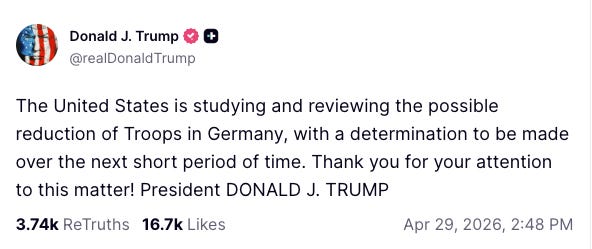
Trump has been sparring with German Chancellor Friedrich Merz over the war in Iran in recent days. On Tuesday, he said Merz didn't know what he was talking about after the German leader said the Iranians were humiliating the U.S. in talks to end the two-month-old war. Merz on Wednesday said relations with Trump were good, despite the row over the war.
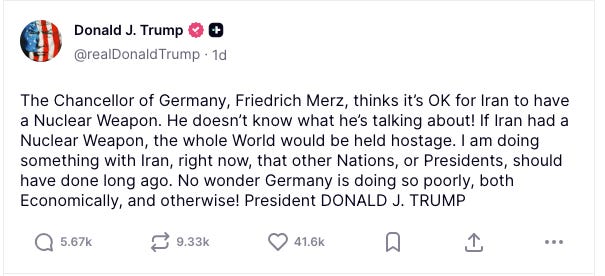
The president’s comments were in response to Merz’s speech in Marsberg Monday, where he said the U.S. “leadership obviously had no strategy” in Iran and was being “humiliated by the Iranian leadership.”
After the online exchange, Trump responded yesterday with a 90-minute conversation with Russian President Putin to discuss a possible ceasefire in the Ukraine War. Putin’s Russia is part of the State Capitalist faction, led by CCP China. Most of Trump’s posturing with Russia is the attempt to draw Russia away from the China orbit and offer Russia a better deal, or at the very least, a separate peace.
This sequence of events can be seen as part of the further escalation of the Capitalist Civil War within the Transnational Capitalist Class, an ongoing feud between the Four Factions of the TCC: Davos, the Imperialists, Silicon Valley and the State Capitalists.
Elon Musk has been openly hostile toward European regulation, particularly after the European Commission fined his social media platform X €120 million ($140 million) in December 2025, for violating the EU’s Digital Services Act (DSA). The fine was imposed due to deceptive practices around the blue checkmark verification system, lack of ad transparency, and failure to provide data access to researchers.
Musk responded on X:
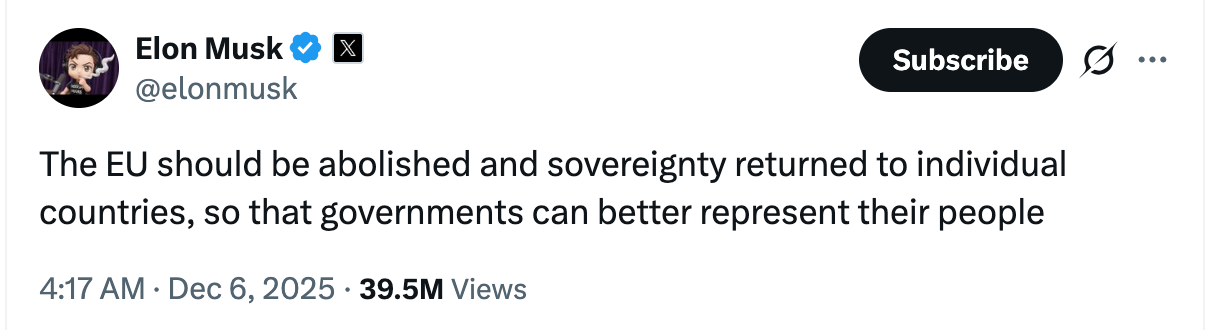
The Silicon Valley faction is at odds with both the Davos faction and the Imperialists. Peter Thiel’s funding of conservative figures in UK politics is seen as infiltration of the political spectrum by the Curtis Yarvin Dark Enlightenment project according to recent comments by a UK political commentator:
“Together, these strands form a cross-party pincer movement: Thiel’s hard power through Palantir’s contracts, and his soft power through the normalisation of discredited pseudo-scientific neo-reactionary ideas.
As figures like Yarvin move alongside establishment names, Thiel’s network is shifting ideas once confined to the far-right fringe into the centre of mainstream debate.”
Then on Thursday morning, Mark Carney made his move.
The Canadian prime minister announced that he was appointing Jonathan Wilkinson — a sitting Liberal MP and former Trudeau-era environment and natural resources minister — as Canada’s next ambassador to the European Union. The appointment costs Carney a seat in the House and triggers a by-election. The Prime Minister’s Office framed it explicitly around “the New EU-Canada Strategic Partnership of the Future,” the Security and Defence Partnership, and Canada’s accession to the EU’s SAFE defence procurement initiative.
Wilkinson’s own statement: “2026 is not 2015. The world has changed in fundamental ways, and Canada now faces new economic, geopolitical, and environmental tests.”
This weekend, Carney becomes the first non-European leader ever to attend a European Political Community summit, in Yerevan, Armenia. He is moving Canada into the European bloc, in real time, on the day Trump is moving the United States out of it.
Separate events, but there is a pattern.
To see the pattern, you have to stop thinking about politics in left-right terms and start thinking about it in terms of the Four Factions: Davos, Imperialists, Silicon Valley and the State Capitalists. The people who actually run the global economy — the people who own the capital, command the institutions, and set the agenda — are not a unified class. They are at war with each other. And what we just watched, in the space of forty-eight hours, was three of those factions throwing punches in public.
Pavel speaks for one of them — The Davos faction: the World Economic Forum, BlackRock, the IMF, the constellation of multilateral institutions, transnational NGOs, and central bank alumni that have run the post-Cold War order. Their project is borderless capital, harmonized regulation, climate-finance architecture, and the gradual erosion of the nation-state in favour of supranational governance. Pavel’s “United States of Europe” is the maximalist version of their vision.
So is Mark Carney’s keynote at Davos in January, in which the Canadian prime minister told the assembled billionaires that “we are in the midst of a rupture, not a transition,” and called on the world’s “middle powers” to band together because “if you are not at the table, you are on the menu.” Carney delivered that speech alongside Larry Fink of BlackRock, who interim co-chairs the WEF. The faction’s nervous system was on full display.
Trump, when he picks up the phone to Putin and threatens to pull troops out of Germany, speaks for a different faction entirely — the Imperialists, the people who believe in hard military power, sovereign borders, bilateral deals between strong men, and the demolition of the multilateral architecture the Davos crowd built.
In January of this year, Trump withdrew the United States from 66 international organizations, treaties, and agreements in a single executive memorandum. The withdrawal was not a tantrum. It was the worldview of the Imperialist faction in action. They sees the WTO, the UN, the climate accords, and the European Union itself as constraints on American power that need to be either cut down or walked away from. When Trump cuts a bilateral deal with Putin over Ukraine, he is not just ending a war. He is dropping a bomb on the rules-based international order, the Atlantic alliance, the EU’s claim to a seat at the great-power table that the Davos faction depends on.
Merz is caught in the middle, which is why Trump went after him. Germany is the keystone of the European project. Without American troops underwriting German security, “more Europe” stops being a federalist vision and starts being a desperate emergency. Pavel’s call for a United States of Europe and Trump’s threat to pull troops out of Germany are not unrelated stories. They are the same story, told from opposite sides of the fracture.
What they are fighting over is the financial and institutional architecture of the planet — who controls capital flows, who writes the regulations, who commands the militaries, who sets the rules for AI and energy and trade. The left-right argument we are still being sold every night on cable news is a kind of theatre where the actors are not even aware they are on a stage. The real argument is happening in phone calls between presidents, in posts on Truth Social, in CNN interviews with Czech ex-generals, and in keynote speeches at Swiss mountain conclaves.
This week, three of the four factions made their moves on the same chessboard, in the same forty-eight hours, in front of all of the whole world.
It’s worth learning to see the game.
For further discussions:
The Great Divide: Why We’re Fighting the Wrong War
This is simply the best analysis I have yet encountered. An octave above Simon Dixon,,,Thanks!
There's no such thing as a nuke