

The Vatican gift shop buys its rosaries and prayer rugs from China. Crucifixes too, and candles for weekly mass.
And iPhones.
Because even the Pope buys from China.
God bless capitalism.
The Chinese Communist Party built a capitalist country deliberately, methodically, and painstakingly over the last five decades, while continuing to call itself communist. The result is one of the largest semantic frauds in modern political history — and one of the most consequential, because the entire Western framing of the “new cold war” depends on accepting the fraud at face value.
If China is communist, then the conflict between Beijing and Washington is ideological: capitalism versus its old enemy, freedom versus authoritarianism, human rights versus oppression.
If China is capitalist — and it is by any honest appraisal — then the conflict is something else.
It is a fight inside the global capitalist class. A civil war between competing models of capitalism, between factions of the ruling class, competing over markets, labor, financial infrastructure and data.
The first task is to stop pretending.
1. The Marx Test
Let’s start with the numbers.
Based on 2026 data from the Hurun Global Rich List China has 1,110 billionaires. The United States has 1,000 billionaires.
China has surpassed the United States to become the country with the most billionaires in the world. This surge is largely attributed to growth in manufacturing, semiconductors, healthcare, and AI.
What would Marx actually say looking at modern China?
Wage labor exists. According to Marx, capitalism depends on the exploitation of workers by using the surplus value of their work to accumulate capital. China’s rise is fundamentally based on its massive cheap labour force managed by the state.
Capital accumulates privately in China. 65% of GDP is from private enterprises. Private capital operates under market competition, accumulates profit, and exploits wage labour—core features Marx associated with capitalism. The CCP has legally recognized private property rights, including ownership of productive assets.
Communism, in Marx’s view, requires the abolition of private property in the means of production, classless social relations, and the withering away of the state. None of these apply to China. The state is not withering away any day soon. In fact, the state in China has expanded and is in full bloom.
A substantial billionaire class has emerged, a robust middle class (24%) and working class that represents 75% of the population. The remaining 1% are the wealthy, a social stratification that bears resemblance to Western capitalist society.
The means of production are partially privately owned; surplus value extracted; class differentiation visible; Chinese population are the second largest owners of residential property in the world. China's homeownership rate is 96% (2022 data), placing it second after Kazakhstan.
2. How the Chinese Communist Party Built a Capitalist Country
If China were genuinely communist, the history of the past forty-seven years, since the beginning of China’s "Reform and Opening Up" era under Deng Xiaoping, would need to be completely rewritten. The historical record is one of methodical, deliberate construction — by the Communist Party itself — of every institutional feature of a capitalist economy: private property, wage labour markets, foreign direct investment, stock exchanges, a billionaire class, and full integration into global capital flows.
There were in fact four key moments that made this happen:
1978 — Deng Opens the Door.
In December 1978, the Third Plenum of the 11th Central Committee formally abandoned class struggle as the organizing principle of Chinese society, and replaced it with economic construction. Deng Xiaoping’s “Reform and Opening Up” reintroduced market mechanisms, de-collectivized agriculture, and within two years established Special Economic Zones to court foreign capital. Deng’s reforms would have been heresy a decade earlier. In a 1986 60 Minutes interview, Deng defended the pursuit of wealth under socialism, stating: "To get rich is no sin... The main task in the socialist stage is to develop the productive forces... and create material conditions for the advent of a communist society."
Deng’s insistence that material abundance was necessary for a communist society to thrive was not based on socialism becoming the scaffolding for a communist society — it was based on capitalism becoming the scaffolding for the one-party state.
2001 — Capitalists Join the CCP.
Two events in a single year sealed China’s integration into global capitalism. In July 2001, Jiang Zemin’s “Three Represents” doctrine formally invited private entrepreneurs — capitalists, in plain English — to join the Communist Party itself. It was a cornerstone of Jiang Zemin’s effort to modernize the Party, transitioning it from a “revolutionary party” to a “ruling party” capable of managing a market economy.
Five months later, China joined the World Trade Organization. The Party that had been founded to overthrow the bourgeoisie now joined the enemy; the country that had spent half a century outside the global trading system now signed on to its rules. Jack Ma and the first generation of “red capitalists” emerged from this moment, selling toaster ovens with socialist characteristics.
2002–2012 — The Hu-Wen Boom.
Under Hu Jintao and Wen Jiabao, China became the workshop of the world. GDP grew at roughly 10 percent annually for a decade. Manufacturing output surpassed the United States. The private sector reached 65 percent of GDP. A property market emerged, then exploded. Stock exchanges in Shanghai and Shenzhen swelled. The state controlled the main pillars of the economy — banking, telecoms, energy — but the day to day economic life of the average Chinese citizen became unmistakably capitalist: wage labour, consumer credit, real estate speculation, brand consumption, and growing wealth inequality.
The Gini coefficient that measures wealth inequality climbed past 0.49. China’s inequality rose dramatically from a Gini of 0.30 in 1980 to peaks above 0.50 in the 2000s, driven by rural-urban divides and regional disparities — comparable numbers to the USA, both having Gini coefficients over the 0.4 threshold indicating high wealth inequality.
2013–Present — Xi Consolidates.
Xi Jinping is often compared to Mao in the West as a turn back toward hardcore communism, but the truth is that what Xi has consolidated is not a return to communism but the party-state’s authority over capital — a different thing altogether. Tech billionaires who grew too autonomous (Jack Ma, the Ant Group IPO) were disciplined, not expropriated — the $37 billion IPO of Ant Group, Ma’s fintech arm, was abruptly suspended days after his 2020 speech criticizing the CCP’s regulations on capital, claiming Chinese banks were operating with a "pawnshop" mentality. Alibaba was fined $2.8 billion in 2021 for antitrust violations.
State-owned enterprises were strengthened as instruments of industrial policy, not as replacements for the private sector. The 2026 Hurun list reports 1,110 Chinese billionaires, up 287 in a single year, with the new wealth concentrated in semiconductors, AI, EV batteries, and pharmaceuticals — the strategic sectors Beijing has explicitly prioritized. Xi has not reversed capitalism in China. He has subordinated it to the party-state.
3. Capitalism with Chinese Characteristics
To claim that China is a communist country that follows Marxism, Leninism, socialism or any other variation on the theme is a gross violation of not only the English language, but also a betrayal of Karl Marx.
“Socialism with Chinese characteristics” is a euphemism for capitalism.
China is currently trading with over 200 nations and territories — the whole planet buys Chinese goods.
Under the capitalist economic management of the CCP and its CEO Xi Jinping, there is a pronounced and deliberate effort to “Sinicize Marxism” by integrating it with traditional Chinese culture. Confucius and Traditional Culture: Xi Jinping has strongly promoted “cultural confidence” and frequently quotes Confucius and other classical Chinese thinkers.
A recent TV series, aired on Hunan Satellite TV, When Marx Met Confucius, with the intention of popularizing President Xi Jinping’s ideological concept known as the "second combination," which seeks to merge Marxist theory with traditional Chinese culture. Based on a 1925 short story by Guo Moruo, the five-episode series features digital avatars of Karl Marx and Confucius engaging in question-and-answer sessions with students, interspersed with traditional performances and modern rap music.
On Chinese social media and overseas diaspora platforms, viewers have described it as bizarre, cringeworthy, and ideologically incoherent. Hardline Maoist websites like Wuyouzhixiang and Red Songs Association criticized the film for deviating from Marxist orthodoxy and rehabilitating Confucius, whom Mao condemned. Meanwhile, major Confucian websites such as the Chinese Confucius Academy have largely ignored the series, suggesting discomfort with its politicized portrayal of Confucianism.
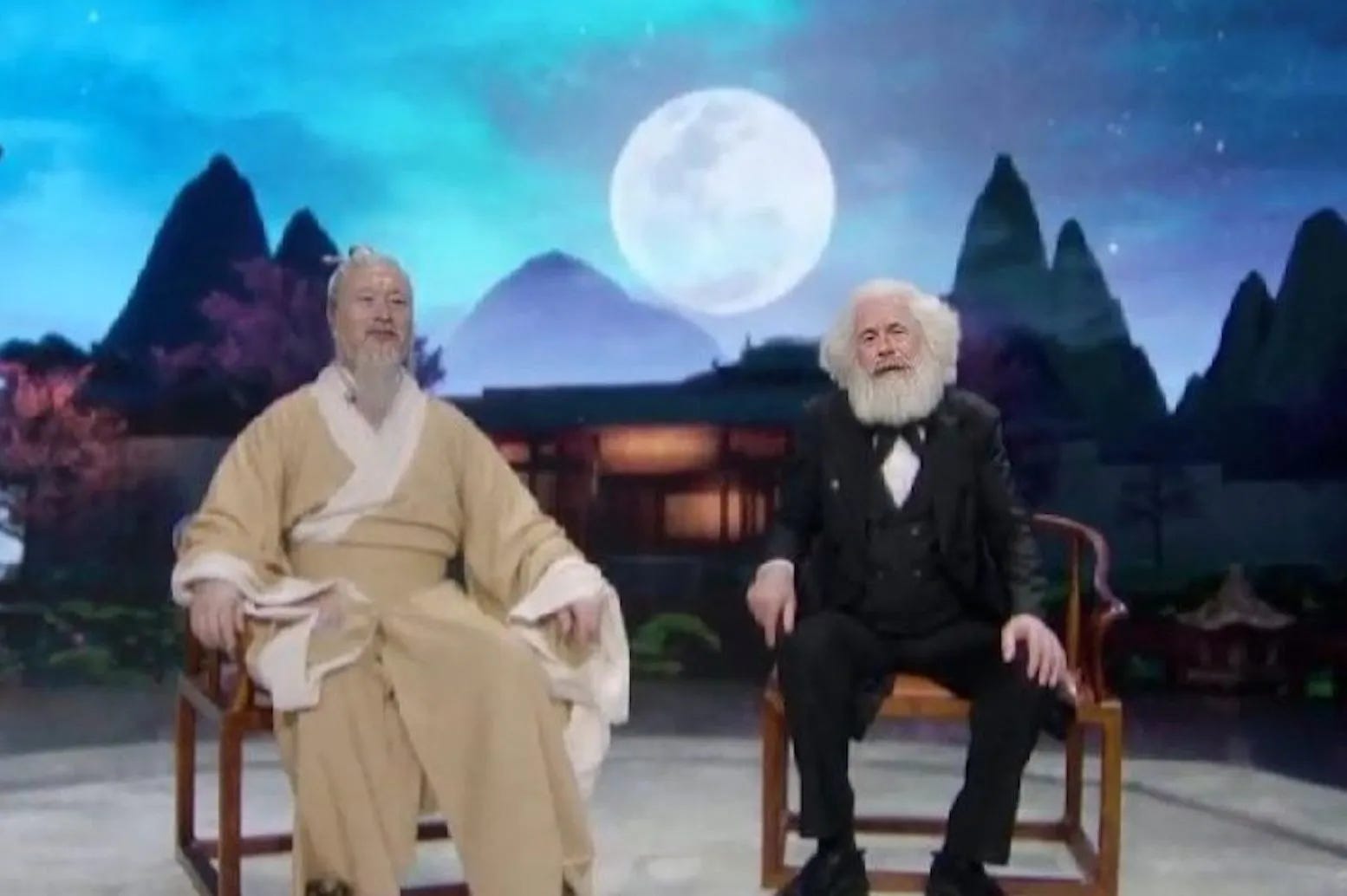
The elephant in the room, that Xi Jinping is unable and/or unwilling to acknowledge is capitalism. To make China relevant, China should produce a TV series about a conversation between Karl Marx, Confucius and Adam Smith, who all sit around, get drunk and discuss the Chinese Capitalist Party and its massive economic integration into the global capitalist market.
Karl Marx and Adam Smith would probably get into a fistfight, and Confucius would have to break it up.
“Hey guys, can’t we all try and get along?!”
China is arguably a state-run mega factory staffed by wage slaves, middle managers and an entrepreneurial class of 1,110 billionaires who are allowed to reap the rewards of capitalism, while the state manages the mega factory.
4. Communism is Dead
Xi Jinping identifies Marxism-Leninism as the fundamental ideological framework of the Chinese Communist Party (CCP), asserting that it is the "political soul" and "spiritual pillar" of Communists. Xi consistently emphasizes the need to adapt Marxism to the Chinese context and the needs of the times, arguing that its scientific truth has saved China from national humiliation and enabled its rise to a global superpower.
This is patently absurd. Capitalism saved China from national humiliation and enabled its rise to a global superpower.
Alternatively, communism is dead (or barely breathing). Prior to the fall of the Berlin Wall in 1989, there were over 40 nations overtly communist.
The fall of the Berlin Wall, on November 9, 1989, marked the symbolic end of communist rule in Eastern Europe, triggering a rapid collapse of Marxist–Leninist governments across the region.
Communism collapsed in 1989. China didn't — because what survived in China was never communism in the first place.
China’s attempt to flog the dead horse of communism back into life by claiming that Marxism is the core ideology of China is absurd, hypocritical or just plain myopic.
Other commentators and political scientists from the West, such as Francis Fukuyama, famously argued that the neoliberal democratic model is the only model remaining and we are now at the End of History because capitalism is the best model for the world. If this is true, then the CCP whole-heartedly agrees.
5. Toaster Ovens
When hunter-gatherers gave up their nomadic existence 12,000 years ago, and adopted farming and herding, the need for fair exchange of goods was developed. Private property, division of labor and the need for a public market emerged. Capitalism is buying and selling goods and services using an exchange medium — money.
Exchange is universal, capitalism is one historically specific institutional form of organizing exchange.
Ideological models of organizing human society are based on ideals, not ideas. Ideals such as freedom, peace, love, tolerance, justice and harmony.
Capitalism does not include (or preclude) any of these ideals.
We cannot base human society on exchange of goods and services. We can only base human society on elusive, subjective, relative and ephemeral notions. Values. Meanings. Origins. Purposes.
Buying a new toaster oven on Alibaba or Amazon doesn’t have any meaning, unless you give it meaning. It doesn’t matter if your toaster oven is communist or capitalist, as long as it makes toast.
What does it matter if the state is communist or capitalist if the results are the same — the government and the billionaires are in bed together exploiting and controlling the rest of the population.
6. Capitalism Versus Capitalism
The current feud on the world stage is not between left and right, or between capitalism and communism — call it a new cold war if you like — but the truth is, it is a protracted Civil War between different factions of the capitalist class. There are four factions in this civil war: the Davos globalists, the Silicon Valley technocrats, the Imperial Nationalists clustered around Trump and Netanyahu, and the State Capitalists led from Beijing. They are not allies. They are not even stable rivals. They are four competing models of capitalism, fighting over the financial infrastructure of the planet.
The real fight is not capitalism versus communism. It is capitalism versus capitalism. And the four factions waging it are the subject of this series.
“The hardest thing of all is to find a black cat in a dark room,
especially if there is no cat.”
― Chinese proverb
For previous articles in the series:
The Great Divide: Why We’re Fighting the Wrong War
Morbid Symptoms: The Origins of the Capitalist Civil War
The Four Factions of the Transnational Capitalist Class
Davos Faction Floats the United States of Europe
Modus Operandi: Who are the Transnational Capitalist Class?
Globespeak: The Four Dialects of the Transnational Capitalist Class
Carney Does Europe: A Marriage Made in Heaven
Hello Richard,
a very good overview of the situation in China, which is unknown to many...
Allow me to make a few notes.
You write that “The fall of the Berlin Wall, on November 9, 1989, marked the symbolic end of communist rule in Eastern Europe, triggering a rapid collapse of Marxist–Leninist governments across the region. Communism collapsed in 1989.” I doubt that.
• Take a look here: https://www.1989mauerfall.berlin/book-6/
• I worked at the liaison office of a U.S. corporation in East Berlin from 1986 to 1990, was transferred to Moscow after German reunification, and founded the liaison office in the Soviet Union in 1991.
• I worked in Moscow until 1997 and witnessed two coup attempts (1991, 1993), and it was then that I began to realize that the fall of the Berlin Wall was a deception operation carried out as part of Perestroika. The international community was made to believe that state socialism had collapsed. This is because, since 1966, the Soviet Union had been developing a long-term strategy to infiltrate the West. My book refers to this.
That is why I believe that even the continued existence of the Communist Party in China is ultimately a sham. Once the West has been brought to its knees, the comrades in China will at least expropriate the major corporations. Even today, every corporation (including Western ones) in China has a representative of the Communist Party on its board of directors.
More on the Soviet strateg here: https://www.amazon.de/dp/B0F896K98G
and here: https://www.1989mauerfall.berlin/
Best regards from Berlin,
Mike Wolski
Hi Richard, I've just subscribed, have been meaning to for a couple of weeks. I will write more later when I have a keyboard instead of the damn phone but wanted to say thanks, great series! Something that I can pass on for sure.
Pat