

What exactly are we looking at when we peer through the microscope at the tech billionaires in Silicon Valley? Are they a weird cult, a billionaire’s club, a cabal of conspiracists, or a class apart?
Silicon Valley is one of four factions of the Transnational Capitalist Class, now at war over the financial infrastructure of the planet.
What kind of faction is it?
This is what Gramsci called an organic intellectual apparatus — the institutional, financial, and ideological scaffolding through which an emerging class faction develops its own worldview, recruits cadres, produces propaganda, and prepares to bid for hegemony. It is not a conspiracy in the sense of secret coordination, because almost none of it is secret. It is highly visible. They have a book, a conference, a school, podcasts, Substack networks, physical demonstration sites, and a venture fund — all branded as the network state movement.
But it is also not random emergence. The same dozen-ish funders finance the projects. The same ideologues set the intellectual frame. The same handful of think tanks produce the policy papers. The founders all know each other, attend each other’s events, invest in each other’s projects, and rotate through each other’s pop-up cities.
What you have, in concrete terms, is a faction-in-formation building its own integral state in miniature.
Organic Intellectuals and Practical Organisers
According to Antonio Gramsci, organic intellectuals are not defined by profession or formal education, but by their social function within a particular class. Organic intellectuals don’t merely speak for a class — they constitute it as a class, giving it self-consciousness, preparing it for political action. Without them, you have an economic club. With them, you have a class capable of bidding for power.
As Gramsci wrote in his Prison Notebooks, the organic intellectual is less a detached thinker and more a practical organizer, involved in constructing new forms of cultural and political life.
Although Gramsci was chiefly concerned with organic intellectuals emerging from the working class, he made the same point about the capitalist class itself: "The capitalist entrepreneur creates alongside himself the industrial technician, the specialist in political economy, the organisers of a new culture, of a new legal system... If not all entrepreneurs, at least an elite amongst them must have the capacity to be an organiser of society."
Let me lay out what’s actually happening here.
How to Start a New Country
Balaji Srinivasan’s Network State vision, borrowed from his book of the same name, outlines a master plan to create “a digital-first community that establishes post-Westphalian sovereignty by crowdfunding physical territories and eventually gaining diplomatic recognition from existing nation-states.”
Srinivasan, along with other Silicon Valley techno-sovereigns are organizing online chat groups with those who share common values and interests, then crowdfunding capital to buy territory and establish a startup city. The “network” part is the non-territorial residents that live around the world who are part of the state, but only exist as online members, interacting and participating in tech projects through the internet. Entrance to the physical city is by invitation only — thus the city acts as a central hub of elite members. The decentralized cities would eventually apply for United Nations recognition at some future point when population, GDP and political clout are sufficient.
From Srinivasan’s book: “The key idea is to populate the land from the cloud, and do so all over the Earth. Unlike an ideologically disaligned and geographically centralized legacy state, which packs millions of disputants in one place, a network state is ideologically aligned but geographically de-centralized. The people are spread around the world in clusters of varying size, but their hearts are in one place.”
The idea has gained significant traction — there are several projects in various stages of development.
Praxis: Heroism, Truth and Beauty
As of mid-2026, Praxis has not yet finalized a binding legal agreement with any host government to establish its city, but it is actively negotiating and has made significant progress. Investors include Peter Thiel, Sam Altman and the Winklevoss twins. Praxis’ founder Dryden Brown, a university drop-out surfer, inspired by Ayn Rand, claims he is offering partner governments “a slice of Silicon Valley.”
Its website brags: “Our purpose is to revitalize Western Civilization by creating a new culture focused on the pursuit of heroism, truth, and beauty.”
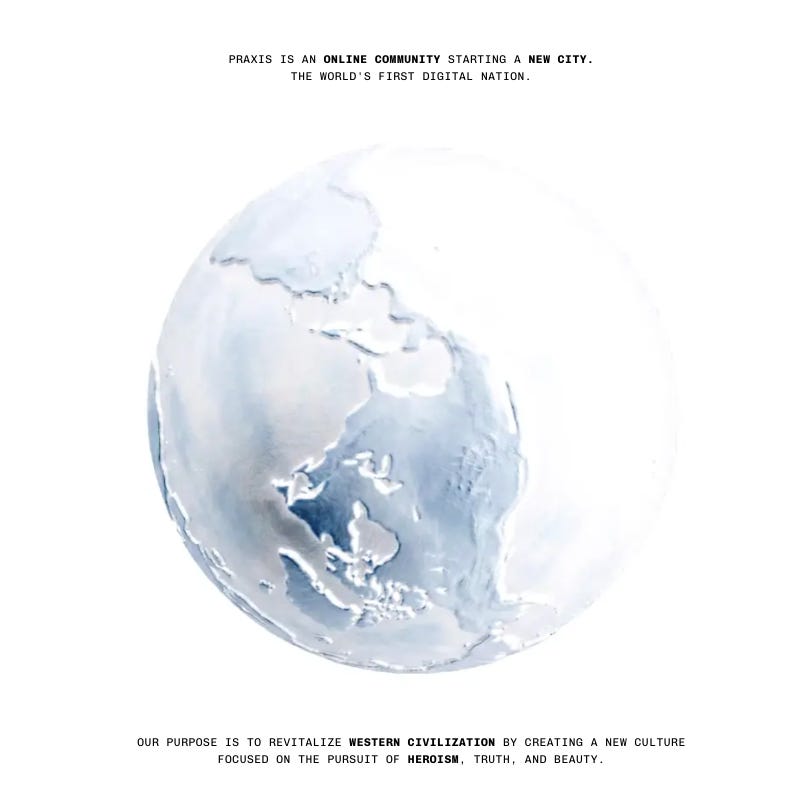
What that really means: Praxis or any other network state is nothing more than a libertarian utopia with minimal corporate regulation created for an economically select few who want to live in a place without regulatory oversight or financial checks that explicitly prioritizes capital over democracy and human rights.
Dryden recognizes that Praxis needs a host: “When partnering with governments, there’s a lot of bureaucracy and paperwork you just have to accept. Generally, you want to work with governments that have a really strong incentive to partner with you … what we’re offering governments is a totally unprecedented human capital transfer.”
Praxis has confirmed it is in discussions with seven governments about establishing an “Acceleration Zone,” its term for a Special Economic Zone (SEZ) with reduced regulatory barriers. In early 2024, Praxis announced it had received two formal government offers to host the city, though the specific countries have not been publicly disclosed. In June 2025, Vanity Fair reported that Brown had instead selected a location in California to build the city — a project named Atlas, about an hour north of Santa Barbara.
The team includes Stephen Harper, former Prime Minister of Canada, on its government relations team, signaling a serious diplomatic effort. Despite raising $525 million in crypto, and having conceptual designs from Zaha Hadid Architects, Praxis does not currently hold legal status as an SEZ or autonomous territory in any country. The project remains in the negotiation and planning phase.
In summary, Praxis has advanced government discussions and formal offers, but no final legal or regulatory framework has been enacted to establish the city as of May 2026.
Other projects include Zuzalu, a project incubated by Ethereum co-founder Vitalik Buterin; Nation3: Led by Aragon founder Luis Cuende, Nation3 aims to create a new nation state on the cloud, aimed at launching an online-first, zero-tax nation with its own internet-native jurisdiction and solarpunk society powered by Web3 technology.
Próspera: Private Tech City
Próspera — So far, the only actual city up and running, complete with condos for sale or rent, golf course, restaurants, resort and commercial district.
It is built on the Caribbean island of Roatán in Honduras, with 400 acres of land. It is a SEZ with investment by Peter Thiel. It has approximately 2,000 residents, over 300 businesses, and ongoing construction, despite legal challenges from the Honduran government, which repealed the ZEDE law in 2022 and saw the framework declared unconstitutional by Honduras's Supreme Court in September 2024.
Próspera has filed an $11 billion ICSID arbitration claim against Honduras — leveraging the very state-to-state legal architecture that the network state movement claims to transcend.
It’s promo video sums it up: “Próspera is building the fastest growing private city project in the world elevating human potential through a radically decentralized private governance framework. Legacy systems of governance keep individuals from reaching their full potential. Próspera provides a pro-innovation governance framework creating the most transparent and efficient business environment in the world.”
Residents of Honduras argue that Próspera city will degrade their culture, and it is a form of “neo-colonization” that undermines national sovereignty. They report that Próspera’s expansion has strained local public services like roads and police, without contributing tax revenue to support them.
Próspera exists because the nation of Honduras has granted them special rights and economic privileges that forming a nation would prevent.
California Forever: Stealth Campaign
The California Forever project is a large-scale real estate development initiative aiming to build a new city from scratch in southeastern Solano County, California, approximately 60 miles northeast of San Francisco. Spearheaded by Czech-born entrepreneur Jan Sramek, the project is managed through his company, California Forever, and their mysterious subsidiary Flannery Associates. Since 2017, the company quietly acquired — some called it a “stealth campaign,” — over 54,000 acres of agricultural land, roughly the size of Oakland—for an estimated $800–$900 million.
The vision is to create a walkable, sustainable city for up to 400,000 residents, featuring dense urban neighborhoods, clean energy infrastructure, and modern transportation systems. Proponents claim it could help solve California’s housing crisis and serve as an “economic engine” for the region.
Critics, like grass-roots opposition, Solano Together, claim that 70% of residents do not want 400,000 new residents in their community, stressing the negative environmental impact and distrust of secretive billionaires.
U.S. Representative John Garamendi summed up the opposition: “The community is very angry — by the secrecy, by the duplicity, by the attack on family farmers,” and “The atmosphere is very, very negative,” reflecting broader fears that the project would primarily benefit the wealthy investors while putting the livelihoods of residents and farm workers at risk.
The Network State is More Than a Movement
A social movement is a broad, loosely organized collective of people pushing for or resisting large-scale social change, whereas a faction (or class faction) is a specific, structured subgroup within a larger organization or social class fighting for its own narrow interests. Class factions are strictly rooted in economics.
Factions are highly organized, cohesive, and self-aware. Members actively coordinate strategies to gain power, votes, or influence within their parent organization or class.
Let’s look at the evidence.
There is a capital coordinator.
Silicon Valley billionaires are flush with cash.
Pronomos Capital is the first venture fund dedicated to charter cities. It invests in early stage projects that are aiming to get land, to rezone that land with different rules and institutions that will drive economic growth, and then capture some of the economic growth they create via taxes or lease prices. Pronomos was founded in 2019 by Patri Friedman — grandson of Milton Friedman, son of David Friedman, founder of the Seasteading Institute (a project he now calls “baggage”.) Patri is on the board of the Startup Societies Foundation and advises a variety of new governance projects. Pronomos’s LPs and advisors include Peter Thiel, Marc Andreessen, Joe Lonsdale, Balaji Srinivasan. Pronomos has portfolio positions in multiple network state projects — Próspera, Praxis, Itana (Nigeria), and others.
There is a think tank ecosystem.
The Charter Cities Institute in DC, founded by Mark Lutter, publishes research, runs a podcast, and hosts the academic-policy interface. The Adrianople Group documents “historical self-governing societies” and supplies historical legitimation. The Institute for Decentralized Governance, where Tom W. Bell — a former Cato policy director — promotes the movement. The Startup Societies Foundation. Each plays a defined role in producing intellectual scaffolding.
There is an annual conference.
Balaji Srinivasan’s Network State Conference began in 2023, opened a school in 2024, and held its 2025 edition in Singapore on October 3 with 3000+ registrations. Speakers included Vitalik Buterin, Bryan Johnson, Ben Horowitz, Brian Armstrong, Arthur Hayes, Andrew Huberman, and the governments of Singapore, Dubai, Abu Dhabi, and El Salvador. Note that last detail. The 2025 schedule featured presentations from the Singapore JTC, Bitcoin Office of El Salvador, Expo City Dubai, and Abu Dhabi ADGM — alongside Pronomos’s Patri Friedman and Bradford Cross, Próspera’s Lonis Hamaili, Liberland’s Vít Jedlička, and most of the rest of the active network state founders.
The conferences are openly declaring their plans. It is where founders pitch investors, where state capitalist governments (Singapore, Gulf monarchies, El Salvador) audition as potential hosts, and where the movement’s ideologues — Balaji, Naval Ravikant, Bryan Johnson, Niall Ferguson — keep the philosophical frame coherent.
There is a founding textbook.
Srinivasan’s The Network State, self-published 2022, functions as the movement’s bible. Yarvin’s earlier writings (Unqualified Reservations, the Moldbug essays) supply the political-theoretical ammunition. Yarvin has been called the “house philosopher” of the techno-sovereigns.
There is a physical hub.
Próspera has become the movement’s de facto prototype model city. Pronomos’s Patri Friedman attended a Vitalia pop-up village in Próspera on Roatán, where Joseph McKinney led a Startup Cities weekend, and where attendees could access advanced gene therapies from Lantern Bioworks and Minicircle. Vitalia, Edge City, Zuzalu — these are pop-up “society” prototypes that move between Honduras, Montenegro, Tbilisi, Chiang Mai, and other locations, building network-effects among the same several thousand people.
Popup villages, according to Edge City’s website:
“A popup village is a month-long gathering where people working at the frontiers of science, technology, and culture come together to reimagine how we live and work.”
There is overlapping investor capital.
The same fifteen or twenty names appear across nearly every project: Thiel, Andreessen, Lonsdale, Friedman, Srinivasan, Altman, the Winklevoss twins, Brian Armstrong, Fred Ehrsam, Naval, Bryan Johnson. Praxis’s largest backer is Paradigm. Other investors include Pronomos Capital, backed by Peter Thiel and first led by Patri Friedman, as well as venture capitalists Balaji Srinivasan and Palantir co-founder Joe Lonsdale, both associates of Peter Thiel.
Advertised Versus Reality
The three case studies of Próspera, Praxis and California Forever show what the Network State vision has actually produced: one private enclave operating in defiance of a constitutional ruling, one project that pivoted from international host-hunting to California real estate after no host materialized, and one stealth land grab that has spent eight years acquiring acreage it cannot get permission to build on.
The Silicon Valley techno-sovereigns cannot win on their own terms. The network-state vision — Srinivasan-style cloud polities, charter cities, exit-the-state — is what they say they want. What they actually do is capture state apparatus.
Elon Musk needs NASA, DARPA, FAA approvals, EV credits, Pentagon contracts, FCC spectrum allocation. Thiel needs ICE, the IC, DoD, the NHS contract in the UK. Andreessen needs the SEC to look the other way on crypto. The “demolish the administrative state” rhetoric is selective — they want to demolish the parts that constrain them and capture the parts that fund them.
The advertised victory of exiting the state and living in a Libertarian tax-free haven depends on the host state supplying the very state capacity the Network State claims to transcend, such as currency, military protection, legal system, the internet’s physical layer, roads, streetlights, sewage and electrical grid.
The reality is that the Network State is an invader that exploits the infrastructure of its host. Silicon Valley’s advertised project is exiting the state, but the reality is that it is capturing the state.
The four factions of the Transnational Capitalist Class are now fighting over the financial infrastructure of the planet. The Davos faction wants to govern it through transnational institutions. The Imperial Nationalists want to defend it with hard military power. The State Capitalists want to fuse it to the party-state. Silicon Valley want to own the operating system underneath — and they have decided that the most effective way to capture the state is to convince everyone they are trying to leave it. The network state, the charter city, the pop-up village, the cloud polity: these are not the exit. They are the cover.
For previous articles in the series:
The Great Divide: Why We’re Fighting the Wrong War
Morbid Symptoms: The Origins of the Capitalist Civil War
The Four Factions of the Transnational Capitalist Class
Davos Faction Floats the United States of Europe
Modus Operandi: Who are the Transnational Capitalist Class?
Globespeak: The Four Dialects of the Transnational Capitalist Class