

Building on the fracture of the Transnational Capitalist Class outlined in Chapter 1 and Chapter 2, this chapter examines the four clocks — decades (Davos), election cycles (Imperial Nationalists), product/civilizational arcs (Silicon Valley), and dynasties (State Capitalists) — and why their incompatibility produces a stalemate.
This piece is part of a longer project — a book-in-progress on the four-faction civil war inside the transnational capitalist class. If this kind of elite-power analysis is what you want more of, paid subscribers make this work possible.
The four factions of the Transnational Capitalist Class disagree about time, and not because they wear faulty wrist watches or exist in different time zones, but rather, because they are trapped in a foot race where one runner is in a marathon, another is in a hundred-metre sprint, a third is running hurdles, and the fourth is in a relay.
Davos plans in decades. Imperial Nationalists plan in election cycles. Silicon Valley plans in product cycles and civilizational arcs. State Capitalists plan in dynasties. These are not stylistic differences. Each faction’s temporal horizon is its theory of power. Davos believes power flows from coordinating long-horizon institutional commitments. Imperial Nationalists believe power is maintained and exercised by compressed transactional victories. Silicon Valley believes power flows from circumventing institutions altogether. State Capitalists believe power flows from outlasting opponents. Time is not what they disagree about. Time is the medium through which each faction theorizes power itself.
This produces a structural asymmetry that defines the stalemate. Three of the four factions can win on their own clock. Imperialists win by blocking. State Capitalists win by outlasting. Silicon Valley wins by rendering the question moot through acceleration. Only Davos requires the others’ cooperation on its preferred timescale — because only Davos believes the prize is something that has to be built together by all the factions.
The result is what we could call chronopolitical friction: the structural grinding that occurs when actors operating on incompatible timeframes are forced to govern, regulate, and compete within the same geopolitical space. A world where one faction is planning for 2050, another for November’s midterms, another for the next software update, and another for the next dynasty cannot produce coordinated global decisions. Davos’s only weapon — long-horizon institutional coordination — is the one the other three factions are incapable of wielding, regardless of stated intentions.
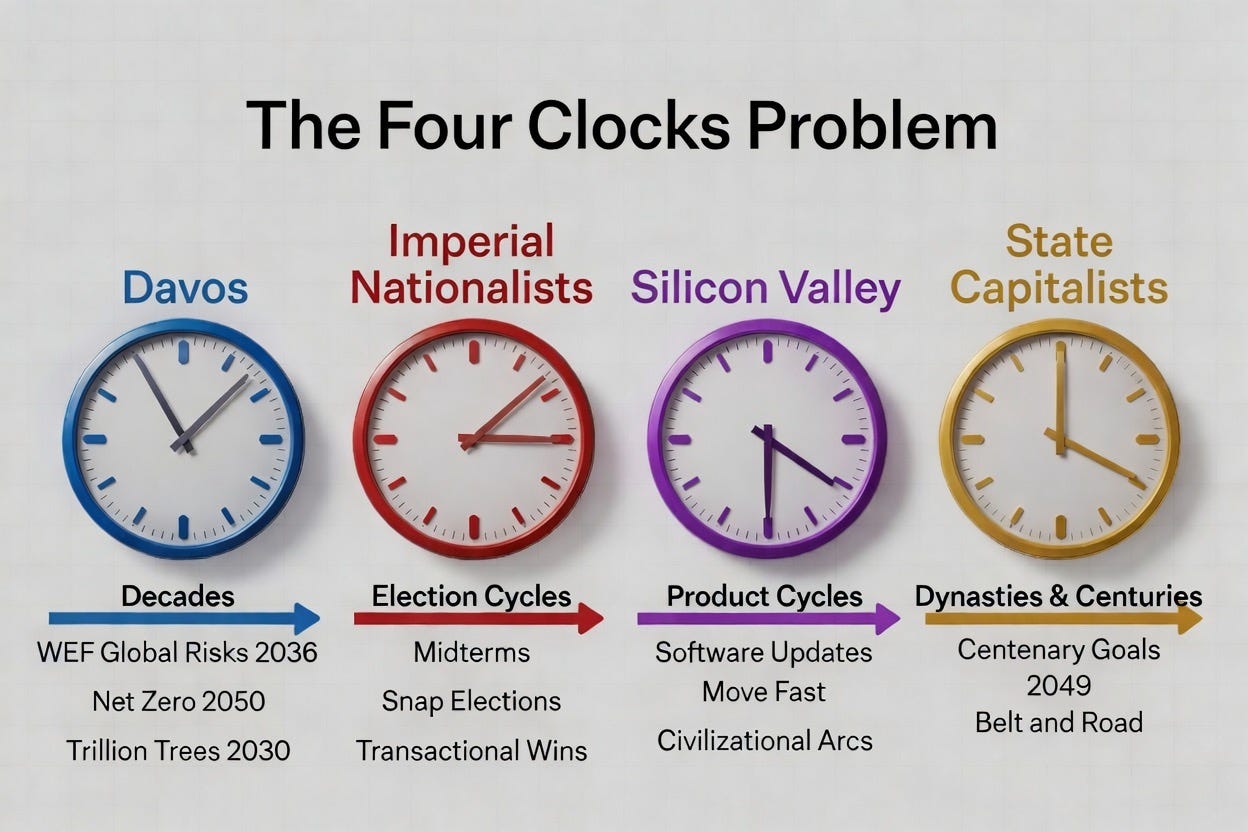
Davos: The Decades Clock
The World Economic Forum, which meets every year in Switzerland, is the central arena of the Davos faction. The WEF has no formal 10-year mandate, but it structures its policies, risk assessments, and global initiatives around a 10-year structural planning horizon — the energy transition, demographic curves, ESG timelines — all of which exceed any single election cycle.
Ten years is the unit in which the faction thinks.
The clearest evidence of the WEF’s operational timelines is found in its annual flagship publication, the Global Risks Report. Every year, the WEF mandates its network of experts to evaluate systemic threats across three distinct, explicitly stated horizons: “It explores risks in the current or immediate term (in 2026), the short-to-medium term (to 2028) and in the long term (to 2036).”
The issues Davos exists to address all exceed the four-year election cycle. The 1t.org Trillion Trees initiative, launched at Davos 2020, aims to conserve, restore, and grow one trillion trees worldwide by 2030 — a ten-year horizon for a problem that operates on a geological time. The Reskilling Revolution, launched the same year, pledged to provide one billion people with better education, skills, and economic opportunity by 2030. The decade lens is the standard unit for tracking what Davos worries about: technological displacement, climate tipping points, long-term societal polarization.
The structural weakness of Davos's timeframe is the gap between what it can coordinate and what it cannot. Where the plan only requires private capital to commit, the decade horizon works beautifully: the Reskilling Revolution and the Trillion Trees initiative are tracking toward their 2030 targets, because they ask corporations to pledge things corporations were already willing to do, and a pledge can be carried across ten years by the institution that made it. Where the plan requires a sovereign state to act against its own short-term electoral interest, it collapses.
Net-Zero 2050 is the cleanest case: the target assumes that every government along the way will keep honouring a commitment its predecessor made, through every election in between. The decade horizon assumes the institutions executing the plan will still be standing — and still oriented toward the plan — when the decade ends. Trump signed the executive order withdrawing the United States from the Paris Agreement on his first day in office, January 20, 2025; the withdrawal took legal effect on January 27, 2026, exactly one year later under the agreement's own statutory delay. One of the world's largest emitters exited the framework on which Net-Zero 2050 was built, and the framework's own architecture required a year to register the loss. A corporation that pledged in 2020 is still that corporation in 2030. A government that ratified in 2020 may, by 2026, be run by a faction that treats the ratification as a foreign imposition to be torn up.
The 2026 Global Risks Report provides evidence from the WEF’s own inner investigations: “geoeconomic confrontation” (trade wars, sanctions, the weaponisation of economic policy) moved up eight positions in a single year to become the WEF's top-ranked short-term risk. State-based armed conflict was right behind it. Meanwhile, the long-horizon environmental risks the faction was built to address fell in the rankings: critical change to Earth systems dropped seven positions, biodiversity loss dropped five. The report titled itself the Age of Competition. The 2026 annual meeting's official theme was Reestablishing a Spirit of Dialogue. When the coordination summit has to plead for permission to be a coordination summit, the coordination has already broken — “ruptured” in the words of Mark Carney.
Every January in Davos, the Forum publishes its updated ten-year risk landscape, and every January the political conditions for acting on it have deteriorated further. The Annual Meeting itself has become less a coordination summit than a barometer — a temperature check on a global economy that the faction can describe but increasingly cannot move.
Imperial Nationalists: The Election Clock
The faction centered on the US-Israel axis operates on a fundamentally different clock: the two-to-four-year democratic election cycle. It emphasizes fast, transactional, high-profile victories. Where Davos treats the decade as the minimum unit of meaningful action, Imperial Nationalists treat anything beyond the next polling date as a risk and a vulnerability. The US presidency runs four years with a disruptive midterm at exactly the halfway point.
Netanyahu’s coalitions, perpetually fragile, often compress his effective planning window to twelve or eighteen months between snap elections. Netanyahu’s own coalition put forward a bill to dissolve the Knesset on May 13, 2026, and trigger a snap election. On May 20, 2026, the Knesset held a preliminary vote on the dissolution bill, which passed with 110 votes in favor and no opposition.
The national temporal horizon is short, unpredictable, and constantly being reset.
This produces a political culture built around the visible win. Rather than committing capital to a ten-year structural transition — a green energy grid, a renewed multilateral architecture, an industrial re-skilling program — the faction prioritizes immediate results that can be messaged to voters within months. Tariffs deliver headlines faster than trade agreements. Strikes deliver headlines faster than treaties. Accords delivered before a coalition collapses are more politically useful than frameworks negotiated to last beyond it.
The Abraham Accords were structured to be signed within Netanyahu and Trump’s compressed window; the Obama administration’s nuclear framework with Iran, by contrast, was negotiated as a multi-decade agreement and, because it was never ratified as a treaty, ran directly into the 2016 election. The Trump administration tore it up within months of taking office. The same temporal asymmetry that makes long-horizon coordination difficult to build makes it relatively easy to destroy.
A dramatic recent illustration of how the Imperial Nationalists forgo diplomacy in favor of optics came in May 2026, when Brett Ratner — the Hollywood director rehabilitated through making First Lady propaganda — hitched a ride on Air Force One to scout Rush Hour 4 locations in China. Ratner was traveling alongside Musk, Cook, Fink, Schwarzman, and Solomon on a presidential summit with Xi Jinping. There was no real separation between deal-making, image management, and diplomacy. A diplomatic trip and a location scout flying together on the presidential plane.
The clash between the Imperialists and Davos is, at root, a clash about the perceived weaponization of time. Long-term predictability — the entire premise of multilateral coordination — appears from inside the Imperial Nationalists’ worldview as a mechanism by which unelected bureaucrats lock future governments into policies they cannot change. Net-Zero 2050. The SDGs. The thirty-year climate frameworks.
From the inside of a four-year cycle, these read as foreign interference in domestic sovereignty, and a faction operating on this clock will happily break a ten-year international agreement to gain a two-year electoral advantage. This is not a weakness of the faction’s temporal horizon. It is the central feature.
Silicon Valley: The Product Cycle Clock
The Silicon Valley techno-sovereigns faction operates on two clocks at once: At the micro-level, Silicon Valley runs on weeks or months — the software release cycle, the venture funding round — “move fast and break things.” At the macro-level, it stretches across centuries or millennia — longtermism, effective accelerationism (e/acc), astroengineering.
The two temporal horizons are both in opposition to institutional time — the time of elections, treaties, regulatory hearings, multilateral negotiations. The future arrives faster than legislatures can debate it, and the timescales worth caring about are longer than any electoral mandate. Either way, the state’s clock is irrelevant.
The short horizon is a political weapon. Deploying a new technology faster than a government can comprehend, debate, or regulate it is not a side effect of engineering velocity; it is the deliberate strategy by which the faction has accumulated power. While the WEF spends five years conducting committee studies on AI risks, a techno-sovereign can rewrite a platform’s code, deploy an algorithmic change, or shift billions in capital overnight — instantly altering global information ecosystems in ways that legislators are still drafting white papers about.
When regulation finally arrives, the technology has already pivoted to something the legislation does not cover. The faction’s chronopolitics is not anti-state in the populist sense. It is post-state: indifferent to the question of governance because it operates at a speed governance cannot match.
The long horizon does the same work from the opposite direction. Influenced by longtermism and effective accelerationism, the faction treats existing political systems as minor, fleeting blips in deep evolutionary time. The projects worth pursuing — AGI, radical life extension, multi-planetary civilization — are not policy goals to be negotiated through institutions but engineering challenges to be solved by sufficiently well-capitalized private actors.
Alvin Toffler saw their organizational form in 1970, before any of this faction’s principals were adults: “The embryonic Ad-hocracies of today demand a radically different constellation of human characteristics... the fast-moving, information-rich, kinetic organization of the future, filled with transient cells and extremely mobile individuals.” Toffler in his book, Future Shock, was describing a workplace. He had, in fact, described the operating system of a political faction that would arrive fifty years later.
The faction’s leaders are not young — Thiel is 58, Andreessen and Musk both 54 — but the operating tempo is set by the work, not the workforce. Discord-and-group-chat communication, meme-driven politics, the gig-economy relationship to labour: this is what middle-aged capital looks like when it has adopted youth culture’s pace as its political mode. The structural point is what this leaves the faction unable to do. Silicon Valley cannot, on its own, govern territory. Coordination on a four-year cycle is too slow; coordination on a thousand-year horizon is a sci-fi novel.
The faction’s theory of power is that institutional time can be made irrelevant — that the question of who governs becomes moot if you can simply outrun governance. This is why it keeps attaching itself to whichever territorial faction will let it operate at speed. The mode is brilliantly effective at evading state authority. It is structurally incapable of replacing it.
State Capitalists: The Dynasty Clock
The State Capitalist faction — led by China, Russia and Iran — operates on a horizon the Western factions cannot match, because none of the state capitalist regimes are subject to the kind of four-year electoral disruption that defines Western politics.
And this is despite the variations on the theme of state capital: China runs a single-party state, Russia and Iran run consolidated autocracies and India runs a democracy whose civilizational planning transcends electoral cycles. What is similar about the faction is not how leadership is selected but what leadership selection does not do: it does not reset the long-horizon plan every four years. The faction’s coherence is the durability of its planning horizon, not the form of its government.
China operates the most institutionalized long-horizon planning in the world. The Chinese Communist Party structures its entire geopolitical and economic existence around Centenary Goals — explicit hundred-year planning windows pegged to founding anniversaries. The Imperialist interpretation of this project is captured in Michael Pillsbury’s The Hundred-Year Marathon, which frames the project as a secret strategy to outpace the United States as the world’s dominant power by 2049, the centenary of the People’s Republic. Pillsbury’s framing is contested within China studies, but the underlying observation is not: the leadership does not change based on a vacillating public vote, which means a 30-year industrial policy — the Belt and Road Initiative, the monopolization of critical mineral supply chains, the EV and battery dominance — can be put into place without the risk that a new administration cancels it every four years.
For the sanctioned, autarkic regimes of Russia and Iran, time functions as a cushion rather than a horizon. They do not need to plan in centuries; they need only to outlast the Western politicians opposing them. A hostile American administration hits an election hard stop in two-to-four years, with foreign policy potentially inverting at each turn. The temporal strategy of these regimes is attrition — absorbing short-term pain through sanctions and kinetic gridlock, because they know their political structures will physically outlast their adversaries’ terms in office. This is long-horizon politics by negation: not because the regimes plan ahead, but because they cannot be electorally removed within any timeframe their opponents can rely on.
India is the most complicated and hybrid case, blending elements of all four factions. It runs democratic elections, participates heavily in Western financial structures, possesses Silicon Valley’s demographic and technical depth, and operates a multi-decade developmental plan — the Amrit Kaal, the “Golden Era,” aimed at Target Year 2047, the centenary of independence. India’s dominant temporal mode is civilizational, but the structure is hybrid: democratic, sovereign autonomy internationally, and a 25-year development plan.
Across the faction’s internal variation — Chinese Centenary planning, Russian and Iranian attrition, Indian civilizational ascent — the underlying claim is the same. The state-capitalist faction treats time as an asset that it owns. The Western factions treat time as a resource they are rapidly running out of.
Conclusion
Temporal misalignment is not a symptom of the stalemate between the four factions. It is the stalemate’s structural feature.
The factions disagree about time because they disagree about what power is. Davos believes power flows from long-horizon institutional coordination. Imperialists believe it flows from compressed transactional victories. Silicon Valley believes it flows from outrunning institutions altogether. State Capitalists believe it flows from outlasting opponents. These are not competing strategies within a shared game. They are four games being played simultaneously on the same board, each with its own clock, each with its own definition of winning.
Davos can read the global risk landscape but no longer move it. Imperial Nationalists can disrupt the coordination others require but cannot build the institutions to replace it. Silicon Valley can evade state authority but cannot replace state capacity. State Capitalists can outlast the West but cannot impose a positive global order on a system whose institutions they do not control. Each faction is structurally capable of preventing the others from winning. None is structurally capable of winning itself.
This is what the stalemate actually is. Not a pause between resolutions. Not a transitional moment awaiting a new balance of power. The interregnum is the balance of power.
The temporal architecture of the ruling class once supported coordination, in the unified phase of the Transnational Capitalist Class that preceded its fracture. It no longer does. To break the stalemate, the factions would need to coordinate. To coordinate, they would need a shared temporal horizon. The absence of that shared horizon is what makes them factions. The ruling class can no longer cooperate well enough to repair the conditions that destroyed its ability to cooperate. The very thing that would have to happen — coordination across factions — cannot happen, because the conditions for it to happen no longer exist.
This article is a chapter in an ongoing series I’m working on. It’s a work in progress, organized as it will eventually appear in my upcoming book, The Capitalist Civil War. Some of the articles are commentary on current developments to test the thesis in real time.
INTRODUCTION: The Great Divide: Why We’re Fighting the Wrong War
CHAPTER 1: Morbid Symptoms: The Origins of the Capitalist Civil War
CHAPTER 2: The Four Factions of the Transnational Capitalist Class
(COMMENTARY) Davos Faction Floats the United States of Europe
CHAPTER 3: Modus Operandi: Who are the Transnational Capitalist Class?
CHAPTER 4: Globespeak: The Four Dialects of the Transnational Capitalist Class
(COMMENTARY) Carney Does Europe: A Marriage Made in Heaven
CHAPTER 5: The Chinese Capitalist Party
(COMMENTARY) Trump Hurries to Beijing for Emergency De-Risking
CHAPTER 6: Silicon Valley: Cult, Club, Cabal, or Class?
(COMMENTARY) The Quadripolar World Order at the Beijing Summit
CHAPTER 7: How Mark Carney Learned to Stop Worrying and Love Variable Geometry
(COMMENTARY) BRICS is Dead.
(COMMENTARY) Danielle Smith’s Referendum is Aimed at Carney, Not Alberta
CHAPTER 8: Awareness Creep: How the Four Factions Woke Up to the War
Thanks for providing a model / paradigm that helps make some sense of global news and current events. So much better than having fragments or news coming from different directions in a kind of cacophanous mess that seems to make no sense. So much media "analysis" is not really analysis at all - just clickbait aimed at confirming people's biases and thereby getting more clicks. You help the reader to open their mind, to step back and consider the geopolitical news from a meta-position not offered anywhere else (at least not that I am aware of). I think you must be one of those really smart guys that is good at "pattern recognition", ahead of the curve during periods of change when the old assumptions and models just don't work anymore. People working in such fields as financial advice or investment advice and even policy development are giving meaningless advice or doubling down on counter-productive policies because they wont admit that their paradigms and models have become obsolete.
Richard! We found each other here! 🎉
This was a very illuminating chapter. And something I really never thought about or studied. What is interesting - time is a construct of this 3D matrix. Once you step out of it, none of this is relevant. 🤔😆
I'm actually learning to live in the eye of the storm. Zero Point.
Hey, I'm also writing my own book about all the crazy adventures of my life. Especially over the last 6 years. My goal is to publish my book in July.
So I have some questions on, what is the best way to self-publish? My book is controversial, so it needs to be on an independent platform. Great work Richard!❤️🔥