

I. The New Digital Heartland
If we trace the rheopolitical board down through fibre optic cables, internet connections, and software platforms, we eventually will arrive at its building blocks: the advanced semiconductor. Everything on the new grand chessboard in our study of rheopolitics — from rheo, meaning flow, stream, river — rests on a layer of computation that runs on chips only a handful of people on earth can make: the AI that coordinates the informational streams, the platforms that carry them, the models that increasingly run the financial and military machinery.
The advanced semiconductor is the equivalent of Mackinder’s Heartland — the landlocked pivot of central Asia that had to be fought over to command the world. The advanced semiconductor, and specifically the NVIDIA Blackwell B200 AI chip, confers control of everything downstream of it. Control the chips, control the world.
The Blackwell B200 is arguably the second most sophisticated technology ever built by human beings. The first is the machine that makes it. We’ll get to that.
The B200 is the new oil.
Sort of.
Because the metaphor breaks down in certain ways, and that is where the real danger lives. Oil is a fixed resource, conditioned by geology — it is where it is because of where it was formed, and there is nothing to be done about that. The chip is conditioned by knowledge: it is scarce not because the materials are rare — its raw substance is sand — but because it is fabricated by the most sophisticated industrial process ever devised. And that manufacturing process is controlled by several nations and factions.
It is a supply and fab chain — designed in the United States, fabricated by a Taiwanese company, on lithography machines from one company in the Netherlands, built with optics from another company in Germany, using materials and tools from Japan and South Korea. The new oil is not a reserve any nation owns. It is a fragile transnational sequence of supply chains, fabrication plants, chokepoints, and kill switches.
II. Anatomy of the New Oil
The Blackwell B200 is not built by a single company — NVIDIA is a fabless designer, it owns the architecture but depends on an intricate global ecosystem of specialists to physically build it.
The sequence begins in the Netherlands, where ASML builds the Twinscan lithography machines required to etch atomic-scale patterns. These ship to TSMC, which fabricates the core GPU silicon on a highly customised 4N / 4NP process node — a custom, NVIDIA-only variant of TSMC’s 4nm FinFET technology. To reach its speeds, the dies are paired with ultra-dense High-Bandwidth Memory (HBM3e) supplied by SK Hynix in South Korea.
The B200 is too complex to live on a single die, so the components travel to Taiwan, where TSMC fuses two GPU dies and eight memory stacks onto one substrate using its proprietary Chip-on-Wafer-on-Substrate (CoWoS) packaging — the substrate itself manufactured by Ibiden in Japan. Foxconn builds the boards and server trays; Supermicro and Dell integrate the rack-scale, liquid-cooled systems shipped to the cloud providers.
As of October 2025, the first Blackwell wafer was produced not in Taiwan but at TSMC’s Fab 21 in Phoenix, Arizona. The wafer has onshored. But the chip still has to fly back to Taiwan to be finished, because CoWoS packaging exists nowhere else. The Amkor packaging fab in Arizona meant to close the gap isn’t slated to begin production until around 2028.
III. The Machine That Makes the Machine
As promised: the ASML lithography machine is arguably the most sophisticated technology ever built by human beings — and it is the machine that makes the B200.
The tool that prints the B200’s transistors is ASML’s extreme-ultraviolet (EUV) scanner — the standard, 0.33-NA generation, priced at roughly $200 million. It is the size of a bus. Inside it, a high-power industrial laser vaporises some 50,000 microscopic droplets of molten tin per second, creating a plasma that emits EUV light at a wavelength of 13.5 nanometres. The light is focused by mirrors crafted by Germany’s ZEISS, polished to such atomic precision that if one were scaled to the size of the Earth, its largest imperfection would stand less than a millimetre high.
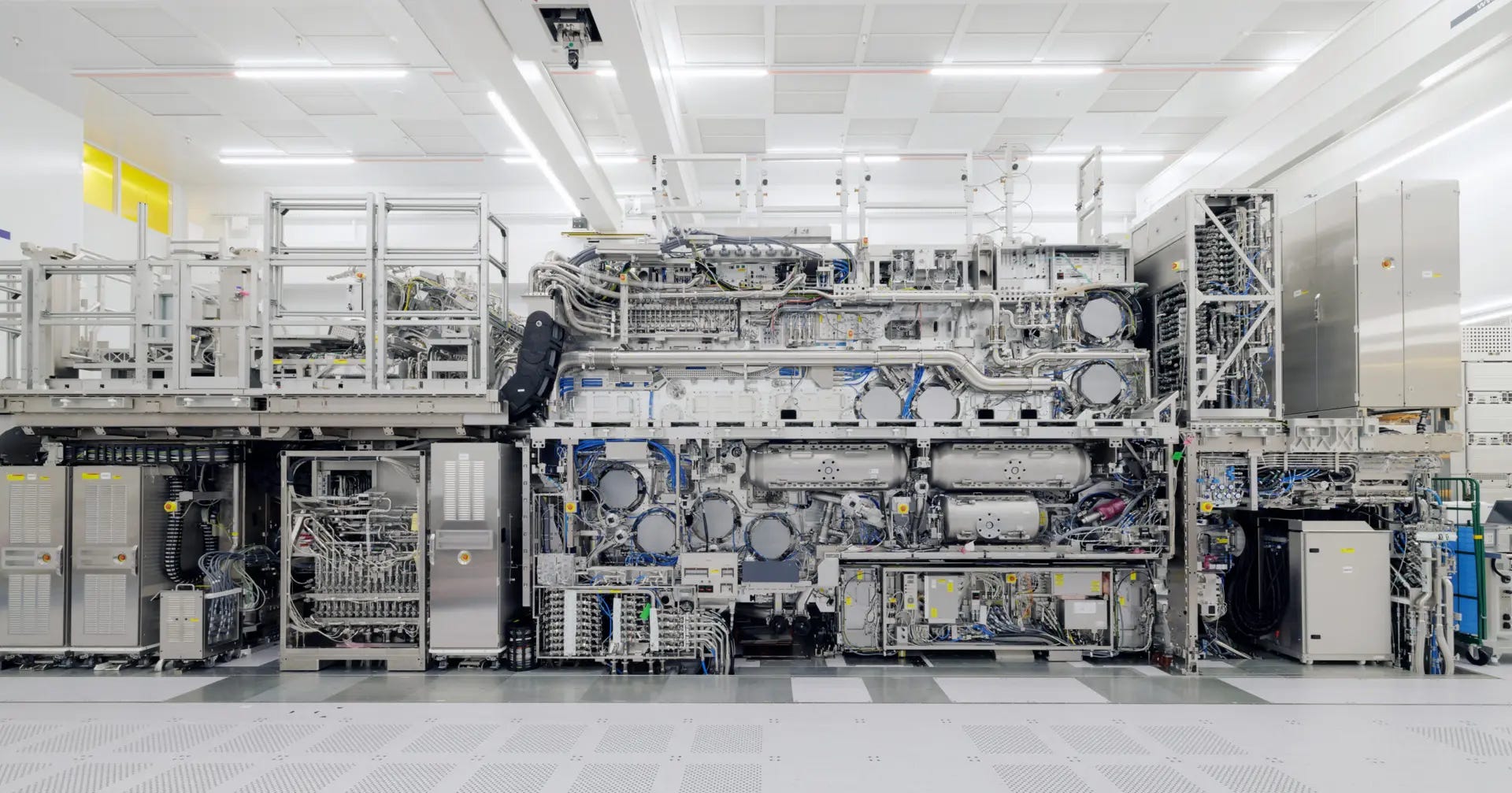
A newer, larger machine — ASML’s High-NA EUV, the $380-million class — is already arriving for the chips that will succeed Blackwell, though TSMC has so far chosen to push its standard tools further rather than adopt it. For now, the B200 is a standard-EUV chip.
And here is the first kill switch — a literal one. According to a 2024 Bloomberg report, ASML can remotely disable the EUV machines it services, rendering them inert should China seize TSMC’s fabs. The capability was reportedly added through the routine software updates the machines require to keep running; ASML, TSMC, and the Dutch government all declined to confirm it. It would not destroy the hardware — a disabled machine could in principle still be captured and reverse-engineered — but it would turn the most advanced fabrication line on earth into so much idle steel.
IV. The Weaponisation of the Chokepoint
Because ASML’s machines rest on a web of global patents — among them US-made Cymer lasers — the United States and its allies have weaponised export controls. By legally barring ASML from shipping advanced EUV systems to specific countries, China chief among them, the West holds a multi-year lead in AI and advanced military hardware. This is the denial ability of the Imperial Nationalist faction in plain sight.
But a chokepoint has two ends, and China holds the other one. If the West controls the frontier, China controls the foundation — the raw and refined materials the whole chain runs on before a single transistor is etched. China produced an estimated 98 to 99 percent of the world’s gallium in 2024, most of its germanium and antimony, and it dominates the processing of the world’s rare earths. The State Capitalists have the ability to deny the world.
Unlike the Western lever, a slow strategic squeeze that takes years before the pain is felt, China can instantly turn off the flow of rare earth metals, and it has done it before. The day after Washington blacklisted 140 Chinese chip firms in December 2024, Beijing banned the export of gallium, germanium, and antimony to the United States outright. In April 2025 it added seven heavy rare earths and in October it went further, issuing a licensing regime explicitly modelled on America’s own Foreign Direct Product Rule — any product, anywhere, carrying a trace of Chinese rare earth now requiring Beijing’s permission to ship. Then, in a November 2025 truce, it suspended the measures, through to late 2026, with the licensing discretion retained. The lever was not pulled back fully, just delayed.
Nor is China treating the frontier lockout as permanent. It is building a different road to the same place. Barred from EUV, its foundries pushed older deep-ultraviolet machines through multiple patterning to reach 7-nanometre chips and, reportedly, beyond — slower and costlier than EUV, but functional. And it is chasing EUV itself by a route ASML never took: a domestically developed light source, reportedly in trial at Huawei’s Dongguan facility, with the state setting a target of functional production by 2028. Whether it arrives on that timeline is unknown; the claims run well ahead of the verification, and the distance from a prototype to a working fab is measured in years. ASML took two decades to develop its machine.
So the standoff is not a checkmate, it’s a stalemate. It is two denials levelled at each other — the West withholding the future, China the present — and each side running a clock. The West races to finish building its stack before it no longer needs Taiwan; China races to finish its own stack before the lockout sets. Whoever crosses the line first redraws the board, and neither has crossed it. That is the stalemate: not an absence of weapons, but a surplus of them, each held to the other’s head.
V. Taiwan
This is where the Mackinder board, the Maritime-Space Commons, and the Rheopolitical Board meet on a single square. Taiwan is the place where the most advanced node of the post-Mackinder economy — the fabrication and finishing of the chips on which all three boards depend — happens to sit on the most dangerous fault line of the Mackinder continental board. The production of the B200 is tied to the ground, and the ground is contested. If there is a New Cold War, it is the stalemate between China and the United States over Taiwan, and thus over ultimate control of the semiconductor market.
Taiwan has been called “the most dangerous place on Earth” by multiple Western analysts, including the Economist:
”War would be a catastrophe, and not only because of the bloodshed in Taiwan and the risk of escalation between two nuclear powers. One reason is economic. The island lies at the heart of the semiconductor industry. TSMC, the world’s most valuable chipmaker, etches 84% of the most advanced chips. Were production at TSMC to stop, so would the global electronics industry, at incalculable cost. The firm’s technology and know-how are perhaps a decade ahead of its rivals’, and it will take many years of work before either America or China can hope to catch up.
The bigger reason is that Taiwan is an arena for the rivalry between China and America. Although the United States is not treaty-bound to defend Taiwan, a Chinese assault would be a test of America’s military might and its diplomatic and political resolve. If the Seventh Fleet failed to turn up, China would overnight become the dominant power in Asia. America’s allies around the world would know that they could not count on it. Pax Americana would collapse.”
The future of the Three Grand Chessboards runs through a question as old as Mackinder: who holds the territory? The most advanced thing our civilisation has built turns out to rest on the most ancient kind of vulnerability — a piece of land, and the ships and missiles ranged around it. Every thread of the new board, traced to its roots, arrives at this island in the South China Sea.

VI. The Silicon Shield
Taiwan manufactures roughly 80 to 90 percent of the world’s most advanced semiconductors — the nodes below 5nm — and a single company, TSMC, handles the vast majority of it. Apple, NVIDIA, AMD, and Qualcomm have no near-term alternative foundry for their top-tier architecture.
Halt those factories and the damage is immediate. Bloomberg Economics has estimated that a major Taiwan conflict would erase some $10 trillion — roughly 10 percent of global GDP — exceeding the amount lost during the pandemic. Because a single modern car relies on a thousand chips or more, a disruption would trigger a global chip famine within weeks.
For decades this capability has been Taiwan’s “Silicon Shield” — the theory that the world cannot afford to let the island fall, and so must deter aggression against it. But the shield is double-edged: the same indispensability that protects Taiwan also makes it the most coveted ground on earth, and it has driven the West into a frantic, slow race to copy a thirty-year industrial ecosystem through the CHIPS Act.
And the geography compounds the stakes. The Taiwan Strait is one of the busiest shipping lanes on earth: in 2022, some 44 percent of the world’s container fleet and 88 percent of its largest ships by tonnage passed through a channel as little as a hundred miles off the Chinese mainland.
VII. Mutual Asymmetric Denial
What makes the rheopolitical map dangerous is that the kill switch has four levers, and each faction has a hand on one of them. Any of them can pull it, and ignite a global catastrophe.
Call this mutual asymmetric denial. Mutual, because the power runs both ways — each side can deny the other. Asymmetric, because the levers are not the same weapon mirrored: one withholds the future, the other the present, on different clocks and at different thresholds. And denial, because none of it is the power to build — only the power to stop. It is not mutual assured destruction. MAD is stable precisely because it is symmetrical, the same nuclear death promised to both. This is the opposite. Because the levers are unlike, they cannot be weighed against each other, cannot be deterred in mirror image, and they cannot freeze into a cold war of identical arsenals.
The Imperial Nationalists hold the licence — the coercive overlay, the sovereign power to forbid the sale. Through the Foreign Direct Product Rule and allied export controls, Washington and The Hague can bar ASML from shipping EUV systems to an adversary, or force NVIDIA to decrease or block specific exports outright. They do not design the chip; they hold the legal authority to stop it crossing a border. The literal kill switch — ASML’s reported ability to disable the machines from afar — shows how the levers run through one another: a Dutch company holds the physical means to brick the most important machine on earth, a capability reportedly installed under American pressure. The Imperial Nationalist lever reaches its hand through a Davos-coded instrument.
Silicon Valley holds the architecture. NVIDIA and the hyperscalers — Microsoft, Amazon, Google, Meta — own the architecture, the software lock-in of CUDA (Compute Unified Device Architecture), and the physical data centres where Blackwell racks are deployed. As the primary buyers, they control who gets compute. If NVIDIA or a hyperscaler decides a startup, a sovereign, or a rival is a risk, it can deny allocation, revoke API access, or shut a customer out of the ecosystem entirely.
Davos holds the rule book. Its denial power is regulatory, not physical: the European Commission cannot build a chip or close a border, but it can block monetisation. Through antitrust enforcement and tech-sovereignty rules — the EU AI Act, data-sovereignty regulation — Brussels can threaten fines or ban non-sovereign cloud architectures on its soil, making Blackwell deployment commercially unviable across a major economic zone. EU competition law caps fines near 10 percent of global turnover; the Digital Markets Act regime rises to 10 percent, and then 20 percent for repeat breaches.
The State Capitalists hold the rare-earth and the Taiwan Strait. China controls the rare-earth and minor-metal inputs (gallium, germanium, antimony) the packaging depends on, and the maritime lanes around the island. It can choke the raw elements that feed the assembly, or blockade Taiwan and halt TSMC’s exports at a stroke. Its hand on the lever is the most physical of the four — and the most absolute.
None of these factions can act alone. Silicon Valley cannot build the chips without the Imperial Nationalists granting export licences. The Imperial Nationalists cannot finish the chips without the State Capitalists’ refined elements. The State Capitalists cannot use the technology if Davos and the Western hyperscalers cut them off from market integration and Western software. It is a multi-sided standoff in which every faction has a hand on the kill switch — and the reason no one pulls the lever is that the kill switch kills everybody.
But mutual asymmetric denial holds only while the four hands exist in a balance of power. If one faction concludes the clock is running against it, and that waiting will leave it weaker, then it may believe it must pull the lever now.

VIII. The Closing Window Danger Zone
There are two questions that will decide the game from here, and neither is one that either the Mackinder board or the Commons board could have posed.
The first: does the infrastructure stay a single contested pipe — one financial system, one internet, one compute base that everyone fights to control — or does it split into two rival stacks, a Western and a Chinese, forcing every unaligned nation to choose which to plug into?
The second: does the fabrication of the B200 stay concentrated on that one island, or does it disperse — to Arizona, to Japan, to Germany, to a Chinese industry racing to build its own — until the chokepoint dissolves and Taiwan loses both its value and its danger?
Take the second question first, because it is already being answered, and the answer is more dangerous than it looks. Die fabrication has begun to disperse: TSMC’s Fab 21 in Arizona is live, producing Blackwell wafers on American soil. But the chokepoint — packaging — has not moved. Amkor broke ground on a $7 billion packaging-and-test campus in Peoria in October 2025, purpose-built to finish the wafers the Arizona fab produces, but that campus is still under construction and isn’t slated to begin production until around 2028. Until it does, the finished chip still has to fly back to Taiwan. So the wafer is leaving the island; the packaging is not.
It would be comfortable to read that as de-escalation — the chokepoint dissolving, Taiwan softening into ordinary geography. It is the opposite. The Silicon Shield is a deterrent only because Taiwan is indispensable: the world cannot afford to lose it, so the world must defend it. De-escalation does not resolve the conflict because the invasion was never only about chips. It is about Chinese unification — the breakaway province returned to the homeland.
Arizona reduces the Western stake in Taiwan. It does not reduce China’s bid for unification. So the most dangerous moment is neither the one where Taiwan is irreplaceable nor the one where it is fully replaced — it is the long transition, where the shield has lost some of its deterrence, but capturing Taiwan is still tempting. Some analysts have stopped calling it a silicon shield, and started calling it a silicon trap.
The West can rebuild the stack in the open; China can only build a parallel one — slower, by a different road, and not yet finished. For now it is behind at the frontier, which is what makes the window close on Beijing rather than Washington. Every month the Western stack onshores, Taiwan becomes a weaker hostage and China's own road a longer shot.
A closing window is the most invasion-prone condition there is: it converts a deterrent into a deadline. Which means the Arizona timeline is not a peace clock. It is a countdown. The most dangerous power is rarely the strongest one. It is the one that believes it is still strong enough to act, certain it will be weaker later, and convinced that waiting forecloses its options. That conviction — that the future is worse than the present — sat behind the calendar in 1914 and behind Pearl Harbor. It is the logic the Arizona clock now hands to Beijing.
If the levers are ever pulled in earnest, TSMC is destroyed in the invasion — ASML bricks the machines, TSMC burns the factory to the ground. A much-cited US war paper, McKinney and Harris’s “Broken Nest,” argues Taiwan should pre-commit to demolishing TSMC to make itself unwantable. A war over the chip does not hand over the chip to China. It vaporises it, for everyone. The $10 trillion global GDP loss is not a transfer from one faction to another; it is a deadweight loss to the whole board. The kill switch, fully engaged, kills everyone.
And that is only the second question. The first is larger, and it can be answered without a single shot fired. The compute base can simply split in two — a Western stack and a Chinese stack, each unaligned nation forced to plug into one or the other, the contest hardening from a war inside one infrastructure into two sealed, incompatible infrastructures that no longer integrate. That is not a chokepoint dissolving. It is the terrain itself splitting in two. The danger is not only that Taiwan burns. It is that the world wires itself into two nervous systems that cannot speak to each other — and the Capitalist Civil War, which began as four factions fighting over one machine, ends with two of them building separate machines and calling it peace.
So the road forks, and neither branch is soft. On one side, the broken nest: the shield disintegrates, the window closes, and the island is taken or torched while it still matters. On the other, the world order splits in two: no shot is fired, the stack splits, and the single contested pipe becomes two.
The better path — a clean de-escalation, and Taiwan de-risked into irrelevance — is possible. But it is not a third road; it is a narrowing thread between the two, and to reach it the de-escalation must conclude before the window shuts. That race is already on. TSMC Fab 21 is live, Amkor is still pouring concrete, the export controls are hardening the second stack into being, and the pressure around the island is a present-tense pressure cooker, not a forecast. Every variable that decides which branch we take is already in motion — which is why the fork is not two years away.
We are standing in it now.
About this series: Building on the fracture of the Transnational Capitalist Class outlined in Chapter 1 and Chapter 2, this article forms part of a book-in-progress, The Capitalist Civil War. It is an ongoing investigation, into the emerging conflict between four factions of the global elite: Davos Institutionalists, Imperial Nationalists, Silicon Valley techno-sovereigns, and State Capitalists. Each chapter explores a different aspect of that struggle. If you want more of this kind of elite-power analysis, paid subscribers make this work possible.
Here is the project so far. Some of the articles are commentary on current developments to test the thesis in real time.
INTRODUCTION: The Great Divide: Why We’re Fighting the Wrong War
CHAPTER 1: Morbid Symptoms: The Origins of the Capitalist Civil War
CHAPTER 2: The Four Factions of the Transnational Capitalist Class
(COMMENTARY) Davos Faction Floats the United States of Europe
CHAPTER 3: Modus Operandi: Who are the Transnational Capitalist Class?
CHAPTER 4: Globespeak: The Four Dialects of the Transnational Capitalist Class
(COMMENTARY) Carney Does Europe: A Marriage Made in Heaven
CHAPTER 5: The Chinese Capitalist Party
(COMMENTARY) Trump Hurries to Beijing for Emergency De-Risking
CHAPTER 6: Silicon Valley: Cult, Club, Cabal, or Class?
(COMMENTARY) The Quadripolar World Order at the Beijing Summit
CHAPTER 7: How Mark Carney Learned to Stop Worrying and Love Variable Geometry
(COMMENTARY) BRICS is Dead.
(COMMENTARY) Danielle Smith’s Referendum is Aimed at Carney, Not Alberta
CHAPTER 8: Awareness Creep: How the Four Factions Woke Up to the War
CHAPTER 9: The Four-Clocks Problem
CHAPTER 10: The New Grand Chessboard
CHAPTER 11: The War Inside the Panopticon
(COMMENTARY) Hats Off to the Conspiratorial Commentariat
(COMMENTARY) Musk’s Trillion Dollar Coronation Inside the Cathedral
Thanks for the clarity of your description of this pregnant historical moment, Richard.