

There has never been a single all-seeing surveillance state — only rival ones. This is the story of how the West built the most complete surveillance machine in history, then broke it into warring pieces; how China built a second machine and put it up for sale; and why the result is not a panopticon but a quadropticon — four rival powers fighting over the controls of a machine.
I. Origins of the Panopticon
The twentieth century witnessed the rise of competing surveillance civilizations. The Anglo-American, Soviet, and Chinese systems emerged from different political traditions, but all sought the same strategic objective: converting information into power. The Cold War was therefore not only a military and ideological struggle but also a contest between rival architectures for collecting, processing, and controlling information.
From that perspective, Capt. Ralph Van Deman, widely regarded as the “father of American military intelligence,” is often cited as the man who transformed scattered military, police, and private intelligence practices into a more systematic national security apparatus during World War I. His institutions and methods became important building blocks of the later American surveillance state.
The Soviet Cheka and its successors developed another branch during the same time frame, while the Chinese Communist Party eventually built a third. The digital age has not replaced these traditions; it has amplified them.
The modern American surveillance apparatus traces to the 1898 conquest of the Philippines — in 1901 Capt. Ralph Van Deman took command of the Army's Division of Military Information, originating with the U.S. Army’s Division of Military Information. He utilized emerging technologies like telegraphy, photography, and index-card databases to compile detailed files on thousands of Filipino leaders. This apparatus was designed to suppress Filipino resistance through total information control, tracking physical appearance, finances, and political loyalties.
Following the Philippine-American War, Van Deman repatriated these colonial policing methods to the United States. Upon the U.S. entry into World War I in 1917, he established the Military Intelligence Division (MID), adapting the Philippine model for domestic use. Collaborating with the American Protective League, the MID amassed over a million surveillance reports on German Americans and political dissidents, laying the institutional foundations for future agencies like the NSA.
The Soviet Union arguably built the world’s most extensive human intelligence surveillance system, relying on millions of informants, party officials, workplace monitors, and security officers. The All-Russian Extraordinary Commission, abbreviated as VChK, and commonly known as the Cheka was the first Soviet secret police organization, that morphed into the NKVD and then, eventually the KGB which became one of the largest intelligence organizations in history.
In November 1927, the CCP established its first formal intelligence service, with Zhou Enlai founding the Central Special Branch to conduct "special operations" work. Informally called Teke, Zhou Enlai established secret bases across the Chinese territory which was an early ancestor of the China’s Ministry of Public Security (1949), later MSS (1983).
In the West, the National Security Act created the CIA in 1947, followed by the consolidation of UKUSA into Five Eyes SIGINT-sharing.
II. Computerizing the Dragnet (1945–1990)
The SIGINT apparatus went machine-scale during Project SHAMROCK’s telegram interception program that lasted for three decades (1945–75). MINARET was the watchlist program that targeted specific Americans (including senators and Martin Luther King Jr.) — and along with the automated Five Eyes dragnet that became known as ECHELON — it expanded from intercepting satellite and telex traffic to monitoring emails, faxes, and internet traffic, utilizing ground-based stations and satellites to collect global data.
The Church Committee, formally the U.S. Senate Select Committee to Study Governmental Operations with Respect to Intelligence Activities, was established in 1975 to investigate covert operations and abuses by the CIA, FBI, and NSA. Chaired by Senator Frank Church (D-Idaho) and Vice-Chaired by Senator John Tower (R-Texas), the bipartisan committee conducted a 16-month investigation that exposed widespread illegal domestic surveillance, including Project Shamrock and Project Minaret, which involved the warrantless monitoring of American citizens and political dissidents.
During the same time period, the KGB relied on advanced electronic eavesdropping. They deployed resonant cavity microphones, FM transmitter bugs, and wireline intercepts.
The most famous of these resonant-cavity devices was discovered bugging the U.S. Embassy in Moscow. In 1952, a sweep of the U.S. embassy in Moscow picked up the voice of Ambassador George Kennan with no transmitter in sight. The source turned out to be a carved wooden Great Seal of the United States — a wartime gift from the Soviets, hanging in Kennan's study. Smashed open, it revealed a pencil-shaped bug that needed no power source: it sat dormant until Soviet technicians nearby bombarded it with microwaves, then resonated Kennan's every word back to them, and could have done so indefinitely. The Americans only found it by having Kennan pretend to dictate a telegram, baiting the Soviets into switching it on. Kennan recalled an "acutely conscious" sense of unseen presence — and the morning after, a "new grimness" among the staff, the air so thick with hostility "one could have cut it with a knife."
The KGB’s primary domestic role was suppressing dissent. They maintained extensive files on dissidents. They monitored public figures and private citizens through informants, wiretaps, and secret detentions, forcing many to self-censor. Unlike the U.S., there was no judicial oversight; surveillance was a tool of the Communist Party to enforce ideological purity.
III. The Western Unipolar Consolidation (1991–2013)
The Soviet collapse temporarily removed the rivalry. The 1990s laid the digital groundwork: the US-centric internet backbone, the Clipper Chip and Crypto Wars (1993). Then 9/11 detonated the modern surveillance state — the Patriot Act (2001), warrantless wiretapping, Stellar Wind (2001), Total Information Awareness (2002–03), PRISM (2007), and the fusion of state SIGINT with the new hyperscaler data layer.
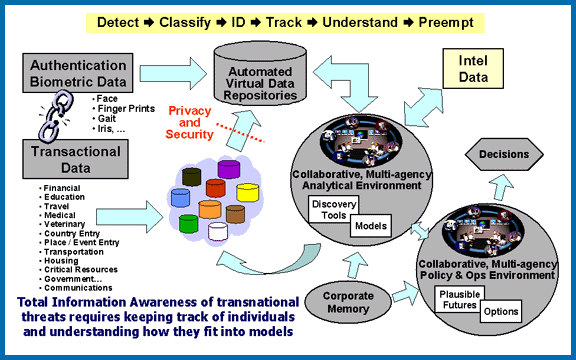
The Five Eyes was itself expanded to the Nine Eyes and Fourteen Eyes and data collection programs PRISM and XKEYSCORE as Snowden would describe it in 2014.
On January 26, 2014, the German broadcaster Norddeutscher Rundfunk asked Edward Snowden in a TV interview: “What could you do if you would use XKeyscore?”
Snowden:
“You could read anyone’s email in the world, anybody you’ve got an email address for. Any website: You can watch traffic to and from it. Any computer that an individual sits at: You can watch it. Any laptop that you’re tracking: you can follow it as it moves from place to place throughout the world. It’s a one-stop-shop for access to the NSA’s information. ... You can tag individuals ... Let’s say you work at a major German corporation and I want access to that network, I can track your username on a website on a forum somewhere, I can track your real name, I can track associations with your friends and I can build what’s called a fingerprint, which is network activity unique to you, which means anywhere you go in the world, anywhere you try to sort of hide your online presence, your identity.”
For a solitary decade the Western grid operated as one integrated apparatus presenting itself as universal. It was the most consolidated panopticon ever built — and it was only half the planet.
IV. China Builds a Surveillance State and Exports it to the World
The other three factions inherited a single machine and are fighting over who controls it. China did the one thing none of them could: it built a second machine — and then put it up for sale.
Following the MPS's 1997 internet regulations, the Golden Shield Project was launched, becoming operational around 2003. The key sections, Articles 4–6, are the following:
“Individuals are prohibited from using the Internet to: harm national security; disclose state secrets; or injure the interests of the state or society. Users are prohibited from using the Internet to create, replicate, retrieve, or transmit information that incites resistance to the PRC Constitution, laws, or administrative regulations; promotes the overthrow of the government or socialist system; undermines national unification; distorts the truth, spreads rumors, or destroys social order; or provides sexually suggestive material or encourages gambling, violence, or murder. Users are prohibited from engaging in activities that harm the security of computer information networks and from using networks or changing network resources without prior approval.”
The Great Firewall (operational 2003) was the beginnning of the splinternet, a term describing the fragmentation of the global internet into isolated, state-controlled digital regions. By enforcing strict censorship through deep packet inspection, DNS spoofing, and TCP reset attacks, the system created a separate, domestic internet ecosystem that blocked access to global platforms like Google, Facebook, and YouTube.
Since 2014, the firewall is operated by the Cyberspace Administration of China (CAC), the national internet content regulator and censor of China. Due to the Great Firewall, China has one of the lowest cross-border internet traffic rates in the world. Usage of foreign apps in China is minuscule.
China’s mass surveillance infrastructure evolved from the Skynet project (launched 2005, expanding to an estimated 600 million cameras) to the Sharp Eyes Project (Xueliang Project), which is a Chinese government surveillance launched a 2015 initiative that aimed to achieve 100% coverage of public spaces, particularly in rural and remote areas. The Social Credit System emerged in 2014 to regulate behavior through data fusion.
Xinjiang serves as the primary testing ground for these technologies, where the Integrated Joint Operations Platform (IJOP) utilizes facial recognition and predictive policing algorithms to monitor and detain Uyghur populations. This regional “laboratory” allowed the state to refine AI-driven behavioral scoring and preemptive control mechanisms before scaling them nationwide.
Edward Snowden said China's mass surveillance mechanisms and machinery of private communications was "utterly mind-boggling." He was initially, “so impressed by the system’s sheer achievement and audacity that I almost forgot to be appalled by its totalitarian controls,” a statement he made in his memoirs, Permanent Record.
Having perfected the machine at home, China began selling it.
China is the world’s dominant exporter of physical surveillance infrastructure and AI-driven control systems. Technology linked to Chinese companies is found in at least sixty-three countries worldwide. Major state-backed firms like Hikvision, Dahua, and Huawei lead this trade, with Chinese companies securing more import deals than any other nation. China exports facial-recognition AI to 83 countries — twice as many as the US (57).
The primary vehicle for export is the “Safe City” (or “Smart City”) package. These are turnkey solutions that bundle hardware, software, and financing into a single government contract, deployed in cities including Nairobi and Belgrade. There are 398 documented cases of smart-city technology exports by 34 Chinese companies across 106 countries, with over US$22 billion invested, loaned, or contracted in Indo-Pacific Digital Silk Road digital infrastructure between 2017 and 2023.
These systems integrate facial recognition, license plate readers, predictive policing algorithms, and centralized command centers. Often funded through subsidized loans from Chinese state lenders such as China Eximbank and the China Development Bank as part of the Belt and Road Initiative, creating long-term dependency on Chinese maintenance and upgrades.
V. The Aftermath of Snowden
The long-term impacts of Edward Snowden’s 2013 leaks of the NSA’s surveillance apparatus have been profound, reshaping American law, the global tech industry, and international relations.
Snowden (June 2013) shattered the Western grid’s legitimacy and triggered global data-localization. In 2018, the NSA was compelled to delete millions of records after it learned that some of the data had been collected from phone service providers without legal authority or authorization.
Domestically, the revelations forced a landmark, albeit incomplete, legal reform: the USA Freedom Act of 2015 formally ended the NSA’s bulk collection of Americans’ phone records under Section 215 of the Patriot Act, a practice later ruled illegal by a federal court.
However, other powerful surveillance authorities—notably Section 702 of the FISA Act and Executive Order 12333 — remain largely intact, ensuring the agency retained significant capabilities.
Internationally, the damage was severe and lasting: revelations that the U.S. had spied on allies such as German Chancellor Angela Merkel frayed diplomatic trust, while the United Nations Human Rights Council affirmed that offline rights apply online, and the European Union invalidated the Safe Harbor data agreement, accelerating global privacy regulations. As for Snowden himself, he remains in exile in Russia, with the Trump administration circle, via Tulsi Gabbard pushing for a pardon. Putin gave Snowden Russian citizenship in 2022.
VI. The Panopticon Eats Itself
The 2013 rupture didn’t kill the grid; it killed the consensus that it served only one master. The post-Snowden question wasn’t “should this exist” but “whose is it now?” Three diverging surveillance models formed inside the Western bloc, concurrent with the split within the Transnational Capitalist Class.
Three factions, one server. To see the war, let’s take a look at the data sitting on a hyperscaler’s machine — Facebook. Three Western factions want three incompatible things from it, and none can have its way without defeating the others.
Silicon Valley owns the data. It is Facebook’s asset, its leverage, its business.
The Imperial state wants to use it. In 2018, Congress passed the CLOUD Act, which asserts a simple, sweeping claim: if a company is American, U.S. authorities can force Facebook to surrender its data wherever on earth the servers physically sit. A Microsoft server in Dublin is, legally, within Washington’s reach. This is the Imperial Nationalist faction annexing the Silicon Valley layer by declaring legal dominion over it.
Davos wants to wall it off — and here the mechanism matters, because it is not a conspiracy theory and no faction recruited an agent. Max Schrems, an Austrian law student, brought a private complaint against Facebook out of genuine conviction; he has spent his career suing European regulators too, for enforcing too little. He was never anyone’s instrument. What turned his grievance into a faction weapon was the institution it landed in. The Court of Justice of the European Union chose — twice — to strike down the transatlantic data agreements not on narrow privacy grounds but on the broadest possible one: that U.S. surveillance law rendered American jurisdiction categorically unsafe for Europeans’ data. Safe Harbor fell in 2015; Privacy Shield in 2020. That is not a privacy holding. It is a sovereignty holding — a border drawn against another faction’s reach, using a private lawsuit as the pretext.
This is what it means to call Brussels a Davos organ rather than an independent power. Davos has no army and no hyperscaler; its instrument is the regulatory machine, and that machine works by converting whatever enters it — a student’s complaint, a merger filing, a market-access request — into binding rules that bind other factions’ systems. Schrems supplied the key. Brussels decided which lock to open. The GDPR (2018) then generalized the principle, and the DMA, DSA (2022), and AI Act (2024) extended it into the architecture of the platforms themselves. The faction actor was never the litigant. It was the court that ruled and the legislature that codified.
Now hold the two orders side by side. The CLOUD Act commands American firms: hand us your data, wherever it lives. Schrems and the GDPR (General Data Protection Regulation) command the same firms: then you may not hold Europeans’ data at all. These are not different rules in different rooms — they are contradictory directives issued to the same companies about the same servers, by two factions of the same broken grid. Silicon Valley cannot obey both: it is legally American, and therefore exposed to Washington’s subpoena, but commercially captive to Europe, and therefore bound by Brussels’s wall. The firm is not a player so much as the ground the other two fight on.
That is the war inside the panopticon, and it explains why none of these factions can simply merge their grids into one. Davos has no army and no hyperscaler; it can only rule by making others comply — which means its power requires the others to remain separate enough to be bound. The Imperial state has the reach but not the consent. Silicon Valley has the machines but neither sovereignty nor jurisdiction of its own. Each holds one layer of a grid that no longer answers to a single master — and each is using its layer to capture, wall off, or escape the others.
And Silicon Valley itself is not one faction but two, split over a single question: Can the state apparatus be reformed, or only escaped?
The first wing — the hyperscalers, Apple and Google and Microsoft and Meta — believes it can be managed from inside. Publicly, they wage a privacy crusade: encryption by default, transparency reports, court fights against overreaching warrants. But the crusade stops exactly where a state’s reach begins. In December 2022, Apple rolled out end-to-end encryption for iCloud backups — genuine protection, the company locked out of its own users’ data. Then in January 2025, the UK served Apple with a secret Technical Capability Notice under the Investigatory Powers Act, demanding blanket access to encrypted iCloud data — even for users outside Britain. Apple pulled the feature from the UK rather than build the backdoor, and challenged the order in court. But it could not win alone: the demand was only beaten in August 2025 after the US intelligence chief intervened on Apple’s behalf — and months later the UK quietly renewed it. The lesson was unmistakable: the platform’s privacy held only because one faction’s state shielded it from another’s. The hyperscalers will defend your data against everyone except the state that owns their jurisdiction.
The Network State wing of Silicon Valley, that is centered around Peter Thiel, Marc Andreessen, crypto, Starlink and the Network State vision, with Curtis Yarvin as house philosopher, concluded that the state is unreformable and started building parallel infrastructure to route around the state. Palantir — Thiel’s company simultaneously selling the security state its surveillance backbone (ICE, the Army) and ideologically committed to exit.
Thiel himself decamped with his family to Buenos Aires in 2026 — a "temporary" bug-out hedge, the New York Times reported — even as Palantir booked $687 million in U.S. government revenue that quarter and Anduril took a $20 billion Army contract. It’s the Hotel California — you can check in, but you can never leave.
VII. Chokepoints
The grid is not one machine but a hundred. Every nation with the means now runs its own — partial or complete, home-built or bought, wired to one of the four faction stacks. It would be naïve to imagine that China, Russia, India, Europe, and the United States ever shared a single interconnected grid.
India is building its own grid from orbit down: a 52-satellite surveillance constellation to watch China and Pakistan, and the domestic Central Monitoring System to spy on its own population. The Gulf states have built comprehensive domestic surveillance that blends mass monitoring with targeted espionage, bought turnkey from whoever sells. And the market reaches everywhere: at least 74 governments have acquired commercial spyware, while African states — Nigeria, Ghana, Morocco, Malawi, Zambia — now spend over a billion dollars a year on surveillance gear they did not build.
And yet, a nation can own every camera within its borders and still not control its grid — because that grid runs on hardware, software, and silicon someone else can switch off. This is the real architecture of power: not who watches, but who can deny whom.
The United States, Israel, and China can degrade or compromise another nation’s surveillance independence outright — through cyber-espionage, supply-chain implants, and the denial of critical chips and code. Russia can disrupt but not deny: Sandworm and the FSB can break and intercept, but cannot dictate the terms on which others build. The Netherlands holds a narrower, sharper lever — ASML’s monopoly on extreme-ultraviolet lithography means a single export license caps the ceiling of any nation’s ability to manufacture advanced chips at all (though Washington keeps its own hand on that valve, pressing The Hague over sales to China). And the EU denies by rule: its dual-use export regime, significantly expanded in late 2025, bars the sale of cyber-surveillance tools to regimes likely to use them for repression.
Deniability is the cornerstone of a faction’s power. Owning a grid is common now; the ability to reach into someone else’s and turn it off is what separates a faction from a customer. Every chokepoint — a chip, a cable, a standard, a software update — is a hand on a switch that belongs to someone else.
VIII. The Quadropticon
There never was a real global panopticon. Even the Communist eye was never one. After the Sino-Soviet split of the 1960s, Moscow and Beijing surveilled each other as rivals. There was never a single all-seeing grid — only ever a contest between them.
The Cold War ran rival eyes — a Western grid, and a Communist East that was itself split between Moscow and Beijing after their 1960s rupture. The Western surveillance apparatus never won, never unified the world under a single control grid; after Snowden’s revelations in 2013 it shattered into three, each faction seizing the layer it could hold. The Eastern faction didn't collapse; its Chinese half went digital and put itself up for sale, while Moscow was demoted into the junior partner that can disrupt but not deny.
So we don’t live under a panopticon. We live under a quadropticon — four surveillance powers, no longer answering to any single master, each using its piece of the apparatus to wall off, reach into, or escape the others. The war inside the machine is four factions fighting over the infrastructure, with humanity as the ground they fight on.
The four of them never argue about the one thing that matters. Every grid points the same direction. The camera always faces down — state to citizen, platform to user, capital to crowd. Not one of them points up. They fight relentlessly over who holds the controls. They have never once disagreed about who is being watched.
That is you. Not the subject of one all-seeing state, but the ground four rival powers are enclosing at once. They all watch you. They each want to own you. And not one of them is accountable to you.
About this series: Building on the fracture of the Transnational Capitalist Class outlined in Chapter 1 and Chapter 2, this article forms part of a book-in-progress, The Capitalist Civil War. It is an ongoing investigation, into the emerging conflict between four factions of the global elite: Davos Institutionalists, Imperial Nationalists, Silicon Valley techno-sovereigns, and State Capitalists. Each chapter explores a different aspect of that struggle. If you want more of this kind of elite-power analysis, paid subscribers make this work possible.
Here is the project so far. Some of the articles are commentary on current developments to test the thesis in real time.
INTRODUCTION: The Great Divide: Why We’re Fighting the Wrong War
CHAPTER 1: Morbid Symptoms: The Origins of the Capitalist Civil War
CHAPTER 2: The Four Factions of the Transnational Capitalist Class
(COMMENTARY) Davos Faction Floats the United States of Europe
CHAPTER 3: Modus Operandi: Who are the Transnational Capitalist Class?
CHAPTER 4: Globespeak: The Four Dialects of the Transnational Capitalist Class
(COMMENTARY) Carney Does Europe: A Marriage Made in Heaven
CHAPTER 5: The Chinese Capitalist Party
(COMMENTARY) Trump Hurries to Beijing for Emergency De-Risking
CHAPTER 6: Silicon Valley: Cult, Club, Cabal, or Class?
(COMMENTARY) The Quadripolar World Order at the Beijing Summit
CHAPTER 7: How Mark Carney Learned to Stop Worrying and Love Variable Geometry
(COMMENTARY) BRICS is Dead.
(COMMENTARY) Danielle Smith’s Referendum is Aimed at Carney, Not Alberta
CHAPTER 8: Awareness Creep: How the Four Factions Woke Up to the War
CHAPTER 9: The Four-Clocks Problem
CHAPTER 10: The New Grand Chessboard
I appreciate the insight and nuance this view provides into each faction's limitations and vulnerabilities as we each figure out how to navigate and circumvent their equally evil aspirations against life and humanity. The general shared attitude of each faction is "rules for thee but not for me"... and is the epitome of hypocrisy.