

1. The Question
Since the end of the Cold War, strategists have repeatedly produced plans for American primacy. The question behind all of them is the same: what would it actually take to rule the world?
In 2026, the answer is surprisingly simple.
Any contender would need to:
make the chips
clear the money
guard the sea
build the board
Four tasks, on three grand chessboards, two of them are physical geography. The third, the rheopolitical board carries two of the four — make the chips, clear the money — which is why it is the most contested.
For a deep dive into the three grand chessboards:

2. The Empty Throne
The throne does exist but only disassembled, because the four pieces don’t combine, scattered among enemies. Like an IKEA purchase that came in a box, unassembled — you read the instructions and realize it’s a bookshelf, a bed, a desk and a lamp, and there is no possible way to put all four together into one product, even with the instruction manual included.
Power on the world stage is no longer strictly geopolitical, and there are four power centers, each one with a different piece of the map.
For example, Taiwan owns the fabrication plant to build the B200 AI chip, but China and USA are in an armed truce contesting the island. The chip itself has multiple supply chain and manufacturing requirements that make it alternately impossible for any one faction to take control. Meanwhile, Brussels has created regulatory rules about chips.

3. How to make the chips, clear the money, guard the sea and build the board.
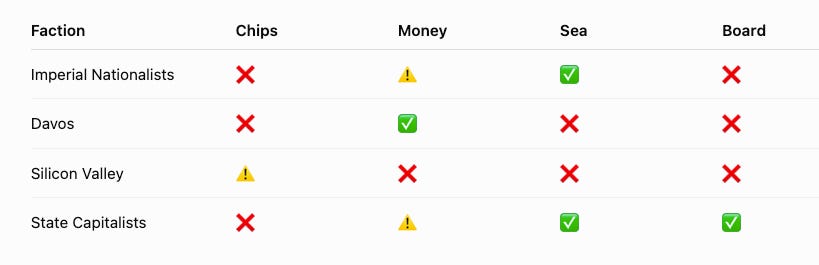
The Imperial Nationalists hold the sea and the dollar’s hard power. They need the chips and Mackinder’s board. But their method is hard power denial — tariffs, export bans, sanctions, walls, guns and wars — and denial strangles chip supply and de-industrializes the home base. To get the missing two pieces, they’d have to reopen the flows their nationalism exists to close. They can only do that by becoming Davos and creating an Umbrella State, that everyone huddles under to keep dry.
The Umbrella State would open diplomatic channels to all nations, cease hostile tariffs and bombing campaigns, and partner with Davos to create multi-stakeholder summits and conferences on American soil.
MAGA does Davos.
Tariffs, export controls turned inward, and the hollowing of domestic fabrication all point toward the same contradiction: the Imperial Nationalists require open flows to obtain the pieces they lack, but their ideology is built on restricting flows. Trump is currently burning bridges for this in a great fire called MAGA. Instead of building an umbrella, Trump is actively burning it to the ground. Trump's tariff regime is disrupting the trade flows required for advanced semiconductor production.
Secondly, China is already building Mackinder’s board: The Belt and Road Initiative is well underway. America’s remaining options are either more extreme hard power: blow it up — or join forces with the Chinese, to finance and build the project.
Not going to happen.
Davos. Clears the money through SWIFT, BIS, IMF, WORLD BANK and the ECB, and its regulatory legitimacy — the dollar’s other half, the trust hard power can’t manufacture. The globalist faction — organized at the World Economic Forum every year — owns the legitimacy story.
Davos has no hard power. It needs guns, chips and Mackinder’s board. It has no coercive layer at all. The instant it picks up a weapon to enforce anything, the neutrality story dies and the money it clears splinters into rival rails. Davos can only win by becoming the Imperial Nationalists — at which point it clears only America’s money, not everyone’s. Mark Carney’s middle powers coalition is Davos’ attempt to acquire a state and build a military-industrial complex to challenge the Imperial Nationalists and the State Capitalists simultaneously.

Davos is having an existential crisis, well-documented at the Munich Security summit in February. A brutal, scathing and one-sided document was published in the run-up to the summit, entitled Under Destruction.
The Munich Security Report 2026, edited by Tobias Bunde and Sophie Eisentraut, pulled no punches in its thesis: the world has entered “wrecking-ball politics,” and the US-led post-1945 order is being demolished from within, with Trump named as “the most powerful of those who take the axe to existing rules and institutions.”
Silicon Valley. Designs the chips it can’t fabricate, and privatized a slice of the sky. Needs sea, money, and a state — but it can’t do any because all three require the one thing the network-state faction is built to escape: sovereign force and a recognized currency. You can’t enforce a sanction from orbit, no one clears their savings in a coin backed by a man rather than an army, you can’t build a city from a server. They can only do any of this by becoming a state — which negates the exit that defines it.
The Network State is the attempt to bypass the state by building Special Economic Zones, piggy backing on an existing state. The Network State is not responsible for roads, sewers, traffic laws, electrical grid and they escape state taxation — thus reaping the benefits of the state without the headache. Even if Network States succeeded technically, the most-cited real-world attempt, Próspera in Honduras, had its legal foundation repealed in 2022 and ruled unconstitutional from inception by the Honduran Supreme Court in 2024; it now survives mainly through a multi-billion-dollar arbitration claim against the very state that revoked it. Even assuming it could expand beyond its small footprint on Roatán, it would take decades to build a collective nation that is both physical and digital — and that is the parasite-on-the-state problem in its purest form: the zone outlives the host’s consent only by suing.
A network of global city-states bunkered on existing state property, interconnected by the internet, seems more of a science fiction fantasy than a realistic plan. For the foreseeable future, the Network State vision seems destined to either flop entirely or exist as a parasite on the state. The only other option is to infiltrate the existing order, and dismantle it, such as Elon Musk’s DOGE fiasco, or Peter Thiel’s Palantir project.
Palantir’s leadership, including CEO Alex Karp and CTO Shyam Sankar, has positioned the company as something like the software backbone and central operating system for defense, intelligence, and civilian agencies.
The structural concern doesn’t need a conspiracy frame to land. In 2025, thirteen former Palantir employees — engineers, managers, and a member of the company’s own privacy team — signed an open letter, shared with NPR, warning that the guardrails meant to prevent discrimination and abuse of power were being violated and rapidly dismantled. A firm built to fuse with the state, and insiders saying the brakes are coming off: that is the switchboard becoming the operating system, described without a single hidden hand.
Reviewing the Imperial Nationalists, Davos and Silicon Valley: in all three, the faction’s defining strength is the direct cause of its fatal gap. There is no plausible path forward for any of these three factions to even attempt a global coup.
4. The One That Almost Works
China is the only real contender for global domination, because it holds three of the four things necessary to rule the world.
The only faction that fuses the boards by design — party and capital are in one hand. China builds the board (BRI), guards the sea (growing blue-water navy capability, BeiDou), clears its own money (CIPS, mBridge, digital yuan). Three of four, and the only player even attempting all of them, with the caveat that China possesses a credible pathway toward maritime control, not current supremacy, and clearing your own money is not the same as clearing the world’s reserve currency.
China can’t make the chips. Leading-edge fabrication still routes through TSMC and ASML, inside the Western denial perimeter. This is precisely what the export-control regime is for.
China currently bypasses Western hardware restrictions through massive state subsidies and software optimizations, even though its local fabrication capabilities remain physically restricted. Because strict export bans prevent domestic foundries from acquiring cutting-edge Extreme Ultraviolet (EUV) lithography machines, manufacturers like SMIC are repurposing older Deep Ultraviolet (DUV) equipment. While this multi-patterning technique suffers from low manufacturing yields and high production costs, heavy government funding is targeting — by Bloomberg’s reporting — up to 1.6 million total AI chip dies in 2026, including 600,000 units of the premier Ascend 910C. These are production targets, not shipped totals: the binding constraint is high-bandwidth memory (HBM), and without foreign HBM, analysts doubt Huawei clears even a million units.
While an individual Chinese chip delivers only about 60% of the inference performance of an older Nvidia H100, China may be able to bridge this hardware gap using advanced clustering and software workarounds. A Huawei-led team claims — via a Shenzhen government announcement, with no published benchmarks — that it completed full-parameter post-training on DeepSeek’s 1.6-trillion-parameter V4-Pro model using a cluster of 1,000 Ascend 910C processors. (Post-training is the lighter job; the heavier pre-training run almost certainly still ran on Nvidia hardware.) Furthermore, by building software links to standard global frameworks like PyTorch and utilizing highly optimized FP8 mathematical formats, Chinese AI laboratories are effectively running frontier-class models on local, less advanced hardware.
China does not own the money. A reserve currency requires that strangers believe you’ll let them take their money out. A party-state whose entire advantage is total control cannot credibly promise not to use that control. The fusion that lets China play three boards with one hand is the exact thing that disqualifies its currency from the fourth. To make the yuan trusted, the Party would have to relinquish control of capital — stop being the State Capitalist faction.
5. The Law of the Empty Throne
The stalemate is not that the factions are evenly matched — evenly-matched players still produce winners on a lucky break. The factions have mutual asymmetric denial. It’s structural: victory requires self-annihilation. The closer a faction gets to commanding the world, the more it stops being itself. The missing piece is always behind a door that opens only if you become the faction you’re trying to defeat.
The great difference between the world that prompted Mackinder to give his speech in 1904 to the Royal Geographical Society in London was that control of the world was possible through strictly geographical means. The world had an empty throne, but still an attainable throne, because power was concentrated on a physical space. Our modern world has four pieces of one throne that won’t assemble, centered on three different chessboards: two are physical geographic boards, and the other is the rheopolitical board made of chips, data, financial clearing and messaging systems.
6. Why Nobody Can
If China can build premium AI chips as good as or better than Blackwell B200 chips, and continue building the Belt and Road, expand its CIPS/mBridge clearing system and expand its navy beyond the South China Sea, it would have a slim, but possible chance to rule the world.
But…
The blowback against Chinese dominance would be astronomical. A defeated, dejected and morally bankrupt United States, that is simultaneously at war with the Davos globalists and at odds with its Silicon Valley allies (who are alternately partnering with the American state and attempting to capture it) would not end the stalemate.
Capturing every chokepoint — compute, clearing, sea lanes, land routes, materials, energy — doesn’t make China the supreme combatant. It makes China the terrain. And terrain doesn’t win wars; it’s the surface wars are fought across. The moment one faction owns the entire grid, it stops being a player with leverage and becomes the thing everyone else must deny, route around, or break.
Davos is the only faction that needs everyone else’s cooperation to function, and this dependence is its structural weakness. Full-stack capture hands that exact weakness to China at planetary scale. The grid only has value while it’s used and it requires others to stay on it. Weaponizing any node to win the war empties that node. You cannot run the world’s clearing system and weaponize it in the same gesture — the first defection begins the instant the system is revealed to be a weapon.
This is exactly what happened with American sanctions against Iran, Russia and others — China saw this and reacted by creating an alternate payment system, and forming an eco-alliance with the BRICS project.
Concentration is fragility, not only power. Every piece in the set is also a target, and the more complete the set, the higher the payoff for breaking any single link. A monopoly on fabricating B200 chips is the most valuable kinetic and embargo target on earth — owning the one thing everyone needs is an invitation to war, not a moat.
Rare-earth leverage depreciates the instant it’s exercised; squeeze processing and you fund Lynas Rare Earths plant, MP Materials, the Australian and North American mineral processing plants fire up and become financially viable. A chokepoint teaches the world to route around it the first time it’s used as a weapon. CIPS nodes are sanctionable, and rails are not reserve trust — mBridge gives you infrastructure but not the world’s willingness to hold your currency. Each chokepoint that is captured converts, on use, into a chokepoint suffered.
A Chinese frontier chip would not capture frontier-lab demand that sits inside the US security perimeter — it captures its own bloc plus the Global South. The Imperial Nationalist response to a Chinese B200 isn’t market surrender; it’s export control run in reverse, a hard compute-bloc partition. US would either put tariffs on the Chinese chips or ban them altogether.
The Strait of Hormuz is the single chokepoint the Imperial Nationalist faction is most organized to contest — the home game of the US-Israel axis. Securing oil through the most contestable waterway on the planet, via a sanctioned and internally fragile junior partner, is a dependency dressed as an asset. China’s actual energy-security posture runs overland — Russia, Central Asia, pipelines — precisely to exit Hormuz, not to plant a flag in it. Leaning on the Strait is strategically regressive: it accepts the one battle the other side most wants to fight.
So the blowback, stated cleanly: not the defeat of China, but the conversion of China from player to terrain. In the stalemate, China is a combatant with leverage — it can withhold, deny, route, and extract because no one owns the whole board. In closure, China owns the board and therefore is the board: the universal target, the thing armed against and routed around by a coalition that exists only because China completed the set. The stalemate is therefore the stronger position. Mutual asymmetric denial is mutual for a reason — the mutuality is what keeps China a combatant. Unilateral capture breaks it and hands the asymmetry to the other side. Now everyone denies China, and China, having become the grid, cannot deny back without degrading itself.
According to Sun Tzu: “Should the enemy strengthen his vanguard, he will weaken his rear; should he strengthen his rear, he will weaken his vanguard... If he sends reinforcements everywhere, he will everywhere be weak.”
Everywhere strong is everywhere weak.
The great powers of the twentieth century fought over a throne. The twenty-first century has an empty throne, split into four pieces. Every faction holds part of the set. Every faction can block the others. None can complete it.
The age of world domination did not end because the contenders became weaker.
It ended because power itself fragmented.
About this series: Building on the fracture of the Transnational Capitalist Class outlined in Chapter 1 and Chapter 2, this article forms part of a book-in-progress, The Capitalist Civil War. It is an ongoing investigation, into the emerging conflict between four factions of the global elite: Davos Institutionalists, Imperial Nationalists, Silicon Valley techno-sovereigns, and State Capitalists. Each chapter explores a different aspect of that struggle. If you want more of this kind of elite-power analysis, paid subscribers make this work possible.
Here is the project so far. Some of the articles are commentary on current developments to test the thesis in real time.
INTRODUCTION: The Great Divide: Why We’re Fighting the Wrong War
CHAPTER 1: Morbid Symptoms: The Origins of the Capitalist Civil War
CHAPTER 2: The Four Factions of the Transnational Capitalist Class
(COMMENTARY) Davos Faction Floats the United States of Europe
CHAPTER 3: Modus Operandi: Who are the Transnational Capitalist Class?
CHAPTER 4: Globespeak: The Four Dialects of the Transnational Capitalist Class
(COMMENTARY) Carney Does Europe: A Marriage Made in Heaven
CHAPTER 5: The Chinese Capitalist Party
(COMMENTARY) Trump Hurries to Beijing for Emergency De-Risking
CHAPTER 6: Silicon Valley: Cult, Club, Cabal, or Class?
(COMMENTARY) The Quadripolar World Order at the Beijing Summit
CHAPTER 7: How Mark Carney Learned to Stop Worrying and Love Variable Geometry
(COMMENTARY) BRICS is Dead.
(COMMENTARY) Danielle Smith’s Referendum is Aimed at Carney, Not Alberta
CHAPTER 8: Awareness Creep: How the Four Factions Woke Up to the War
CHAPTER 9: The Four-Clocks Problem
CHAPTER 10: The New Grand Chessboard
CHAPTER 11: The War Inside the Panopticon
(COMMENTARY) Hats Off to the Conspiratorial Commentariat
(COMMENTARY) Musk’s Trillion Dollar Coronation Inside the Cathedral
CHAPTER 12: The Blackwell B200 Kill Switch
CHAPTER 13: The Layered Global Map
CHAPTER 14: The Transnational Broker Class
Before I even read the second section I feel compelled to link to Tears For Fears', "Everybody Wants To Rule The World", which must already have been playing in your mind: https://www.youtube.com/watch?v=aGCdLKXNF3w