

A civilization survives because things continue to flow. Water. Electricity. Data. Money. Software. Energy. Food. Every modern society depends upon uninterrupted circulation. The actor capable of interrupting those flows possesses a form of power that previous civilizations had no real conception of — primarily, because the technology did not exist.
Consider SWIFT.
A sovereign state, domestically sound with its borders protected can be rendered impotent if it is unable to transact. Being excluded from SWIFT, by those who are able to exclude, is a far more deadly and cost effective weapon than tanks and artillery. A nation can be undefeated on land and sea, but destroyed by sanctions.
Exclusion from SWIFT (Society for Worldwide Interbank Financial Telecommunication) effectively disconnects a nation’s banks from the global financial system, preventing the nation from securely sending or receiving payment instructions. This sanction is often described as the “nuclear option” of financial penalties because it paralyzes international trade and finance by freezing a bank’s ability to execute cross-border transactions, meet foreign obligations, or receive payments for exports.
Immediate consequences for Russia in 2022, after SWIFT sanctions, included severe currency depreciation, such as the 30% tumble of the ruble, and the necessity for central banks to double interest rates and impose capital controls to stabilize the economy. Iran and North Korea have long been cut off from SWIFT, since 2012 and 2017 respectively.
The Rheo Core
We introduced the term, rheopolitics, in a previous chapter: from the Greek rheo, meaning stream, river, flow, and thus, by extension, circuit. In contrast to geopolitics, the study of geography and power, rheopolitics has emerged due to the advent of the digital age — the study of circuits and power. The power of the flows, and the power to deny another actor access to the flows.
Rheopolitics is the study of power exercised through the governance, regulation, and denial of the material and digital flows upon which modern civilization depends.
The highest form of rheopolitical power is not the ability to move flows, but the ability to deny them.
In geopolitics, power comes from controlling territory. In rheopolitics, power comes from controlling circulation. Rheopolitical power is the third axis of power, the third grand chessboard — the first being Mackinder’s Eurasian board, followed by the Maritime-Space Commons board, currently dominated by the United States. The Mackinder board is territory that is held; the Commons board is controlled by navies and satellites; and the rheopolitical board is routed. Flow is a separate board because it can be denied without territory held or sea controlled — the chokepoint that isn't a place. Rheopolitics does not replace geopolitics. The first two chessboards remain:

Traditional geopolitics asks Who controls the territory? Rheopolitics asks Who controls the circulation through the territory?
Rheopolitics does not replace geopolitics because states became less important. It emerged because civilization itself became more integrated. A medieval kingdom could survive without global finance or instantaneous communication. A twenty-first century economy cannot. The more interconnected civilization becomes, the more power shifts from territory itself to the infrastructure that allows territory to communicate, trade, compute, finance, and exchange information.
For centuries, rivers mattered because they carried trade. Today, fiber-optic cables are rivers. Financial messaging networks are rivers. Cloud data centers and internet servers are reservoirs, full of data, waiting to be sent down the river. Semiconductor fabs are springs. AI inference clusters are pumping stations.
AI models are cargo. Payments are currents. Protocols are locks. Routers are sluice gates.
The flows are digital circuits, engineered by computer scientists and software specialists who have created the global digital grid. Rheopolitical power is thus control of routing. The grid does not have a single manager, however, but multiple actors who are dominated by four factions.
Rheopolitics describes a shift in the locus of power itself. Traditional geopolitics begins with territory. Rheopolitics begins with circulation. In classical geopolitics, following thinkers like Halford Mackinder, Alfred Thayer Mahan, and Nicholas Spykman, power comes from controlling physical geography, such as land, sea lanes, chokepoints, resources, and populations.
Land power, sea power, Heartland, rimland.
If no faction can monopolize the global grid, then none can exercise absolute sovereignty. Instead, they compete over specific points of denial within a shared infrastructure. The struggle is less about conquering territory than about controlling the switches, protocols, standards, and chokepoints that allow — or prevent — the circulation of capital, data, computation, and materials. That shifts the central question of international politics from "Who rules the world?" to "Who can stop the world from flowing?"

Political philosopher Carl Schmitt defined political power in his 1922 work Political Theology with the famous dictum: “Sovereign is he who decides on the exception.” This means that true sovereign power is not defined by the routine application of legal norms, but by the absolute authority to suspend the existing legal order during a state of emergency or crisis. In rheopolitics, the “exception” becomes denial. The perfect example was the Reichstag fire, that allowed the Nazis to suspend civil liberties, arrest their opponents and centralize power.
Manuel Castells argues that modern society is organized around networks rather than hierarchies or territories, creating a network society where power is decentralized and flows through electronically processed information networks.
Castells emphasizes that control is exercised by switchers (who connect networks) and programmers (who set network goals), making the ability to link and direct information flows the primary source of power. Castells locates power in the switcher who connects. Rheopolitics locates it in whoever can disconnect.
For the theory of rheopolitics, denial inside the networks is the true exercise of power, not the flow itself, not the ability to connect and direct flows. Castells correctly identifies the emergence of the network society. Rheopolitics accepts this insight but locates sovereign power elsewhere. Networks create circulation. Denial determines sovereignty.
Every modern economy depends upon continuous circulation. Money must flow. Data must flow. Electricity must flow. GPS signals must flow. Software updates must flow. AI models must flow. Cloud authentication must flow. Supply chains must flow.
Medieval Europe possessed its own form of rheopolitics. The Church controlled the institutional circuits of Christendom much as today's financial institutions control the circuits of global commerce. Excommunication functioned as the medieval equivalent of sanctions: not the conquest of territory, but exclusion from the network upon which political legitimacy, diplomacy, and commerce depended.
When Pope Gregory VII excommunicated Henry IV in 1076, or when Pope Innocent III excommunicated King John and placed England under interdict in 1208, the objective was not military victory but political isolation. Their realms remained intact, yet their capacity to govern was profoundly weakened because they had been cut off from the prevailing order. Modern sanctions operate according to the same structural logic. They seek not to occupy a nation, but to deny it participation in the networks through which power and prosperity flow.
The Layered Rheopolitical Stack
The rheopolitical board has layers, and denial works differently at each level. The layers ascend from the undersea cables at the bottom of the ocean to the satellites above the stratosphere.
The physical layer is at the base: submarine fiber optic cables on the seabed, the internet exchanges where they land, the energy grids and pipelines, the satellite hardware in orbit. This is the river at its most literal — glass and copper and high-tension wire, water that must run downhill through something built to channel it. Denial here is literal: actors can sever undersea cables, and they have on occasion; the landing stations where the cables connect can be bombed.
Physical denial is an act of war: this is the layer where the rheopolitical board touches both Mackinder’s board and the Maritime-Space Commons board. To cut the cable you must first command the waters above it, whether by navy or airstrike, or terrorist acts of sabotage.
Above the physical layer sits the protocol layer: the conventions that route, which need no physical mass at all. SWIFT and the dollar clearing CHIPS (SWIFT sends the message, while CHIPS moves the money.) The central-bank BIS network and the standards and compliance regimes that decide what counts as certified. These are not objects but agreements — primarily the Basel Accords and a banking directory (SWIFT). Sanctions can also freeze an individual’s assets by being added to a list, controlled by the EU and the United Nations.
The protocol layer splits into two factions: multilateral standards, the Basel Accords are Davos; SWIFT-exclusion-as-weapon and dollar-jurisdiction are Imperial Nationalist domain. The factions are not a clear-cut club, cult or cabal. It is worth repeating they are a fractured class. Overlap and agreement on many issues does not translate into coordination and a hidden-hand agenda.
Denial here is exclusion from SWIFT, and it is the cleanest weapon on the board. Nothing is touched and no shot is fired. A national bank is removed from a list; a bank that was solvent on Monday cannot transact on Tuesday. Exclusion teaches every observer that the directory is a weapon, and sanctions are tools of deniability. To freeze one nation out of the dollar is to inform all the others that the dollar can freeze — which is how the protocol layer created its own competitors, like China and the BRICS who are opting out and creating their own system (CIPS/mBridge).
We can also say that rheopolitical power is the ability to route around the chokepoint. This means denial isn’t absolute. It is only temporary, which contributes to the instability of the global system.
Every denial creates an incentive to build another route.
Above the protocol layer lies the compute layer: not message and not cable, but the advanced chip design and fabrication, the lithography chokepoint, the GPUs and hyperscale data centres, and the critical minerals that feed them. Denial here is neither cut nor exclusion, but something stranger and slower — the denial of future capacity. An export control does not stop a flow today; it withholds the means to build the flows of a decade later — it is slow strangulation over years.
This is the layer where ownership and denial-authority come apart most visibly: the design IP is held in one faction’s hands while the lever that withholds it is pulled by another’s state. The compute layer is where denial becomes time-based, and where the chokepoint captured today is suffered tomorrow.
For a closer look at this layer:

Above the compute layer sits the interface layer, where the factions stop fighting each other and face the people the rheopolitical board routes — the software, the platforms, the accounts, the feeds through which the 99% encounter a world built without them. The lower three layers are horizontal: they are weapons the factions aim at each other. At the interface, the question is no longer which faction can deny another faction, but which can deny the user, the consumer, the average citizen who pays for an internet connection and buys a laptop at Walmart with a debit card.
The 99% are not parties to the Capitalist Civil War but the ground it is fought over, and an account suspended or a payment declined is not a strike in the horizontal war — it is the management of the governed. Three layers where the factions deny each other; one where they deny everyone else.
Physical Layer
↓
Protocol Layer
↓
Compute Layer
↓
Interface Layer
Four layers, three of them are factions denying each other, and the fourth interface layer is where the factions are denying the general population. The rheopolitical board does not offer a single form of power. It offers a menu.
Mutual Asymmetric Denial
This gives us a simple matrix.
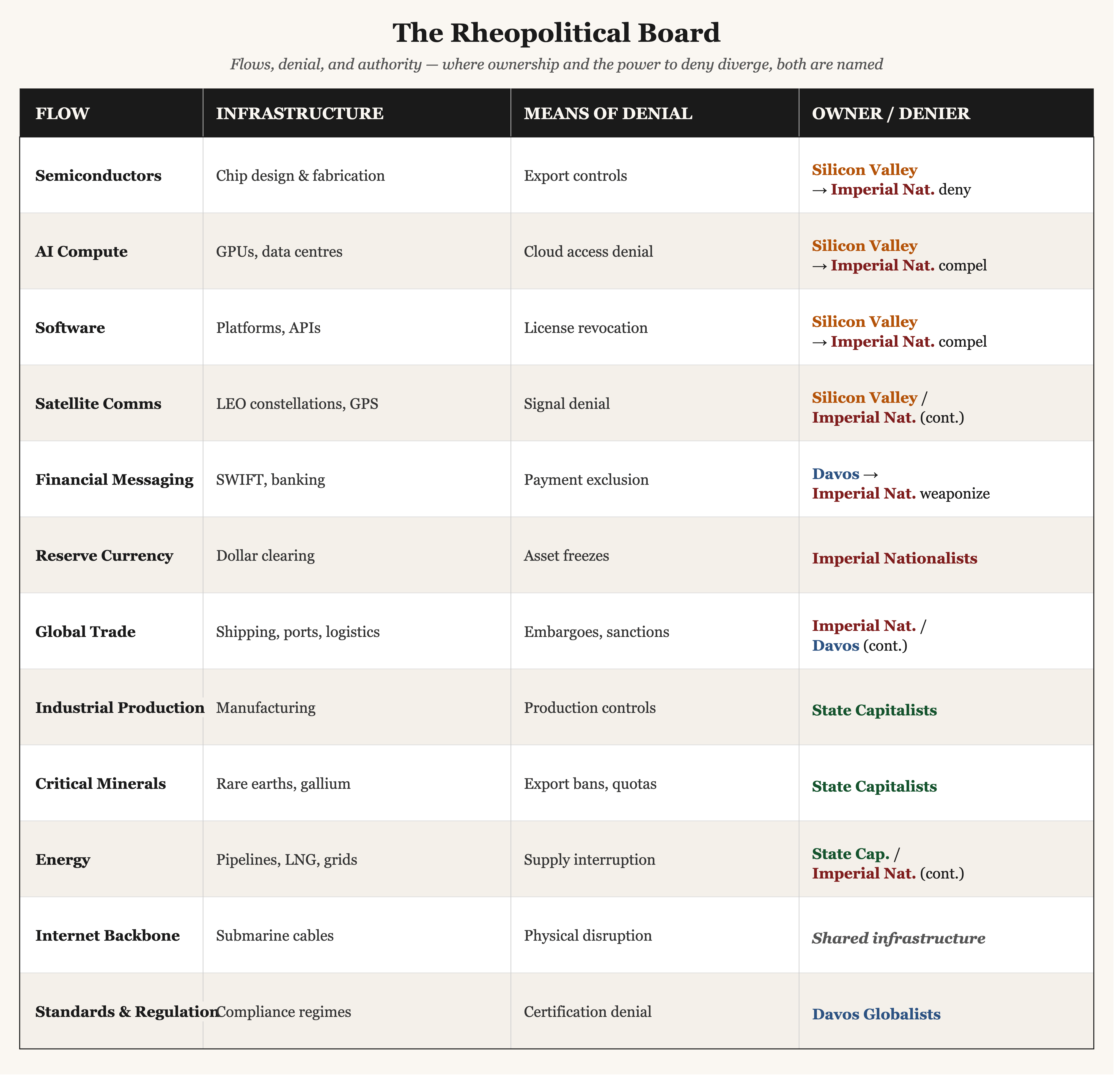
Notice something interesting. None of these require territorial conquest. They merely require control over one critical node. Each faction can hurt the others but none can hurt all of them, because denial runs in every direction but unevenly, and this asymmetry is why the Capitalist Civil War is a stalemate rather than a victory.
The argument developed throughout this chapter can be summarized as a set of first principles. or rheopolitical laws. If geopolitics has its Heartland Theory and sea power doctrines, then rheopolitics has its own foundational laws.
The Valve
The fundamental unit of rheopolitical power is the valve: the point at which a flow can be permitted, redirected, or denied. Every modern civilization depends upon continuous flows of capital, data, energy, computation, materials, and information. These flows move through physical infrastructure, digital networks, financial protocols, and software systems. Wherever a flow can be interrupted, a valve exists. Control of the valve — not ownership of the entire network — is the essence of rheopolitical power.
The First Law of Rheopolitics
The first law of rheopolitics is that power lies not in owning the network, but in possessing indispensable points of denial. Networks create circulation, but sovereignty is exercised at the moment a flow can be interrupted. The actor capable of withholding chips, excluding banks from payment systems, restricting critical minerals, or severing communications possesses power, not because it owns the entire system, but because it controls a valve within it.
The Second Law of Rheopolitics
The second law of rheopolitics is that no actor controls the entire network; every actor controls only particular valves. The global grid is governed by multiple competing centres of power. State Capitalists dominate strategic materials and manufacturing, Imperial Nationalists command financial and legal instruments of coercion, Silicon Valley controls critical digital infrastructure and advanced computing, while Davos Globalists exercise influence through international institutions and regulatory standards. Each possesses unique denial capabilities, yet each remains dependent upon valves controlled by the others. Absolute sovereignty therefore gives way to mutual asymmetric dependence.
The Third Law of Rheopolitics
The third law of rheopolitics is that the effectiveness of denial is proportional to dependency. Not all flows possess equal strategic value. The more essential a society becomes to a particular technology, financial system, supply chain, or communications network, the greater the power of those who can interrupt it. Denial derives its force not from coercion alone, but from the degree to which the denied actor lacks a viable alternative.
The Fourth Law of Rheopolitics
The fourth law of rheopolitics is that every successful denial creates an incentive to route around the chokepoint. Denial is never static. Sanctions encourage alternative payment systems, export controls accelerate domestic manufacturing, and technological embargoes stimulate indigenous innovation. Every exercise of rheopolitical power encourages the construction of new routes that bypass existing valves. The struggle for power therefore becomes a continual contest between the creation of chokepoints and the effort to escape them.
The four rheopolitical laws summarized:
Power lies in denial, not merely in connection.
No faction controls the whole network; each controls different valves.
Dependency determines the effectiveness of denial.
Every denial encourages the creation of alternative routes.
Geopolitics never disappeared. Armies still occupy territory. Navies still patrol oceans. Air forces still command the skies. But beneath those visible contests over geography, another struggle has emerged. Civilization now depends upon an infrastructure of continuous circulation — of data, finance, energy, software, and computation. The central political question is therefore no longer simply who controls territory, but who controls the valves through which civilization flows. That is the domain of rheopolitics. The future belongs not to those who rule the map, but to those who control the flows across it.
About this series: Building on the fracture of the Transnational Capitalist Class outlined in Chapter 1 and Chapter 2, this article forms part of a book-in-progress, The Capitalist Civil War. It is an ongoing investigation, into the emerging conflict between four factions of the global elite: Davos Institutionalists, Imperial Nationalists, Silicon Valley techno-sovereigns, and State Capitalists. Each chapter explores a different aspect of that struggle. If you want more of this kind of elite-power analysis, paid subscribers make this work possible.
Here is the project so far. Some of the articles are commentary on current developments to test the thesis in real time.
INTRODUCTION: The Great Divide: Why We’re Fighting the Wrong War
CHAPTER 1: Morbid Symptoms: The Origins of the Capitalist Civil War
CHAPTER 2: The Four Factions of the Transnational Capitalist Class
(COMMENTARY) Davos Faction Floats the United States of Europe
CHAPTER 3: Modus Operandi: Who are the Transnational Capitalist Class?
CHAPTER 4: Globespeak: The Four Dialects of the Transnational Capitalist Class
(COMMENTARY) Carney Does Europe: A Marriage Made in Heaven
CHAPTER 5: The Chinese Capitalist Party
(COMMENTARY) Trump Hurries to Beijing for Emergency De-Risking
CHAPTER 6: Silicon Valley: Cult, Club, Cabal, or Class?
(COMMENTARY) The Quadripolar World Order at the Beijing Summit
CHAPTER 7: How Mark Carney Learned to Stop Worrying and Love Variable Geometry
(COMMENTARY) BRICS is Dead.
(COMMENTARY) Danielle Smith’s Referendum is Aimed at Carney, Not Alberta
CHAPTER 8: Awareness Creep: How the Four Factions Woke Up to the War
CHAPTER 9: The Four-Clocks Problem
CHAPTER 10: The New Grand Chessboard
CHAPTER 11: The War Inside the Panopticon
(COMMENTARY) Hats Off to the Conspiratorial Commentariat
(COMMENTARY) Musk’s Trillion Dollar Coronation Inside the Cathedral
CHAPTER 12: The Blackwell B200 Kill Switch
CHAPTER 13: The Layered Global Map
CHAPTER 14: The Transnational Broker Class
CHAPTER 15: How to Rule the World and Why Nobody Can
(COMMENTARY) Conspiratorial Answers to Evil
Civilization, goes an old maxim, is only nine meals away from barberism.
Once the food deliveries stop, so does law and order.