

On Oct 17, Vancouver, Canada elected its first Green mayor, Pete Fry, who is the son of Hedy Fry, Canada’s longest-serving female MP, with eleven straight election wins since 1993 — an institution unto herself.
A mere eight days later, on Oct 24, BC elected its first Conservative government in nearly a century. ABC Vancouver’s Ken Sim and the NDP’s David Eby were both thrown out in opposite directions. A Vancouver resident now has a Green mayor, with a Liberal MP mother, in a Conservative province, in a country run by a globalist prime minister.
For some backstory, before we get into it: Greenpeace started in Vancouver, British Columbia, Canada, in 1971, with the express purpose of shutting down the US government’s underground nuclear weapons tests on Amchitka Island, Alaska. 12 brave activists chartered a boat and sailed up the coast. As Greenpeace tells it, “The vessel never made it to Amchitka, and the bomb test went ahead, but it would be the last in the area for the US. The trip had successfully turned public opinion, and Greenpeace’s mission had captured the hearts and minds of people across Canada. In the coming months, this same vision would spread across the globe, and a movement would be born.”
Sounds lovely and green right?
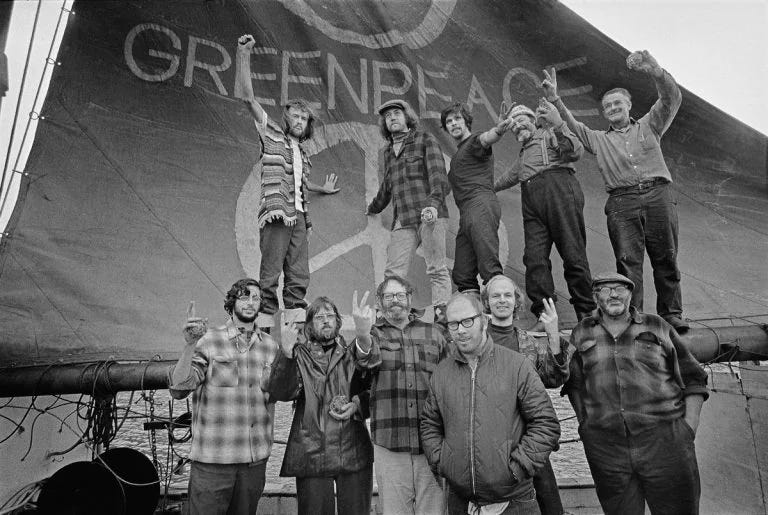
The original promise of the environmental movement was deeply rooted in a fundamental critique of limitless economic growth, consumerism, and the capitalist drive for resource extraction. During the late 1960s and 1970s, mainstream ecology was an explicitly countercultural attempt to envision a different way of living outside the logic of global capitalism.
They envisioned de-centralized self-reliant communities structured around environmental balance and “appropriate technology” rather than corporate growth. By replacing consumerism with voluntary simplicity in harmony with nature, it sought to redefine human wealth through community well-being and a non-extractive relationship with nature. A "steady-state" or zero-growth economy that prioritized stability, resource conservation, and equilibrium with nature over gross domestic product (GDP) expansion.
One of the seminal texts of the movement was The Limits to Growth, commissioned by the Club of Rome. The study directly challenged the core capitalist requirement of infinite economic growth, with the gloomy forecast: “If the present growth trends in world population, industrialization, pollution, food production, and resource depletion continue unchanged, the limits to growth on this planet will be reached sometime within the next one hundred years. The most probable result will be a rather sudden and uncontrollable decline in both population and industrial capacity.”
Critics claim the green packaging hides the red Marxist ideological roots.
(Commies everywhere!)
But …
The claim that Marxism is the root of the green tree is an oversimplification. Rather, the green movement is a separate philosophical tree. Its trunk is made of Thoreau-style romanticism, conservation, and physical earth sciences. The green tree and the red tree intersect because both environmentalism and Marxism share a profound skepticism of unregulated corporate power and infinite economic expansion.
Two trees, with tangled roots.
Somewhere along the way the critique of capitalism became a series of products (advocated by capitalists.) Carbon markets, green bonds, ESG funds, EV subsidies. The green movement didn’t fail. It was turned into a green market.
Multilateralists’ Green Finance
Prime Minister Mark Carney is one of the chief green capitalists who embodies the exact ideological shift toward “green capitalism” and market-led environmentalism.
Having transitioned from serving as the UN Special Envoy on Climate Action and Finance to leading Canada as the 24th Prime Minister, his career trajectory illustrates the stark contrast between the green movement’s roots and reality. Mark Carney’s current variable geometry project is the attempt to build a military-industrial project “built out of Europe.”

Variable Geometry is taken from the Multilateralist playbook, a stakeholder project that uses the playbook’s methods exactly — integration, rules, coalitions — with the ambitious universalism subtracted. With the rules-based order ruptured, Carney has been assembling smaller coalitions: a defence pact with the EU, a rearmament fund he joined as its only non-European member, a new defence bank led by Canada, and up to 12 submarines from German shipbuilder Thyssenkrupp Marine Systems.
Not one universal project but a dozen smaller ones, with whoever will join them.
This is what separates Carney from the nationalist he is now mistaken for. The mistake is odd, given that his resume has “transnationalist” written all over it. The nationalist consolidates at home to withdraw from the system. Carney consolidates at home to rejoin it.
The Green project got tossed out the window the day Carney took office. His first act as prime minister was to scrap the consumer carbon tax.
Carney, the former UN climate finance envoy who built “green finance,” ends up backing a pipeline, and the former environment minister in his cabinet walks out. Steven Guilbeault co-founded Équiterre and was Greenpeace’s Quebec chief — he had grown increasingly disillusioned by what he called the dismantling of climate policies since Carney became prime minister in March 2025.
Guilbeault was strongly opposed to the agreement between Ottawa and Alberta and called the proposal to exempt Alberta from clean electricity regulations “a serious mistake.”
He wrote that “several elements of the climate action plan I worked on as minister of the environment have been, or are about to be, dismantled: the consumer carbon pricing, the zero-emission vehicle standard, the oil and gas sector emissions cap, the framework to eliminate fossil fuel subsidies and the clean electricity regulations.”
The Multilateralists in Europe brandish the BBFC (Brussels-Basel-Frankfurt Complex) regulations as power, with the EU carbon border tax as the soft lever in action.
The Carbon Border Adjustment Mechanism (CBAM) serves as the operational mechanism to enforce these standards across borders. CBAM slaps a carbon price on imports (such as steel, cement, aluminum, and fertilizers) entering the EU so that foreign manufacturers cannot undercut European industries that face strict emissions penalties. By forcing external trading partners to either pay the EU tax or implement their own equivalent carbon-pricing mechanisms, the EU effectively exports its climate policies worldwide because manufacturers do not want to be excluded from Europe’s mega-market.
Ultimately the consumer ends up paying for the carbon tax. Manufacturers jack up the cost of their products to pay for the carbon tax. Economists argue over exactly how much gets passed on, but consumers carry a large share.
Does it do any good?
Short answer is no yes.
A 2025 Energies (MDPI) paper reports a 12.06% reduction for Emissions Trading Systems (ETS) and an 8.91%reduction for carbon taxes. That will not end climate change, only delay it.
The State Capitalists’ Green Factory
The State Capitalists manufacture the hardware, chiefly solar panels and batteries. They also have a significant monopoly on the critical-mineral processing. Going green deepened dependence on China. China has 80% to 95% of global manufacturing capacity of solar panels, about 80% of battery manufacturing and about 75% of manufacturing of electric vehicles. China is also the largest maker of wind-power equipment, with 64% to 75% of manufacturing capacity as of 2024, according to REN21.
Going green means greater dependence on China, and greater dependence on state capitalism not state communism:

Meanwhile, China remains the world’s largest annual emitter of greenhouse gases. Despite launching its “war against pollution” action plan in 2013 and lowering its national average fine particulate matter (PM2.5) concentration significantly, its current level remains nearly six times higher than the World Health Organization’s annual guidelines. Air pollution causes an estimated 1.85 million deaths each year in China, according to the Global Burden of Disease Study.

Before and After AI
Silicon Valley sells efficiency while its AI data centres use more and more power.
While the tech giants spent the 2010s touting ambitious “carbon-neutral” and “carbon-negative” goals, the explosive rise of generative AI has sent their emissions soaring and their green virtue signalling went down the toilet.
Locked in a cycle of skyrocketing energy demands, heavy water usage, and growing local community resistance, and clashing directly with global climate targets, the hyperscalers have flipped on the climate change agenda, aligning themselves with the Imperial Nationalists who promise to cut regulation and ram through data centers at speed. In March 2026, Meta was one of seven large technology companies to back a White House-endorsed “ratepayer protection pledge.”
Hyperscalers frequently defend this expansion by positioning AI as a critical tool for the future of environmentalism, broadcasting that machine learning can track deforestation, optimize smart grids, or model complex climate systems. Mark Zuckerberg’s Meta offered this platitude in 2019:
“We’ve been focused on sustainability for a long time. Our data centers are already among the most efficient in the world, and we’re committed to supporting them with 100% renewable energy.”
And then, after the massive rollout of AI in 2024, the tune changed to more measured tones:
“But I actually think that, before we run into [capital constraints], we’re going to run into energy constraints... When you’re talking about building large new power plants or large build-outs and building transmission lines that cross public or private land... you’re talking about many years of lead time... I don’t think this is something that can be quite as magical as ‘you get a level of AI, get a bunch of capital, and put it in [a big data center].’”
Meta will pay for 10 natural gas plants to power its Hyperion AI data centre in rural Louisiana, tripling its initial plans for three. Fortune reported the plants would add more than 30% to Louisiana’s entire grid capacity.
Elon Musk is no better. Tesla updated its official corporate mission statement on January 21, 2026, to “build a world of amazing abundance”, shifting from its historic mission of “accelerating the world’s transition to sustainable energy”. Musk’s explanied that the new wording is “more joyful.”
At xAI’s Memphis data centre, the Southern Environmental Law Center alleges xAI installed and ran at least 35 combustion turbines without permits or proper pollution controls, in a Memphis neighbourhood long known for asthma, cancer and other ailments tied to air pollution.
Imperial Nationalist Deny and Delay
Imperial Nationalists reject climate policy entirely.
The intentional shift of oil companies over the last two decades has gone from outright denialism to “delayism” — accepting climate change but “it’s not our fault.”
Climate delayism describes a coordinated shift in public relations and lobbying by the fossil fuel industry. Rather than denying that the Earth is warming, delayism accepts the science but uses manipulative arguments to stall regulations and justify the continued extraction of oil and gas.
Whose fault is it?
Directing the public conversation away from the companies producing fossil fuels and placing the ethical burden entirely onto consumers using "climate guilt.” It’s your fault. You didn’t turn off the lights. You drive too much.
The concept of the personal “carbon footprint” was popularized by BP Oil in a 2005 ad campaign designed to shift the responsibility of climate change from fossil fuel corporations onto individual consumer choices.
When analyzing how fossil fuel interests and political actors defer climate action, researchers categorize these strategies as “discourses of delay”.
Extractive industries rely on physical geography. Unlike tech or finance, oil companies need state power including military and diplomatic imperial canopies to secure drilling rights, build pipelines, and guarantee supply chains abroad. Imperial nationalism provides the aggressive foreign policy and state backing necessary to secure these assets.
Transnational capitalism needs an empire, and the empire is turning nationalist.
This is mutual asymmetric dependence. Every faction relies on sea lanes guarded by the US Navy, but none relies on them in the same way.
The State Capitalists are the most exposed. China is the world’s largest crude importer, and most of that oil comes by sea through chokepoints it cannot defend. Its solar panels and EVs are partly an escape route from American-guarded oil.
The Multilateralists in Europe swapped Russian gas for American LNG. Escaping one dependence feeds another.
Silicon Valley data centres need oil, lots of oil.
The Imperial Nationalists don’t need Gulf oil at all, but the Iran War has caused them to feel the pain at the gas pump, and at the ballot box, soon forthcoming in the midterm elections.
Climate Change Quadlock
Each faction blocks the others’ route to the transition, so nobody can dictate the green transition and nobody can stop it.
The Imperial Nationalists alternately deny, delay, and drill. The war that closed the Strait of Hormuz is the nearest live example of Imperial Nationalists’ hard power attempting to lock and block the opposition. An oil shock pushes importers toward solar and batteries, which routes them around the petro-states and straight into Chinese supply chains. Their block backfires.
The State Capitalists choke their own cities with smog while installing more renewables than the rest of the world combined. They block everyone’s path to cheap independence, because nobody can build the green energy transition without their hardware.
Silicon Valley’s AI build-out competes with everyone else for the same clean power. It locks up the grid and justifies new gas plants.
The Multilateralists drop climate goals to hedge against their rivals, yet still use CBAM to block cheaper, dirtier imports.
It’s a climate change quadlock.

Green parties act as reformers to a fractured system. Their critics accuse them of communism and argue that Green economic platforms are naive and mathematically unfeasible.
De-growth’s thinkers want to shrink the system from the inside. Eco-socialism is an attempt to escape from capitalism but very few want to go off-grid and live like a hermit in the woods. Those that do, don’t talk about it, they just do it and are not heard from again.
You cannot change the system by exiting the system.
Pete Fry and the Vancouver Green Party’s agenda of affordable housing, community safety and more bike paths is a watered down version of the Green agenda. It is, however, in stark contrast to the BC Conservatives’ plan to ratchet up LNG production and “cut red tape” — which is itself a euphemism for deregulating the market to allow private enterprise a free hand. Pete Fry’s new Greencouver is forced to rely on the new LNG Conservatives who now control much of his funding and planning power.
In 1971, twelve activists sailed out of Vancouver to stop a nuclear bomb. The bomb went off anyway, but the movement was born. Fifty-five years later, a Green mayor occupies City Hall but has to ask an LNG premier for money to fund his Green agenda. That’s not betrayal. That’s what capitalism does to everyone who tries to sail away from it.
Greencouver won’t escape capitalism either. Nobody can, in a quadlock.
About this series: Building on the fracture of the Transnational Capitalist Class outlined in Chapter 1 and Chapter 2, this article forms part of a book-in-progress, The Capitalist Civil War. It is an ongoing investigation, into the emerging conflict between four factions of the global elite: Multilateralists, Imperial Nationalists, Silicon Valley, and State Capitalists. Each chapter explores a different aspect of that struggle. If you want more of this kind of elite-power analysis, paid subscribers make this work possible.
Here is the project so far. Some of the articles are commentary on current developments to test the thesis in real time.
INTRODUCTION: The Great Divide: Why We’re Fighting the Wrong War
CHAPTER 1: Morbid Symptoms: The Origins of the Capitalist Civil War
CHAPTER 2: The Four Factions of the Transnational Capitalist Class
(COMMENTARY) Davos Faction Floats the United States of Europe
CHAPTER 3: Modus Operandi: Who are the Transnational Capitalist Class?
CHAPTER 4: Globespeak: The Four Dialects of the Transnational Capitalist Class
(COMMENTARY) Carney Does Europe: A Marriage Made in Heaven
CHAPTER 5: The Chinese Capitalist Party
(COMMENTARY) Trump Hurries to Beijing for Emergency De-Risking
CHAPTER 6: Silicon Valley: Cult, Club, Cabal, or Class?
(COMMENTARY) The Quadripolar World Order at the Beijing Summit
CHAPTER 7: How Mark Carney Learned to Stop Worrying and Love Variable Geometry
(COMMENTARY) BRICS is Dead.
(COMMENTARY) Danielle Smith’s Referendum is Aimed at Carney, Not Alberta
CHAPTER 8: Awareness Creep: How the Four Factions Woke Up to the War
CHAPTER 9: The Four-Clocks Problem
CHAPTER 10: The New Grand Chessboard
CHAPTER 11: The War Inside the Panopticon
(COMMENTARY) Hats Off to the Conspiratorial Commentariat
(COMMENTARY) Musk’s Trillion Dollar Coronation Inside the Cathedral
CHAPTER 12: The Blackwell B200 Kill Switch
CHAPTER 13: The Layered Global Map
CHAPTER 14: The Transnational Broker Class
CHAPTER 15: How to Rule the World and Why Nobody Can
(COMMENTARY) Conspiratorial Answers to Evil
CHAPTER 16: Rheopolitics: The Power to Deny
CHAPTER 17: Mortgaged, Extracted, Disconnected
CHAPTER 18: Permanent Planetary Turbulence
CHAPTER 19: Two Wings of the Same Imperial Nationalist Bird
CHAPTER 20: A Herd of Goats
CHAPTER 21: The Great Narrative War