

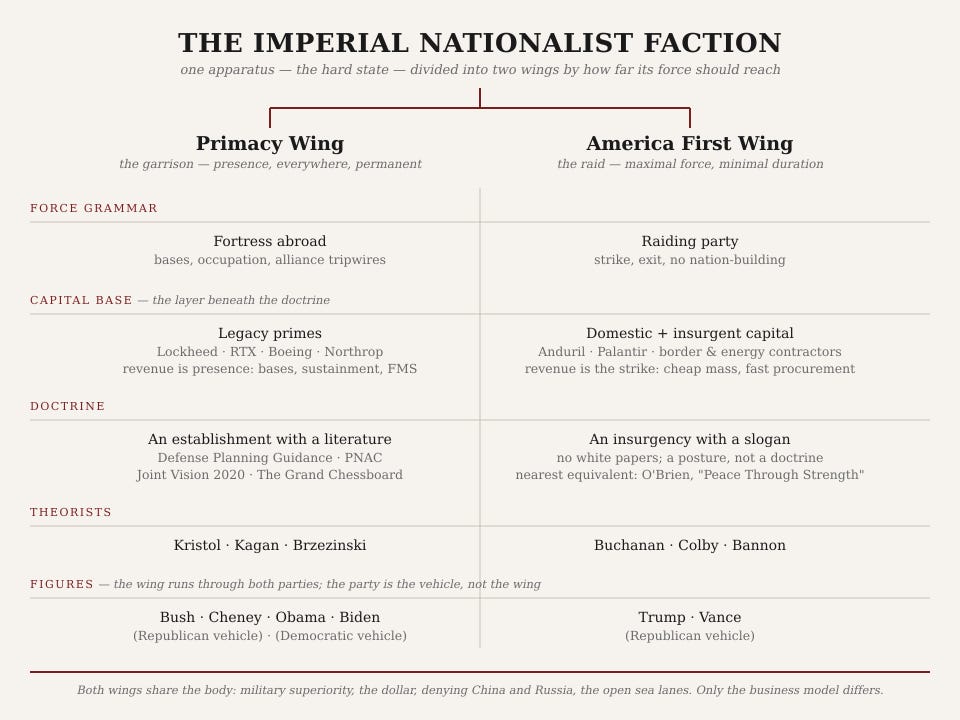
Within the Imperial Nationalist faction are two broad strategic traditions that share the same objective — preserving American predominance — but differ profoundly over how that power should be exercised. The distinction is often presented as a debate over foreign policy. It is more accurately understood as a struggle between two different forms of defense capital whose business models require different military doctrines.
Military strategy is usually portrayed as the product of abstract strategic reasoning. Yet strategies also create demand for particular industries, procurement systems, and revenue models. Different doctrines sustain different forms of capital. The debate between the Primacy and America First wings is therefore not simply a disagreement over how the United States should use power; it is also a contest over which defense economy will dominate the twenty-first century.
The Primacy wing emerged as the dominant strategic tradition after the Cold War. It argues that American security depends upon preserving a U.S.-led international order built around forward military deployments, permanent overseas bases, alliance management, and institutions such as NATO. Its objective is to prevent the emergence of any peer competitor capable of dominating Eurasia or displacing the United States as the world’s leading military power.
Its intellectual foundations can be found in the leaked 1992 Defense Planning Guidance, which argued that U.S. strategy should prevent “the reemergence of a new rival”; the Project for the New American Century (PNAC); Zbigniew Brzezinski’s The Grand Chessboard; and the Joint Chiefs’ doctrine of Full Spectrum Dominance articulated in Joint Vision 2020.
Together these documents describe a strategy of maintaining overwhelming American military superiority across every operational domain while embedding allies within an American-led security architecture.
The America First wing shares the objective of preserving American power but rejects the assumption that global leadership requires permanent global management. It argues that decades of globalization, interventionism, and expansive alliance commitments weakened the United States by hollowing out its industrial base, encouraging endless wars, and shifting resources away from domestic renewal. Rather than sustaining the post-1945 order, it emphasizes rebuilding American manufacturing, securing the border, restoring energy independence, compelling allies to shoulder more of their own defense costs, and employing military force selectively in pursuit of narrowly defined national interests.
The distinction is not one between hawks and doves. Both wings support maintaining overwhelming American military superiority, preserving the dollar-centered international financial system, containing China and Russia, and guaranteeing freedom of navigation across the world’s oceans. Nor is it reflected in defense spending. The annual U.S. defense budget exceeded one trillion dollars in 2026 with overwhelming bipartisan support. The disagreement concerns not whether America should remain powerful, but what kind of military power it should finance.
The Primacy wing prefers permanent presence: overseas garrisons, alliance networks, rotational deployments, and long-term commitments that bind allied militaries to American logistics and industrial supply chains. The America First wing prefers punitive spectacle followed by withdrawal: maximal force, minimal duration, burden-shifted alliances, and military commitments concentrated primarily in the Western Hemisphere and the Indo-Pacific.
One favors the fortress abroad.
The other the raiding party.
These differences are commonly described as competing schools of strategic thought. Yet beneath the military doctrines lie two portfolios of defense capital with fundamentally different supply-and-demand structures.
Two Portfolios of Defense Capital
The Primacy wing represents the capital constituency of America’s global military footprint. Its economic foundation rests upon the legacy defense prime contractors — Lockheed Martin, RTX, Boeing, Northrop Grumman, and General Dynamics — whose business models depend less upon individual wars than upon the infrastructure required to sustain a permanent international military presence.
Their revenues are generated through overseas bases, aircraft carriers, maintenance contracts, logistics, training, software upgrades, spare parts, and Foreign Military Sales extending over decades. A modern weapons platform is not simply sold once; it creates a continuous stream of maintenance, servicing, modernization, and replacement contracts that can endure for half a century.
An aircraft carrier group is therefore not merely a weapon. It is a fifty-year revenue stream beginning in the shipyard and ending at the scrapyard. The Gerald R. Ford-class carrier costs more than US$13 billion to construct, while lifetime ownership costs may exceed US$20 billion once operations, maintenance, modernization, and personnel are included. Every overseas deployment generates additional demand for logistics, fuel, repair facilities, contractor support, intelligence systems, communications infrastructure, and replacement parts.
Foreign Military Sales reinforce this model by embedding allied militaries within American industrial ecosystems. Once a country standardizes around American platforms such as the F-35, Patriot missile systems, or Aegis missile defense, switching suppliers becomes technically complex, economically costly, and strategically disruptive — virtually impossible. Compatible logistics, software, training, maintenance, and munitions create long-term industrial dependence. What Warren Buffett calls a “durable competitive moat” becomes, in geopolitical terms, an alliance structure reinforced by industrial lock-in.
Behind the defense contractors stands another beneficiary: the dollar-security nexus. America’s alliance network encourages governments, investors, and central banks to hold dollar-denominated assets while reinforcing confidence in the broader U.S.-led financial system. Security commitments and financial power therefore reinforce one another.
Primacy is not simply a strategic doctrine adopted by this constellation of capital. It is its business model.
The America First wing is organized around a different portfolio. Its core constituency lies in domestic manufacturing capital weakened by decades of offshoring, energy producers seeking expanded export markets, border-security contractors, and a new generation of venture-capital-backed defense technology firms.
The border-security industry illustrates this model most clearly because immigration enforcement is one of the movement’s defining political priorities. Companies such as GEO Group and CoreCivic generate revenue through immigration detention facilities operated under contract with U.S. Immigration and Customs Enforcement. Their fortunes rise with detention capacity, deportation targets, and expanded border enforcement.
Around this detention infrastructure has emerged an expanding ecosystem of surveillance technologies. Elbit Systems supplies fixed surveillance towers along the southern border. General Atomics supplies MQ-9 Reaper drones adapted for border surveillance. Software companies provide biometric identification, case management, predictive analytics, and targeting systems. Charter airlines profit from deportation flights.
The border itself becomes an integrated security market.
The passage of the One Big Beautiful Bill Act in 2025 dramatically expanded this sector by increasing immigration enforcement funding and significantly enlarging ICE’s operational capacity. For border-security capital, this legislation played a role analogous to NATO enlargement for the traditional defense primes: it created a durable expansion of demand.
The most disruptive agents, however, are the venture-funded defense startups. Anduril Industries began not by building weapons for overseas wars but by developing autonomous surveillance towers for the U.S.–Mexico border before expanding into drones, autonomous systems, and loitering munitions. Palantir followed a similar trajectory, developing data integration and case-management systems for immigration enforcement before becoming a major supplier of military intelligence and battlefield targeting software.
These firms challenge not simply the products of the legacy contractors but their underlying business model. Founder Palmer Luckey has repeatedly argued that traditional defense procurement is too slow, too expensive, and overly dependent upon decades-long cost-plus contracts. Venture-backed firms instead seek rapid development, fixed-price contracts, continuous software updates, and scalable autonomous systems.
The contrast between the two portfolios is therefore more than technological. It is time-based: The legacy primes sell permanence. Their ideal customer is an alliance that lasts generations, sustained by overseas bases, carrier groups, and continuous modernization programs.
Anduril and Palantir sell events — raiding parties. Their ideal customer is a government seeking rapid procurement, autonomous weapons, border security, or a short, high-intensity conflict requiring immediate technological advantage rather than permanent occupation.
One portfolio profits from the garrison. The other profits from the raid. Military doctrine follows naturally. Capital whose revenues depend upon Ramstein Air Base will support doctrines built around permanent forward deployment. Capital whose revenues depend upon autonomous drones, border surveillance, and rapid procurement will favor doctrines emphasizing swift coercion, limited commitments, and technological disruption.
The strategists themselves may genuinely believe their respective visions. Robert Kagan sincerely advocates American primacy. Elbridge Colby sincerely argues for a strategy of denial. Palmer Luckey sincerely believes Silicon Valley can transform defense procurement and make him very rich. Their convictions need not be insincere. But sincerity should not be confused with causality. The deeper division lies not between ideas alone, but between competing structures of capital whose economic interests are sustained by different forms of American power.
Entangling Alliances: The Origins of the Split
Although the contemporary divide appears modern, its roots stretch back more than a century.
The first major rupture emerged after the First World War during the Senate debate over the Treaty of Versailles and the proposed League of Nations. President Woodrow Wilson argued that American security required participation in a permanent system of collective security. His opponents feared precisely the opposite: that international commitments would entangle the United States in conflicts beyond its control.
The most uncompromising opponents became known as the Irreconcilables, led by Senator William Borah. Borah argued that joining the League would abandon the American tradition of avoiding “entangling alliances” that Thomas Jefferson warned of in his inaugural address. Between them stood the Reservationists, led by Senator Henry Cabot Lodge, who supported international cooperation but sought constitutional limits on American obligations.
The Senate ultimately rejected the treaty, preventing the United States from joining the League of Nations and exposing a strategic divide that has reappeared throughout modern American history. The debate established two competing traditions: one believing American security depended upon active engagement in shaping the international order, the other insisting that lasting security required freedom from permanent foreign commitments.
Throughout the 1930s that divide hardened.
Senator Borah became one of the principal architects of American non-interventionism, helping shape the Neutrality Acts, legislation intended to prevent the United States from drifting into another European war. When war again threatened Europe, the America First Committee, founded in 1940 and supported by figures including Charles Lindbergh, Senator Robert Taft, and Henry Ford, argued that America’s security depended upon remaining outside another European conflict. Franklin Roosevelt’s supporters reached the opposite conclusion, believing American security required active engagement before hostile powers could dominate Europe.
Japan’s attack on Pearl Harbor ended that debate politically in 1941, but not intellectually. The isolationist coalition disappeared as an organization, yet many of its underlying assumptions survived within American conservatism: skepticism toward foreign entanglements, concern over executive war powers, opposition to permanent alliances, and a preference for rebuilding national strength before attempting to shape events abroad.
The Cold War temporarily suppressed these disagreements. Containing the Soviet Union required a permanent military establishment, overseas alliances, forward deployments, and a global network of bases. Republicans and Democrats largely converged around this strategy for nearly half a century. Only after the Soviet Union collapsed in 1991 did the old argument return.
Victory in the Cold War presented the United States with an unprecedented question: What should America do with unrivalled global power?
Two competing answers emerged. One became today’s Primacy wing. The other evolved into today’s America First wing.
The Primacy tradition found its clearest expression in the early 1990s. The documents described above were its product, that advocated overwhelming military superiority, alliance leadership, and active American engagement across the globe. Zbigniew Brzezinski’s The Grand Chessboard supplied the geopolitical rationale, arguing that preventing any rival from dominating Eurasia remained the central requirement of American strategy.
Although Brzezinski was neither a neoconservative nor a Republican, his geopolitical realism complemented the broader primacist project. Together these works became the intellectual architecture of the post-Cold War order.
Ideas alone do not explain why this century-old debate repeatedly returns. Each strategic tradition gradually became attached to different sectors of American capital. As the Cold War military-industrial complex expanded, permanent alliances, overseas bases, and long-term procurement increasingly aligned with the interests of the legacy defense contractors. The post-Cold War backlash against globalization, by contrast, became intertwined with domestic manufacturing interests, border-security industries, energy producers, and, more recently, venture-backed defense technology firms. The ideological divide persisted because it came to rest upon different economic foundations.
Resistance emerged almost immediately. During the 1992 presidential campaign, Patrick Buchanan challenged the Republican foreign-policy establishment by arguing that America should revive the spirit of the Monroe Doctrine — protecting the Western Hemisphere while rebuilding domestic manufacturing, controlling immigration, restoring national sovereignty, and avoiding unnecessary foreign interventions. This position lost the battle inside Republican foreign-policy circles during the 1990s.
Yet it never disappeared.
Opposition to globalization, dissatisfaction with free trade, resentment over deindustrialization, and growing skepticism toward the Iraq War steadily rebuilt the coalition. Donald Trump did not invent America First. He inherited a political tradition stretching back through Buchanan, Robert Taft, and William Borah before transforming it into the dominant movement within the Republican Party.
Viewed through this historical lens, the contemporary struggle within the Imperial Nationalist faction is not primarily a contest between Republicans and Democrats. It is a struggle over the purpose of American power.
The Primacy wing argues that American security depends upon managing the international system through alliances, overseas deployments, and global leadership.
The America First wing argues that American power must first be restored at home through industrial renewal, border security, economic nationalism, and more selective military commitments abroad.
Both seek to preserve American predominance. They disagree over whether that predominance is sustained by governing the international order or by strengthening the American nation-state itself.
Two Wings, Shared Assumptions
Although the Primacy and America First wings frequently appear to be in conflict, they share several fundamental assumptions. Both regard the United States as the indispensable military power, support maintaining overwhelming technological superiority, seek to preserve the dollar-centered international financial system, view China as the principal long-term strategic competitor, and support maintaining freedom of navigation across the world’s oceans.
Their disagreement lies primarily in how American power should be exercised rather than whether it should remain dominant. The documentary record, however, is asymmetrical.
The Primacy wing spent three decades producing strategic doctrine. The Defense Planning Guidance, the Project for the New American Century, Joint Vision 2020, and later concepts such as Joint All-Domain Command and Control (JADC2) all describe variations of the same ambition: preserving American military superiority through permanent alliances, technological dominance, and integrated global command systems.
The America First wing produced no comparable body of doctrine. It emerged instead through speeches, campaigns, and political movements rather than military white papers. Its closest equivalent is Robert O’Brien’s essay, “The Return of Peace Through Strength,” which argues for rebuilding American military power while reducing unnecessary foreign commitments. Beyond that, America First is less a doctrine than a posture: selective engagement, burden-sharing within alliances, domestic industrial renewal, border security, and restoring the defense industrial base.
One wing is an establishment with literature.
The other is an insurgency with a slogan.
That asymmetry is itself revealing. It reflects which wing controlled the institutions of American foreign policy during the three decades following the Cold War.
Geopolitics and Rheopolitics
The distinction between the two wings also illustrates the broader argument of The Capitalist Civil War. Brzezinski’s Grand Chessboard remains a geopolitical work. It is concerned with territory, alliances, military positioning, and preventing rival powers from dominating Eurasia. Geography remains the principal arena of competition.
Rheopolitics shifts the emphasis.
In the twenty-first century, power increasingly rests not only upon controlling territory but upon controlling the infrastructure through which civilization flows: payment systems, reserve currencies, semiconductors, cloud computing, artificial intelligence, satellites, logistics networks, undersea cables, energy infrastructure, and digital platforms.
The two wings seek control over different parts of that infrastructure. The Primacy wing emphasizes the valves of global military integration: overseas bases, logistics, alliance interoperability, maritime chokepoints, and long-term industrial dependence through Foreign Military Sales. The America First wing emphasizes domestic valves: borders and immigration control. Neither abandons rheopolitical power. They simply prioritize different valves.

Iran: The Raiding Party
The June 2025 conflict with Iran illustrates the America First approach to military power. In June 2019 Donald Trump cancelled planned airstrikes against Iran with aircraft reportedly already airborne before later dismissing National Security Advisor John Bolton, who had consistently advocated a more expansive military confrontation.
The contrast is instructive. For Bolton, military action formed part of a longer strategic project aimed at permanently reshaping the Middle East. For Trump, military force functioned as a raiding party — the objective was not occupation, regime change, or nation-building. It was overwhelming violence followed by rapid disengagement. The same temporal logic characterized the January 2020 assassination of Qasem Soleimani. America First was never anti-war. It was anti-commitment.
Six years later, in February 2026, Trump authorized strikes against Iran’s Fordow nuclear facility before almost immediately pivoting toward ceasefire negotiations and declaring the operation complete. This time, however, the raiding party met with a much different Iranian strategy, shutting down Hormuz, a key maritime chokepoint, throttling the world’s oil supply.
Military force remained acceptable provided it produced decisive political leverage without evolving into another Iraq or Afghanistan. The conflict nevertheless revealed the limits of this approach. Although American forces demonstrated overwhelming conventional superiority, they could not by themselves reopen shipping lanes, stabilize insurance markets, restore commercial confidence, or compel a regional political settlement. Those outcomes depended upon cooperation — or at least acquiescence — from multiple actors beyond Washington’s direct control.
The Strait of Hormuz therefore became more than a geographic chokepoint. It became a rheopolitical valve. The episode illustrated a central argument of this book: military superiority alone cannot guarantee control over the global flows of energy, finance, shipping, and information upon which modern civilization depends.

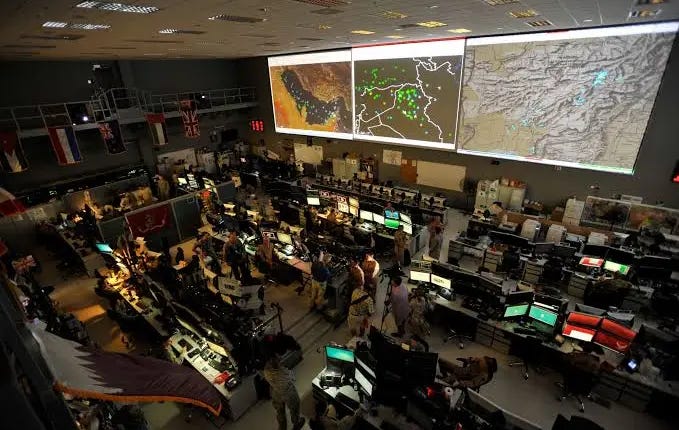
The raid also served as an unintentional audit of the Primacy wing's capital. When Iranian missiles struck Al Udeid in the opening days — disabling the command center that had run American air campaigns across the region for two decades — and did $5 billion in damage to installations from Bahrain to Jordan, the America First wing's short war had demonstrated, on satellite imagery, that the Primacy wing's entire asset class of fixed forward bases are vulnerable targets within Iran’s missile range. The Pentagon's own conclusion — disperse, network, go underground, abandon the large centralized headquarters — was a procurement brief written for the raid wing's portfolio of cheap, distributed, autonomous systems rather than the garrison wing's carriers and bases: one wing's signature war had degraded the other wing's capital and generated demand for its own.
Ukraine: Two Objectives, One War
The war in Ukraine exposed the strategic divide between the two wings with unusual clarity. Both regarded Russia as a strategic competitor. Both opposed a decisive Russian victory, yet they pursued different objectives.
For the Primacy wing, Ukraine became a test of the post-Cold War security architecture. Military assistance to Kyiv reinforced NATO credibility, strengthened American leadership in Europe, and demonstrated that territorial revisionism would impose severe strategic costs.
For the America First wing, Ukraine represented a different problem. Many supported helping Ukraine resist Russian aggression while questioning whether an open-ended proxy war served American national interests. Their preference was to establish military leverage quickly, negotiate from a position of strength, and avoid an indefinite commitment consuming American industrial capacity, fiscal resources, and political attention.
The disagreement therefore concerned duration rather than destination. One wing viewed prolonged alliance management as a strategic investment. The other viewed prolonged commitment as a strategic liability.
The war also revealed why the Davos faction often aligned with the Primacy wing while remaining analytically distinct. For Primacy, Ukraine concerned geopolitical leadership. For Davos, it concerned preserving the institutional, financial, and economic architecture of globalization: sanctions coordination, central bank cooperation, energy diversification, multinational investment, reconstruction finance, and the stability of international markets.
Watch what happened to Russia’s money after the invasion, because it shows the factions fighting in broad daylight. When Russia invaded, the West froze about €300 billion of its central-bank reserves — and the largest piece, roughly €180 billion, has been sitting ever since in a single Belgian institution called Euroclear. The consensus was it should stay frozen but nobody can agree on what to do with it. And in December 2025, the disagreement split cleanly along factional lines. Europe’s plan was to keep the money in European hands and use it to back a loan to Ukraine — leverage held in reserve until Russia pays for the war. At their December summit, European leaders couldn’t even pass that; Belgium, which holds the cash and would face lawsuits, said no, and they fell back to simply keeping it frozen.
Washington had a different plan entirely — and it wasn’t Europe’s. Trump’s proposed peace framework would have pulled the money out of European control, unfrozen it, sent much of it back toward Russia, and turned roughly $100 billion of it into a fund run by American firms to rebuild Ukraine — with future profits split fifty-fifty between the United States and Ukraine. Confiscated Russian wealth, managed by American capital, for an American cut.
The real picture isn’t a secret cabal or a coordinated class dividing the spoils of war — it’s the opposite. The Europeans hold the cash and fear the fallout of spending it. The Americans want to unfreeze it and route the contents to their own contractors. The Russians own it and can’t touch it, but can retaliate — and already have, seizing Western companies’ assets inside Russia and suing Euroclear. That is what this whole book means by a civil war among the powerful: not men in a room agreeing, but factions with incompatible plans, feuding over money, land and resources.
This demonstrates factional divergence and it shows convergence on certain issues, not coordination of agendas. The Primacist and Davos positions are complementary but not identical. The Primacy wing’s organizing principle is American geopolitical leadership — alliances, deterrence, and military power. The Davos faction’s organizing principle is systemic stability — maintaining the institutional, financial, and economic infrastructure of globalization. They often support similar policies in cases like Ukraine, but for different strategic reasons.
Capital Writes Strategy
Ideas do not emerge in an economic vacuum. Different doctrines sustain different procurement systems. Different procurement systems sustain different industries. Different industries generate different political coalitions.
The Primacy wing’s doctrine supports permanent alliances, overseas bases, long procurement cycles, and the industrial ecosystems of the legacy defense contractors. The America First wing’s doctrine supports border security, domestic manufacturing, energy production, venture-backed defense technology, autonomous weapons, and rapid procurement.
Neither doctrine is reducible to economics alone. But neither can be fully understood without examining the structures of capital upon which it rests. Military strategy does not merely reflect geopolitical thought. It also reflects competing political economies of American power.
The two wings beat against one another, but they remain attached to the same imperial body. They share the same assumptions about American military superiority, the dollar-centered financial order, maritime supremacy, and denying China’s rise.
One wing finances the garrison.
The other finances the raid.
Both seek to preserve the empire.
Only the business model differs.
About this series: Building on the fracture of the Transnational Capitalist Class outlined in Chapter 1 and Chapter 2, this article forms part of a book-in-progress, The Capitalist Civil War. It is an ongoing investigation, into the emerging conflict between four factions of the global elite: Davos Institutionalists, Imperial Nationalists, Silicon Valley techno-sovereigns, and State Capitalists. Each chapter explores a different aspect of that struggle. If you want more of this kind of elite-power analysis, paid subscribers make this work possible.
Here is the project so far. Some of the articles are commentary on current developments to test the thesis in real time.
INTRODUCTION: The Great Divide: Why We’re Fighting the Wrong War
CHAPTER 1: Morbid Symptoms: The Origins of the Capitalist Civil War
CHAPTER 2: The Four Factions of the Transnational Capitalist Class
(COMMENTARY) Davos Faction Floats the United States of Europe
CHAPTER 3: Modus Operandi: Who are the Transnational Capitalist Class?
CHAPTER 4: Globespeak: The Four Dialects of the Transnational Capitalist Class
(COMMENTARY) Carney Does Europe: A Marriage Made in Heaven
CHAPTER 5: The Chinese Capitalist Party
(COMMENTARY) Trump Hurries to Beijing for Emergency De-Risking
CHAPTER 6: Silicon Valley: Cult, Club, Cabal, or Class?
(COMMENTARY) The Quadripolar World Order at the Beijing Summit
CHAPTER 7: How Mark Carney Learned to Stop Worrying and Love Variable Geometry
(COMMENTARY) BRICS is Dead.
(COMMENTARY) Danielle Smith’s Referendum is Aimed at Carney, Not Alberta
CHAPTER 8: Awareness Creep: How the Four Factions Woke Up to the War
CHAPTER 9: The Four-Clocks Problem
CHAPTER 10: The New Grand Chessboard
CHAPTER 11: The War Inside the Panopticon
(COMMENTARY) Hats Off to the Conspiratorial Commentariat
(COMMENTARY) Musk’s Trillion Dollar Coronation Inside the Cathedral
CHAPTER 12: The Blackwell B200 Kill Switch
CHAPTER 13: The Layered Global Map
CHAPTER 14: The Transnational Broker Class
CHAPTER 15: How to Rule the World and Why Nobody Can
(COMMENTARY) Conspiratorial Answers to Evil
CHAPTER 16: Rheopolitics: The Power to Deny
CHAPTER 17: Mortgaged, Extracted, Disconnected
CHAPTER 18: Permanent Planetary Turbulence
Thanks Richard. This is timely.
The garrisons can't be maintained as the imperial mystique has been so badly tarnished.
The financial system is rotten at the core, but there is no obvious successor.
Interesting times...